
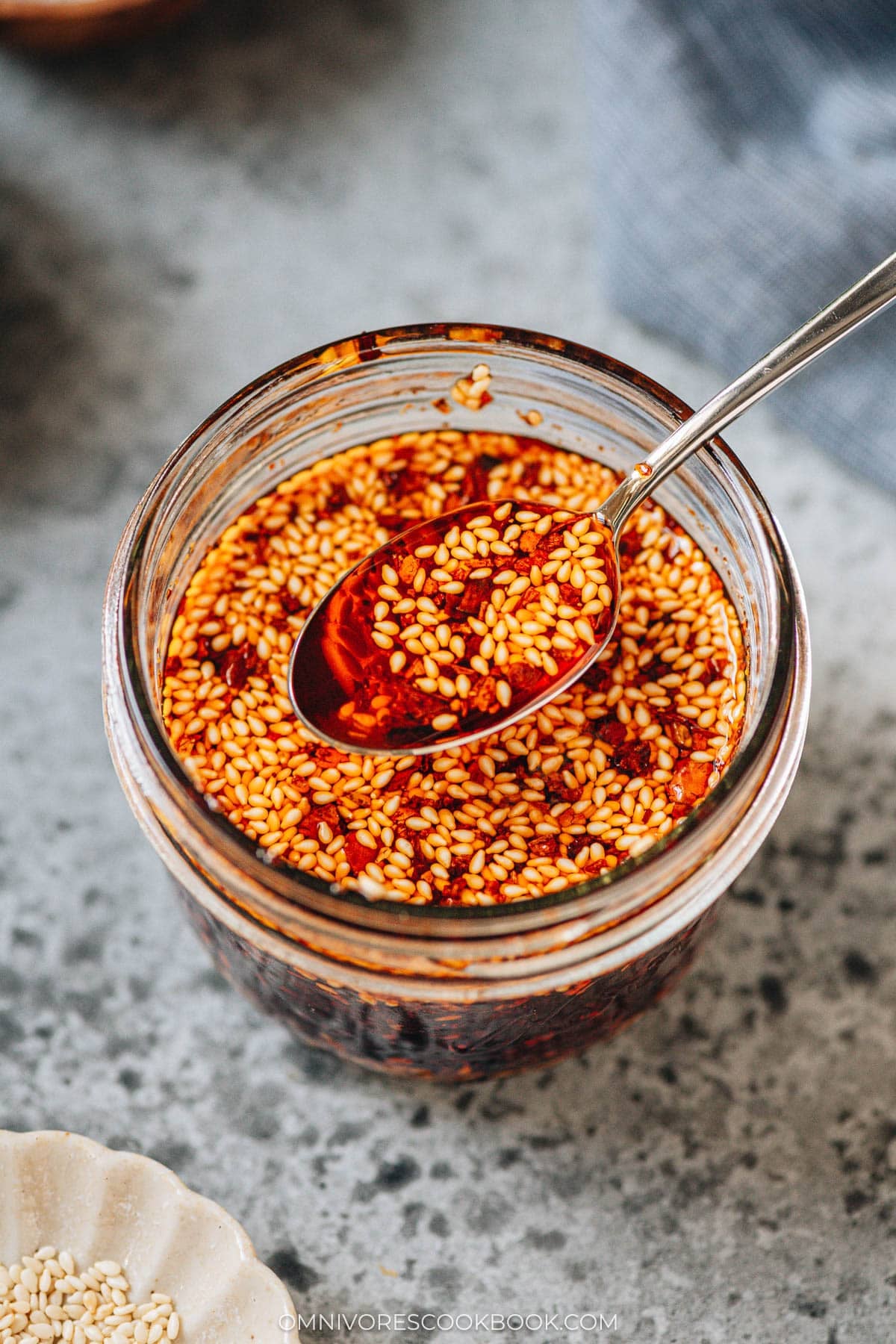
For a Chinese family, chili oil sits on the table next to the soy sauce and the black vinegar, and it shows up at every small noodle shop and dumpling counter I have ever walked into. It is a cousin to the jarred chili crisp you see on shelves now, but thinner and made for spooning over a finished bowl rather than eating by the spoonful. Once you start reaching for it, you will want it on almost everything.
When I say chili oil, I mean the homemade version, because it tastes far better than anything in a jar and keeps just as long in the fridge. The freshness is the whole point, a nutty fragrance that bottled oil loses on the shelf, with no additives or MSG. I use mine the way I grew up using it, stirring in the toasted flakes at the bottom so every bite of dan dan noodles or sesame noodles picks up those crispy and smoky bits I love.
I make this in three moves: I combine the flakes and spices in a heatproof bowl, heat the oil until it is hot but not smoking, then pour it over the spices and let it bubble. The only thing to watch is the oil temperature, and I will walk you through a ginger trick for that if you do not own a thermometer. Pour your first batch the next time a bowl of noodles needs waking up, my directions below take you from cold pan to finished jar in 10 minutes.
Ingredients
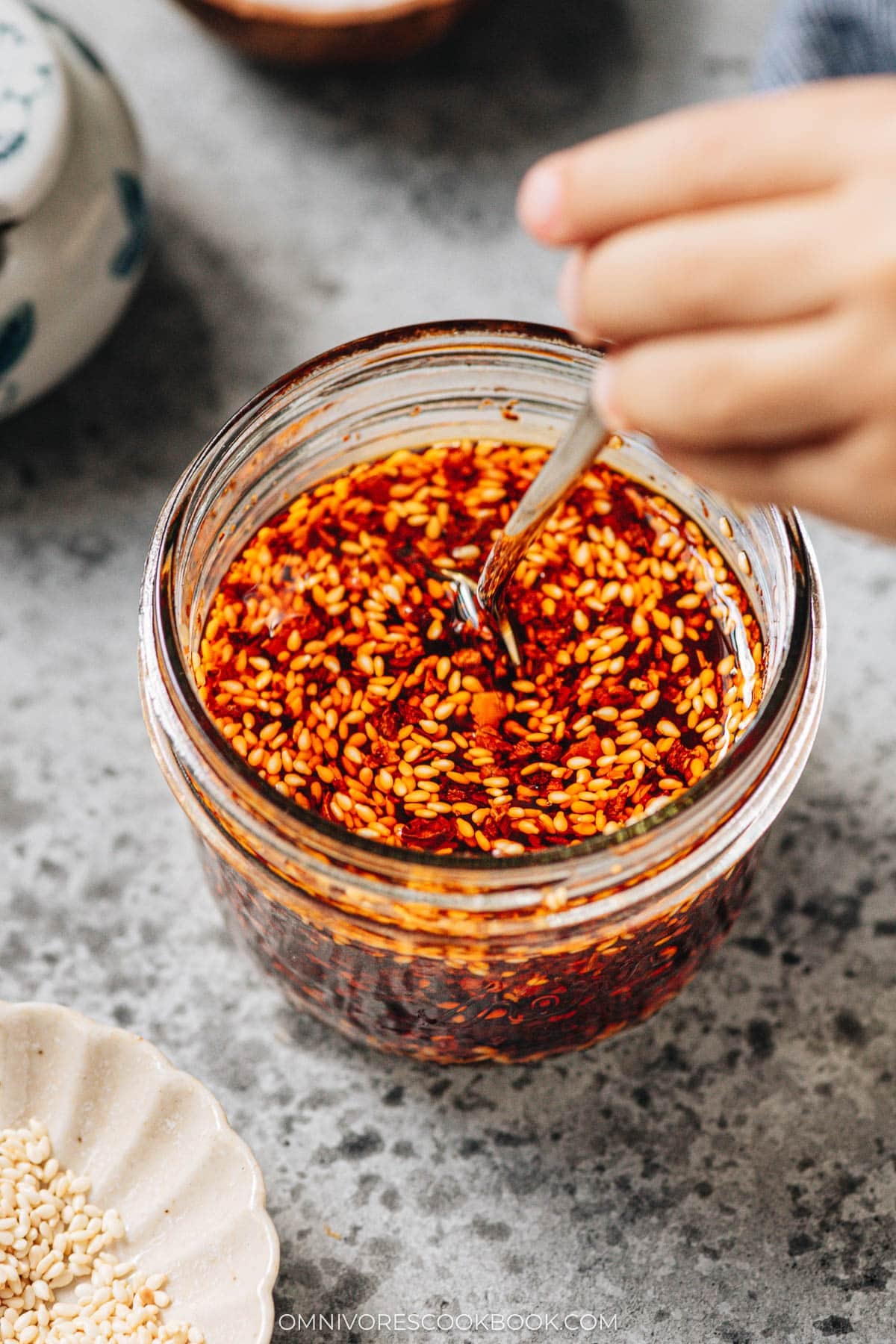
These are the ingredients to make chili at home and the one thing I will not compromise on is the chili flakes, since they set the color and the heat of the whole jar.
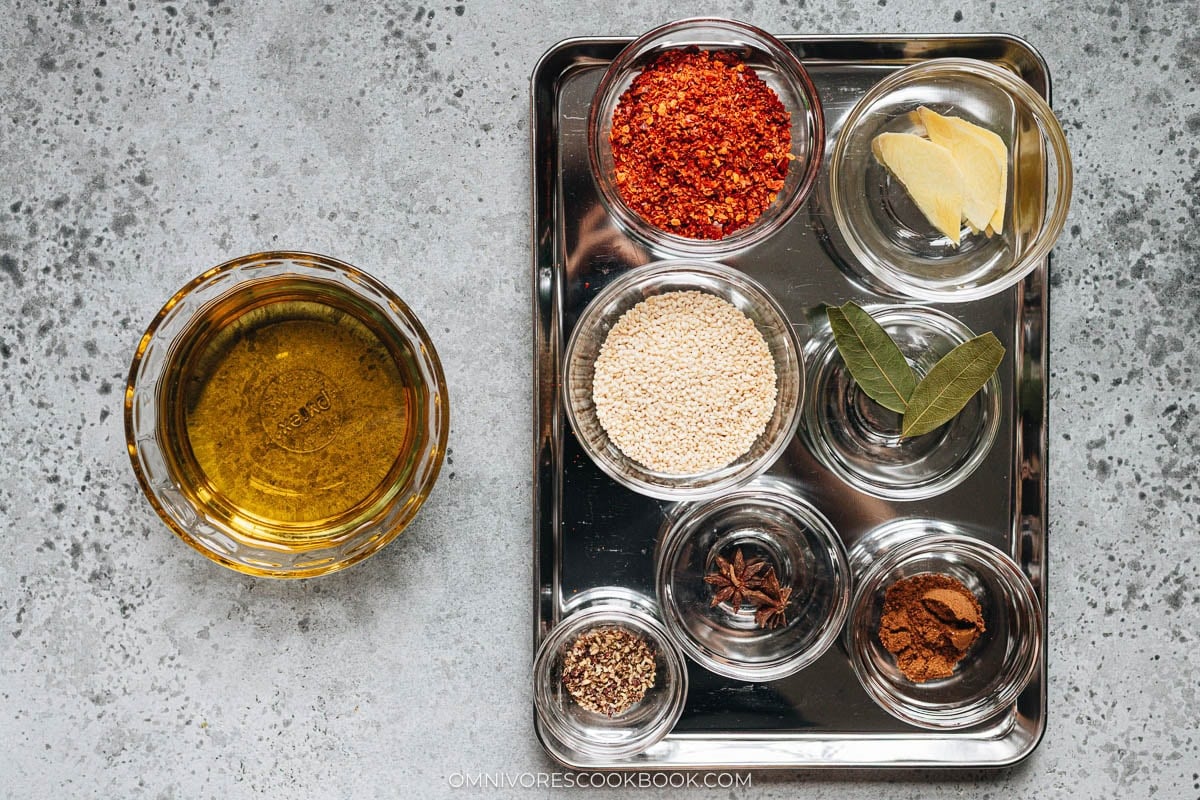
Chili flakes: I highly recommend Chinese chili flakes from The Mala Market, which is very fresh chili flakes imported from Sichuan. They have a vibrant red color and fewer seeds, so the oil comes out fragrant rather than punishingly hot. I use Korean chili flakes as my backup, and while the red color comes out a little softer, the taste holds up.
Aromatic spices: I mix in five spice powder, ground Sichuan peppercorn, a whole star anise, and a couple of bay leaves to give the oil depth beyond straight heat. The star anise and bay leaves come out later, so they perfume the oil without taking over.
Toasted sesame seeds: I add toasted sesame seeds for a nutty layer that plays against the chili, and they crisp up a little more when the hot oil meets them.
Oil: I use a neutral oil like vegetable or grapeseed so nothing competes with the spices. I want the chili and sesame to lead, not the oil itself.
Ginger: I drop in a piece of thinly sliced ginger while the oil heats, and it does double duty, perfuming the oil and telling me when the oil is hot enough to pour.
How to Make
1. Combine the spices: Put the chili flakes, five spice powder, sesame seeds, star anise, Sichuan peppercorn, and bay leaves in a heatproof ceramic bowl that holds at least 2 cups. Set the bowl on a heat resistant coaster before you start the oil.
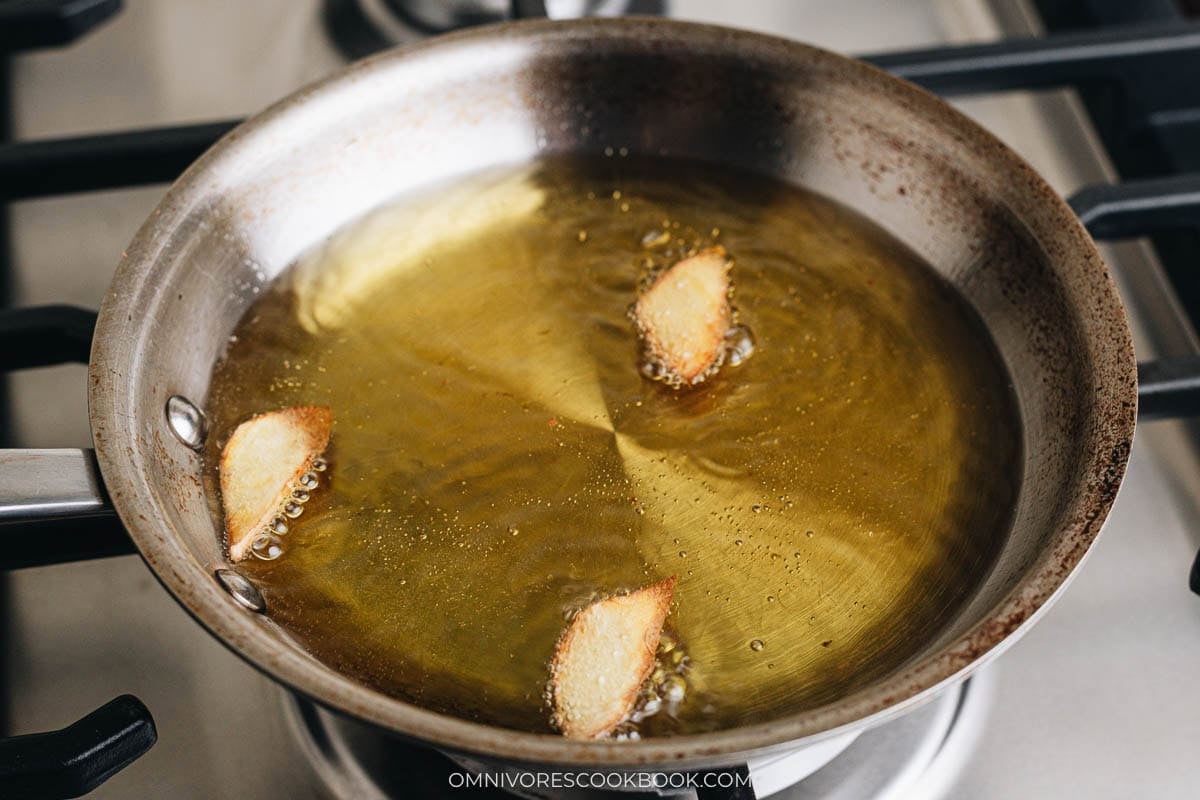
2. Heat the oil: Heat the oil in a wok or skillet over medium-high heat and add the sliced ginger. When the ginger turns golden brown and bubbles are rapidly rising around it, turn off the heat immediately. The oil should reach about 370°F (190°C); do not let it exceed 400°F (200°C).
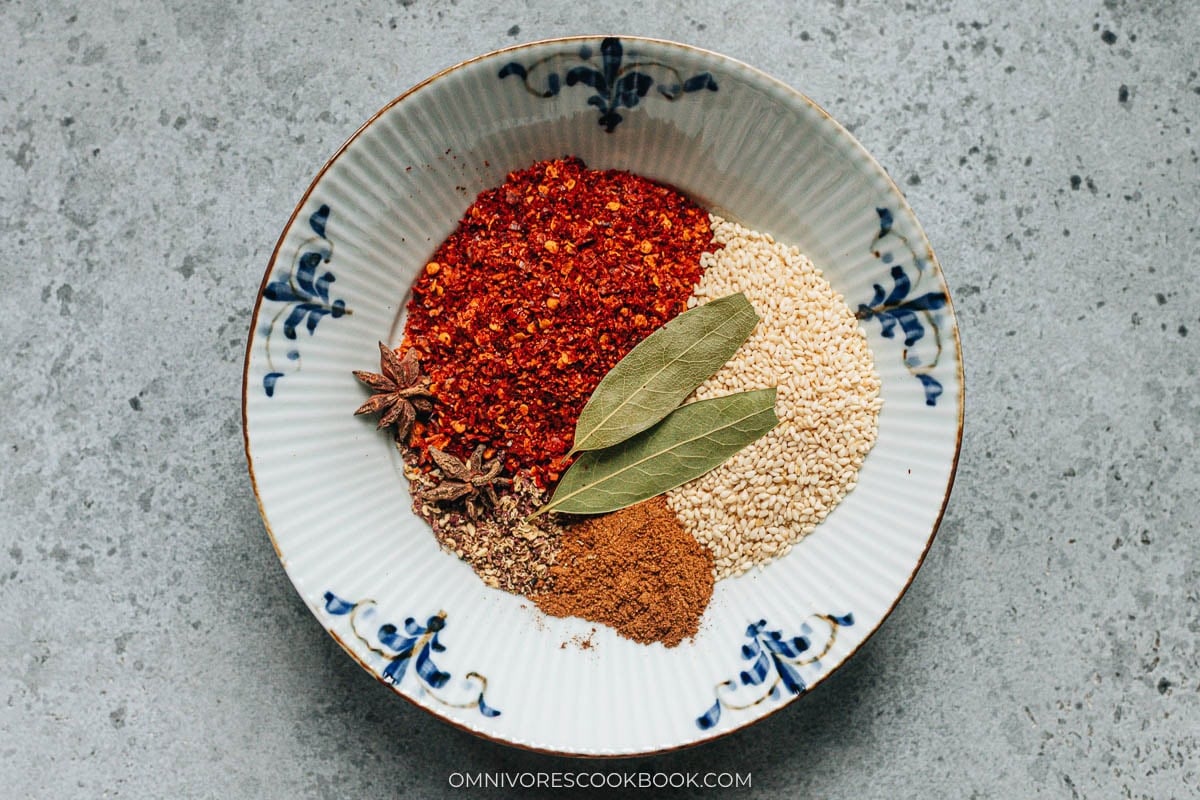
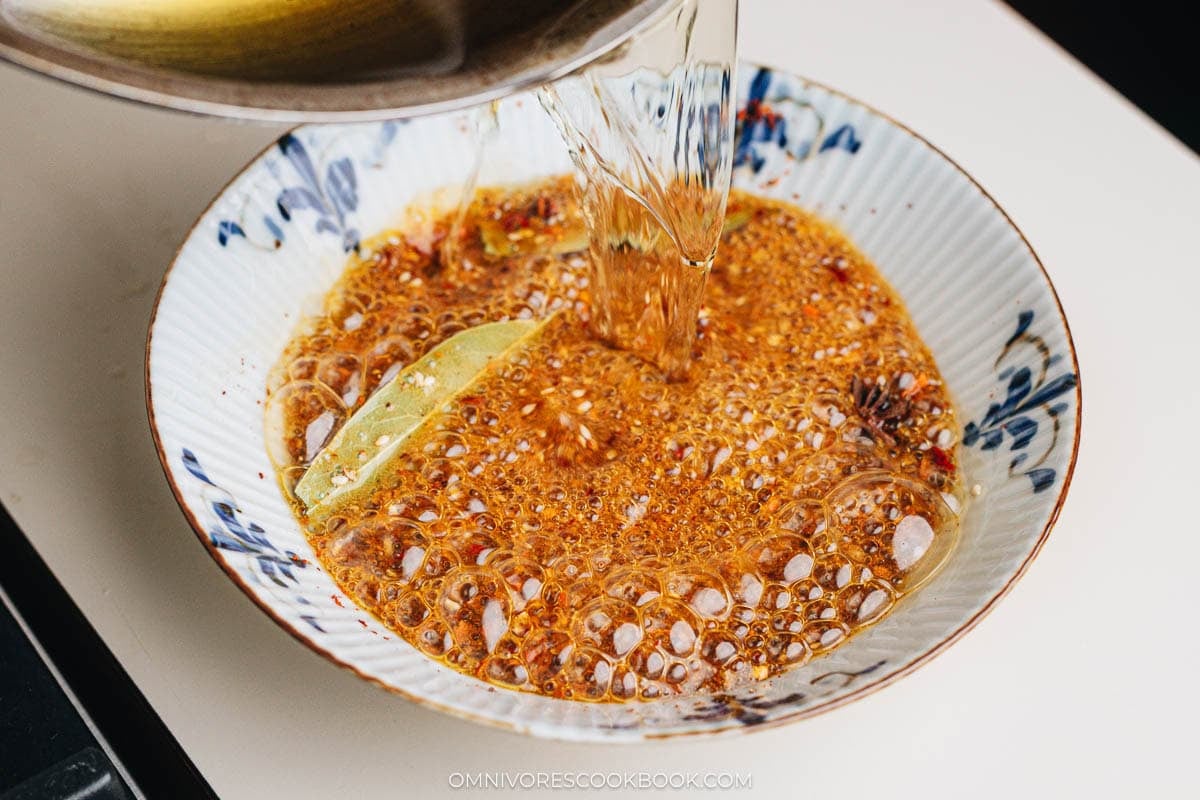
3. Pour the oil over the spices: Carefully pour the hot oil, or ladle it, into the bowl of spices. It will bubble hard for a few seconds and cook everything, so stir with a metal spoon while it bubbles to cook the spices through.
4. Remove the whole spices: Once the oil cools a bit, scoop out and discard the star anise and bay leaves. The oil is ready to use right away.
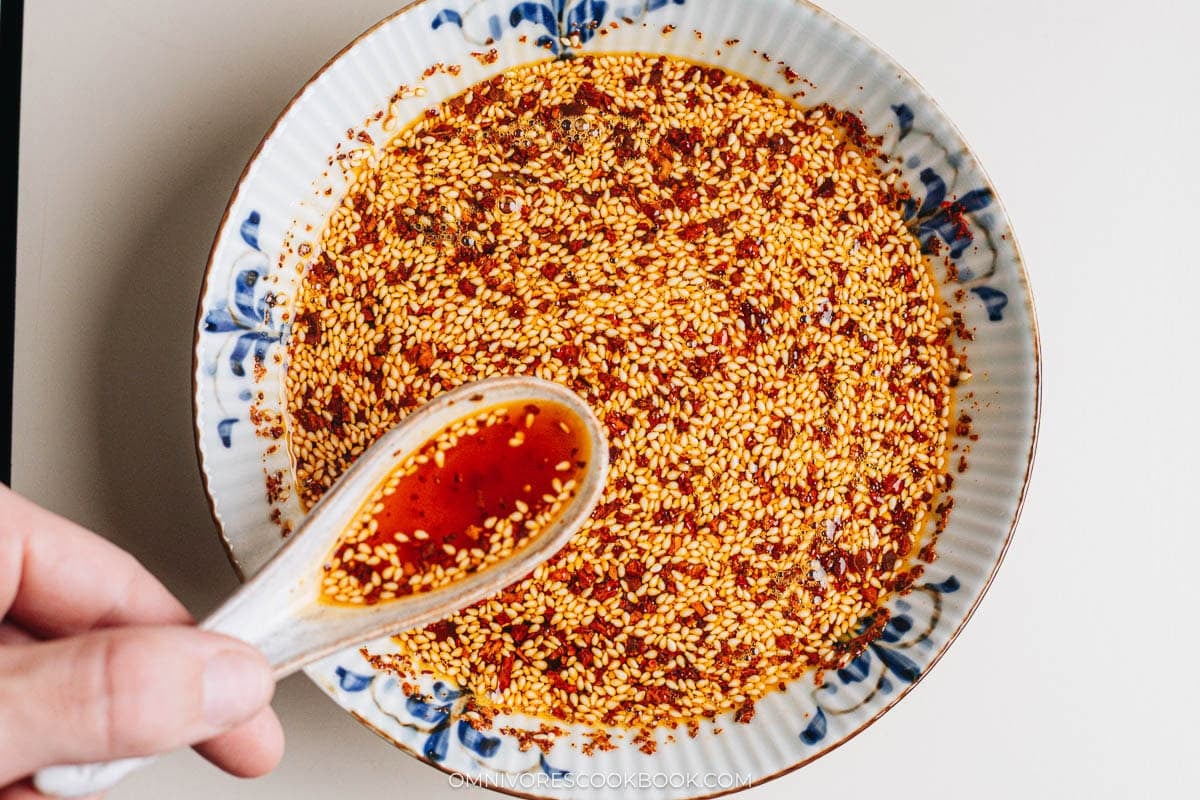
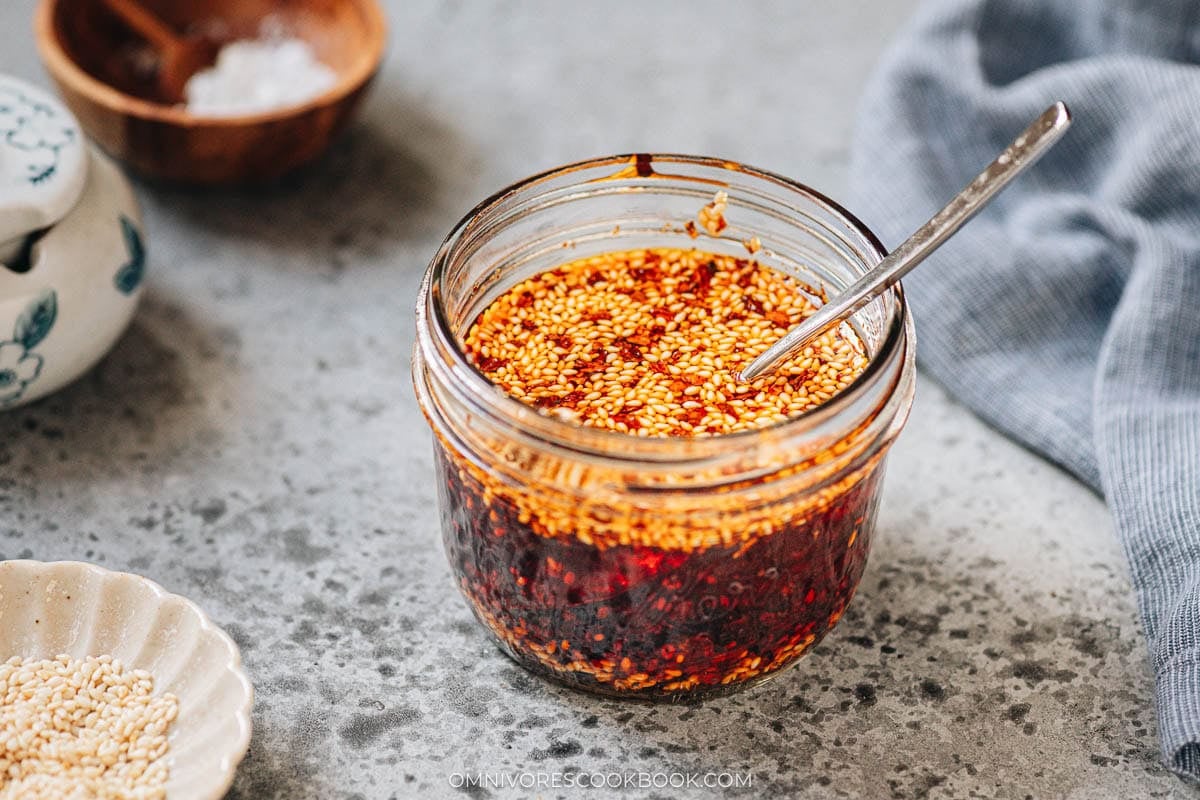
5. Let it rest: For the fullest flavor, let the oil sit for a day so the spices infuse into the oil.
Tips to Consider When Making Chili Oil
Use a ceramic bowl, not glass: I pour 370°F oil into the spices, and a ceramic bowl takes that heat without trouble. If you only have a glass jar, make sure it is labeled heatproof, because ordinary glass can shatter when the hot oil hits it.
Watch for the ginger cue: If you do not own an instant thermometer, the ginger is your gauge. Once the slice withers and goes golden, the oil is in the right range, and that is the moment to kill the heat.
Do not overheat the oil: The line between fragrant and bitter is temperature. Oil that climbs past 400°F scorches the flakes and the sesame seeds, and burnt spices make the whole jar bitter with no way to fix it.
Pick the right pan for pouring: I use a small saucepan with a long handle so I can pour in one steady motion, or I keep a ladle ready. A clumsy pour splashes hot oil, and this is the step where I slow down.
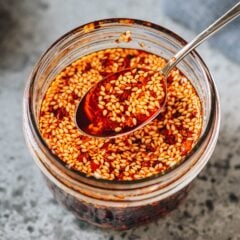
Stir in the flakes when you serve: The toasted flakes at the bottom of the jar are the best part. I scoop oil and flakes together so each spoonful brings smoky crunch, not just heat.
Make the aromatics your own: In China every region and every family has a formula, so treat the spice list as a starting point. This is my family’s version with Sichuan peppercorns for a numbing nuttiness and a pinch of five spice for savory depth, but a plainer chili-flake-only oil is just as valid.
How to Use Chili Oil
Chili oil lives at my table as a finishing spoonful, not a cooking fat, so I keep the jar and a small spoon out whenever noodles or dumplings are on the menu. I spoon it over a bowl of Lanzhou beef noodle soup right before I eat, letting the oil float on the broth and the flakes sink into the noodles.
When I want the chili oil to be the star rather than a garnish, I make a batch of Sichuan spicy wonton in chili oil, where the oil is the sauce and everything rides on getting it right. It is also the finish that makes proper Sichuan dishes sing, spooned over mapo tofu or stirred into a cold spicy cucumber salad. A jar in the fridge means any simple bowl is 30 seconds from tasting like a noodle shop.
For starting my day I use it the same way I did growing up. I stir a spoonful into a bowl of savory oatmeal or plain congee, and I drizzle it over roast vegetables to give a meat-free plate depth. It is the one jar that saves a bland dinner, which is why it never leaves my fridge.
Frequently Ask Questions
What kind of chili flakes should I use?
I use Chinese chili flakes imported from Sichuan for the best color and a fragrant, moderate heat, since they contain fewer seeds. Korean chili flakes (gochugaru) are my reliable second choice. They’re generally milder, and the chili oil will have a slightly lighter red color, but the flavor is still excellent.
Can I use whole dried chilies instead of flakes?
Yes, you can make your own flakes from whole dried chili peppers. I lightly toast the dried chilies first until they darken a little, then grind them into flakes. If I want a milder oil, I cut open half of the peppers with kitchen shears and discard the seeds before grinding.
Should I strain out the chili flakes or leave them in?
Both are common, and the preference varies across China. As a northerner, I grew up with jars that were mostly chili flakes with just enough oil to cover them, so I leave the flakes in for their smoky flavor and texture. But you can strain them out if you prefer a smooth, clear chili oil. Many restaurants in China serve the chili oil and the chili sediment separately, so diners can choose whichever they prefer.
How long does chili oil keep in the fridge and freezer?
Covered at room temperature the oil keeps for about 2 weeks, and in an airtight container in the fridge it lasts up to 6 months. I do not freeze chili oil.
Want to Save This Recipe?
Enter your email below & we’ll send it to your inbox. Plus get great new recipes from us every week!
Watch video
How to Make Chili Oil (辣椒油)
Ingredients
- 4 tablespoons Chinese chili flakes (*footnote 1)
- 1 teaspoon five spice powder
- 3 tablespoons toasted sesame seeds
- 1 teaspoon ground Sichuan peppercorn
- 1 whole star anise (Optional)
- 2 bay leaves
- 1 cup vegetable oil (or grapeseed oil)
- 2 to 3 piece thinly sliced ginger (Optional)
Instructions
- Combine chili flakes, five spice powder, sesame seeds, star anise, Sichuan peppercorns, and bay leaves in a heatproof ceramic bowl that can hold at least 2 cups liquid. Place the bowl on a heat resistant coaster.
- Heat oil in a wok (or a skillet) over medium-high heat. Add ginger. When the ginger starts to wither and turns golden brown, immediately turn off the heat. Remove and discard the ginger. The oil should reach 370 degrees F (190 C) and no higher than 400 F (200 C) if read with an instant thermometer.
- Carefully pour oil or use a ladle to transfer oil into the bowl of mixed spices. The oil will bubble for a few seconds and cook the spices. While the the oil is bubbling, use a metal spoon to stir gently to mix the spices, so they’ll cook thoroughly.
- When the oil cools down a bit, scoop out and discard the star anise and bay leaf.
- The oil is now ready to use! Its flavor will mature if you let it rest for a day, allowing the spices to infuse into the oil.
- The oil can be stored covered at room temperature for two weeks, or up to six months in the fridge in an airtight container.
Notes
Nutrition

Did you make this recipe?
I’d love to hear how it turned out for you! Please take a moment to leave a 5-star rating ⭐️ and share your thoughts in the comments further down the page. It really helps others discover the recipe too.
The recipe was originally published on August 7, 2014, and updated on Sep 10, 2026.
Barbara
I’m confused about the chili flakes. Maybe I’m just ignorant of the available varieties of chili flakes. I think I’m also hampered by living in Japan. The only chili flakes I’ve seen are simply called red chili flakes without any indication of the type of chili in the bottle. Can you direct me to a Japanese source, or a site where I can get more info? I don’t know what to buy for this essential ingredient. Thank you. I’m a much better cook because of you.
Maggie Zhu
Hi Barbara, the chili flake is a blend of ground up chili peppers that have different hot levels.
The ground is coarse than the chili powder, but it’s OK to use the find ground as well.
The product from the Mala Market is the best: https://themalamarket.com/products/sichuan-chili-flakes-xiang-la-jiao-mian?aff=2 (Not sure if they’re offering international shipping right now but it’s a great resource to learn about the product)
The chili pepper you showed in the other comment is one of the chilis that’s used in this blend. If that’s the only dried chili pepper you can find, you can use a food processor or blender to grind it, then use the grind as the chili flakes. The only tricky part is to decide how much seeds you want to include, because the seeds are the most spicy. If not sure, I recommend removing half or most of the seeds, so the oil won’t get too spicy.
Barbara
Thanks! I needed a little reassurance on this point.
Wendy
Amazing! I find myself adding it to everything. My parents gifted a load of chilis, which I dried and used whole out of sheer laziness. Just perfect.
Mary
Mmmmmm. Yeah. That’s good! Thank you!
Nancy Ng
I love this recipe! Simple and easy to follow.
Tania
Hi I think my oil wasn’t hot enough as when I poured it the chilli flakes didn’t foam… have I ruined my chilli oil?
Maggie Zhu
Hi Tania, the oil has to be hot enough to release the flavor from the chili flakes. What you can do is to return everything into a small sauce pan, heat over medium low heat while whisking to slowly bring the oil to a simmer. Use very gentle low heat to cook it for 3 to 4 minutes, until the chili flakes just turn slightly darker and the oil is orange / red. Then you can let it chill completely before using it.
Philip
I can’t wait to try this recipe for chili oil. Unfortunately, I think the ground chili’s you recommend at Mala Market would be too spicy for me (do you know what number on the Scoville scale these might be?) The description says it’s a mixture of mild, moderate, and hot flakes but this link https://themalamarket.com/collections/all/products/er-jing-tiao-chili is more mild so I may try that first.. your thoughts?
Maggie Zhu
I think you can totally buy milder peppers and ground them to make your own blend. The Er jing tiao chili would be nice since it’s milder.
PS. the chili pepper flake blend from the mala market is actually not that spicy if you make them into chili oil. It does contain some hot pepper flakes but I never found it overwhelmingly spicy. Of course you can make your own blend just to be safe 🙂
Philip
Thanks Maggie. I made the oil with some Korean chili flakes I had on hand and it wasn’t too spicy but I did purchase the ones you recommended from the Mala Market. I also bought their Sichuan peppercorns and will make the chili oil again when this batch is gone. 😍
Les
This oil is a hit with everyone. It is so much better than the old stuff on the tables in restaurants it stuns people when they try it!
SCislander
This is a wonderful and easy recipe. I make extra for family members, who love it.
Melissa
I’ve made this chili oil a couple times in the past week and I absolutely love it. Unfortunately, I did not use Sichuan seeds since I don’t have it in on hand, but the result still has the nutty, smoky taste that I crave! I can’t wait to try this recipe with real Sichuan peppers. I also used avocado oil and black sesame seeds, since that’s what I had on hand.
I find this recipe more approachable than some recipes since it calls for using a five spice mix. As a result, I was able to try making chili oil at home for the first time and it was so worth it! Thank you for sharing.
Chet Kastava
I just discovered your site and I love it. Thanks. I have a cooking chili oil problem. Would it be possible to place the ingredients in a pot with the oil and cook at 225? I’m not comfortable with cooking with oil at 375 or 400. I can remove the bay leaves and star anise after it cools. Thanks
Maggie Zhu
I have another recipe that cooks the oil in the pan: https://omnivorescookbook.com/biang-biang-noodles
The formula is different but the result is great.
Peter Buckley
A very fine recipe. We always have some in the fridge and make some fresh monthly. We use very good quality canola oil and are exact about the temperature.
Esther
Hello, this is a great recipe! I was wondering I just have canola oil. Would this work?
Maggie Zhu
Yes canola oil will work. Happy cooking!
Deborah
This is a great recipe. It’s very easy, just takes a bit of time to gather the various components beforehand. We used to buy chili oil in China but since we’ve gone to NZ, it’s hard to find good oil without preservative. Now I make this and it’s great with our noodle soup.
Uncle Gary
This is a great recipe, thank you! How would I go about making this spicier? My family loves it however adding more chili flakes did not make it spicier as I would have expected. Is there another ingredient I can add to increase the heat? Thanks.
Maggie Zhu
You should use a different type of chili such as a bit cayenne powder if you want to increase the heat.
Keirstin
Hi I was just wondering if could just use red pepper flakes instead because I dint want to buy Chinese chili flakes and Sichuan pepper corns. Which is more important?
Maggie Zhu
It’s totally OK to replace the Chinese chili flakes with red pepper flakes as long as your blend is not super spicy. Chinese chili flakes are usually medium spicy so the chili oil will end up fragrant but not too hot.
The Sichuan peppercorns is not spicy at all, but has a numbing tingling taste when chew on it. It will add a different dimension of aroma to the oil, so it’s not replaceable by other spices. That being said, you can always skip it (many chili oil brands do not include it I think), but I really like its taste.
Lily
I put off trying this recipe for such a long time out of…laziness, probably, but I finally made it a couple of weeks ago and I can’t believe it took me so long. I put it on eeeeeeverything, it’s SO delicious!
Hailey
The first time I made this, I thought, I should give some to a friend. How will I go through so much spicy oil before it starts to go bad?
I had to make a new batch three weeks later, because we started putting it on everything! Soups, eggs, meat, fish… it’s great on plain white rice if you’re in the mood for a quick snack. I have to make it every two weeks now. We go through a lot of it.
Gary Peterson
Hi Maggie,
Chili oil is really good. Tried it in Cucumber Salad, in ramen and in Miso soup, goes well with everything.
Gary
Bluesman
370 degrees F is *way* too hot for the oil. I used a thermometer to make sure I got the temp right and the spices and chili flakes burned immediately. Most recipes I’ve looked up use a temp of no more than 250 degrres F.
Rand
Thank you for this excellent recipe Maggie! We made this yesterday to serve with dan dan noodles and it was exactly as you said. We left out the optional ingredients except for the garlic and it was perfect!