
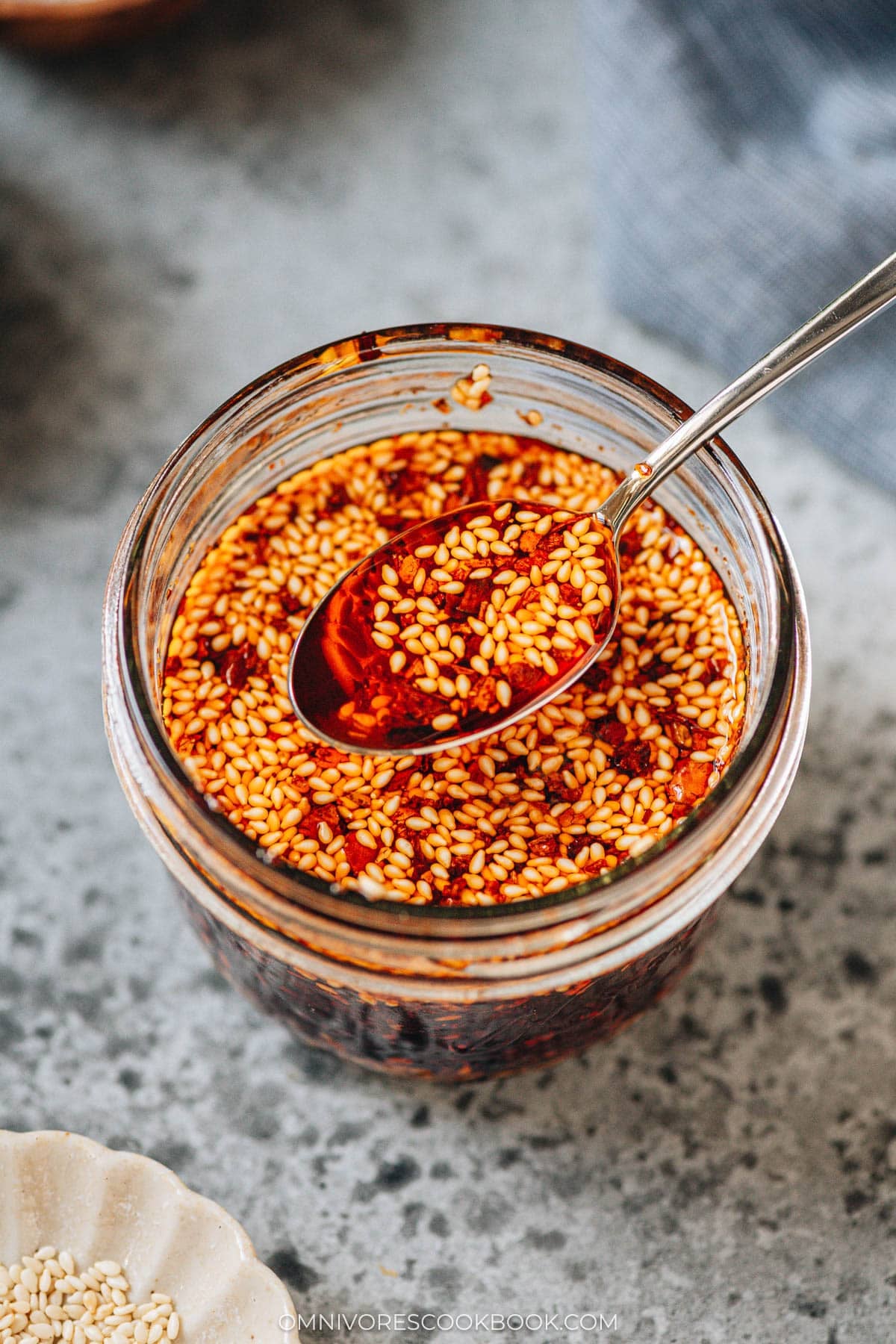
For a Chinese family, chili oil sits on the table next to the soy sauce and the black vinegar, and it shows up at every small noodle shop and dumpling counter I have ever walked into. It is a cousin to the jarred chili crisp you see on shelves now, but thinner and made for spooning over a finished bowl rather than eating by the spoonful. Once you start reaching for it, you will want it on almost everything.
When I say chili oil, I mean the homemade version, because it tastes far better than anything in a jar and keeps just as long in the fridge. The freshness is the whole point, a nutty fragrance that bottled oil loses on the shelf, with no additives or MSG. I use mine the way I grew up using it, stirring in the toasted flakes at the bottom so every bite of dan dan noodles or sesame noodles picks up those crispy and smoky bits I love.
I make this in three moves: I combine the flakes and spices in a heatproof bowl, heat the oil until it is hot but not smoking, then pour it over the spices and let it bubble. The only thing to watch is the oil temperature, and I will walk you through a ginger trick for that if you do not own a thermometer. Pour your first batch the next time a bowl of noodles needs waking up, my directions below take you from cold pan to finished jar in 10 minutes.
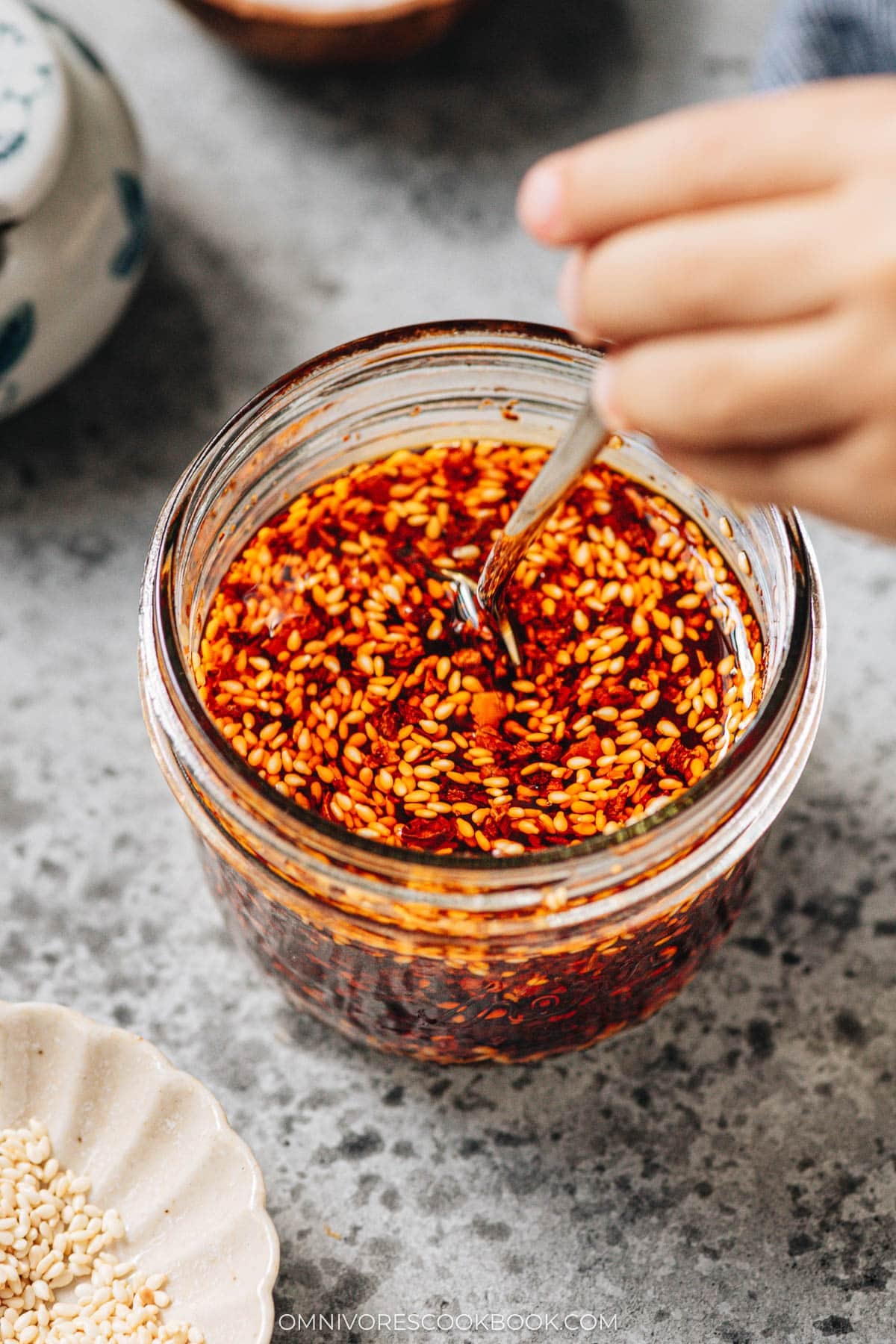
Ingredients
These are the ingredients to make chili at home and the one thing I will not compromise on is the chili flakes, since they set the color and the heat of the whole jar.
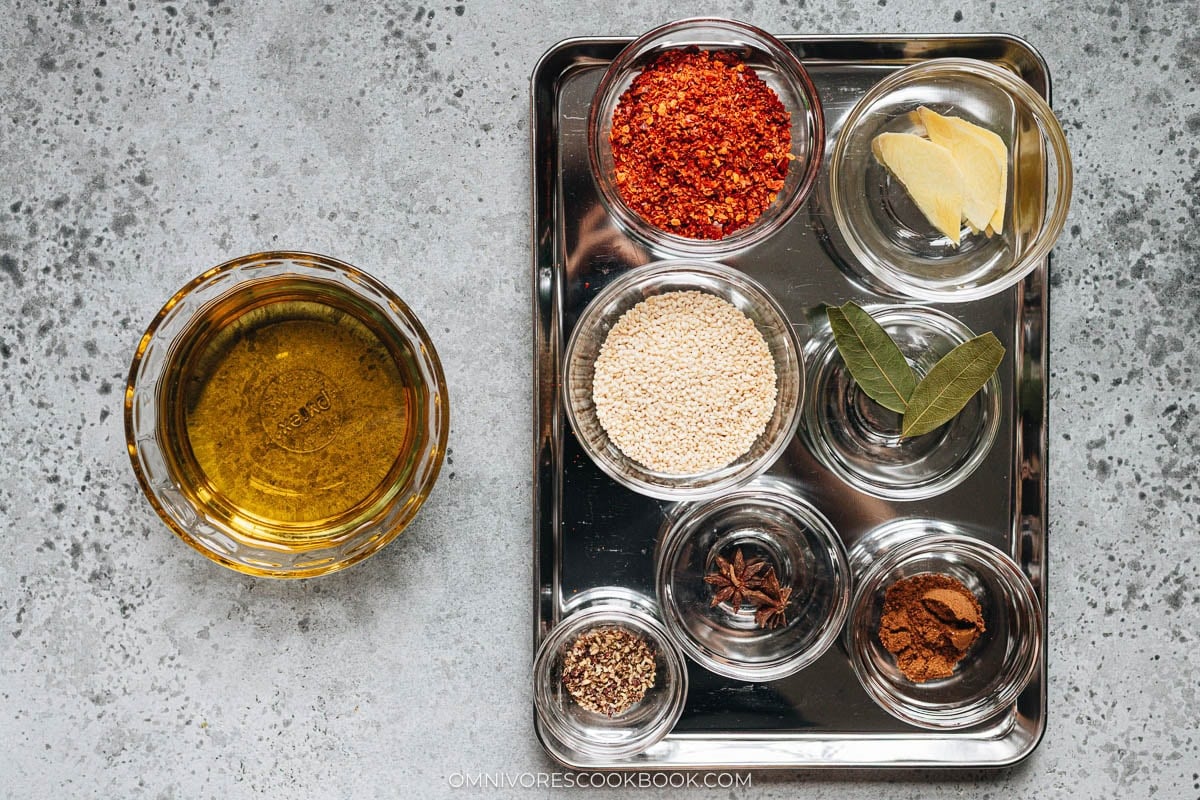
Chili flakes: I highly recommend Chinese chili flakes from The Mala Market, which is very fresh chili flakes imported from Sichuan. They have a vibrant red color and fewer seeds, so the oil comes out fragrant rather than punishingly hot. I use Korean chili flakes as my backup, and while the red color comes out a little softer, the taste holds up.
Aromatic spices: I mix in five spice powder, ground Sichuan peppercorn, a whole star anise, and a couple of bay leaves to give the oil depth beyond straight heat. The star anise and bay leaves come out later, so they perfume the oil without taking over.
Toasted sesame seeds: I add toasted sesame seeds for a nutty layer that plays against the chili, and they crisp up a little more when the hot oil meets them.
Oil: I use a neutral oil like vegetable or grapeseed so nothing competes with the spices. I want the chili and sesame to lead, not the oil itself.
Ginger: I drop in a piece of thinly sliced ginger while the oil heats, and it does double duty, perfuming the oil and telling me when the oil is hot enough to pour.
How to Make
1. Combine the spices: Put the chili flakes, five spice powder, sesame seeds, star anise, Sichuan peppercorn, and bay leaves in a heatproof ceramic bowl that holds at least 2 cups. Set the bowl on a heat resistant coaster before you start the oil.
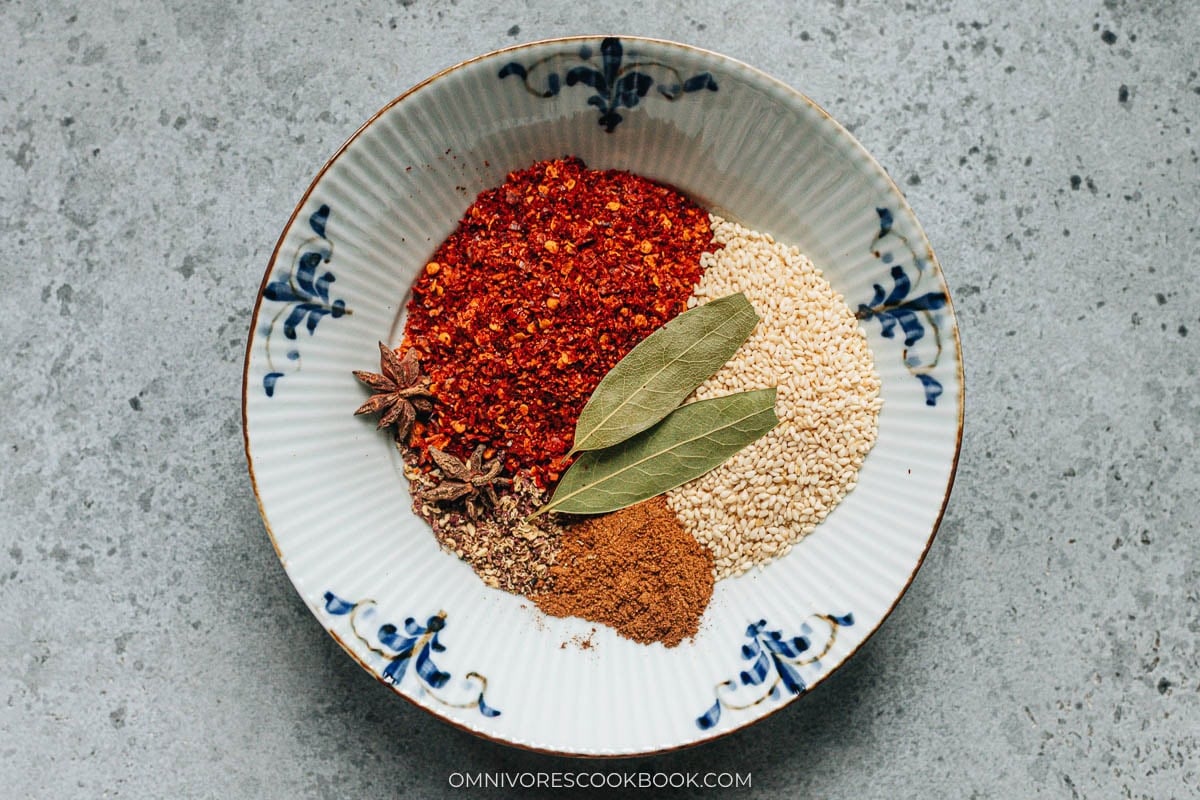
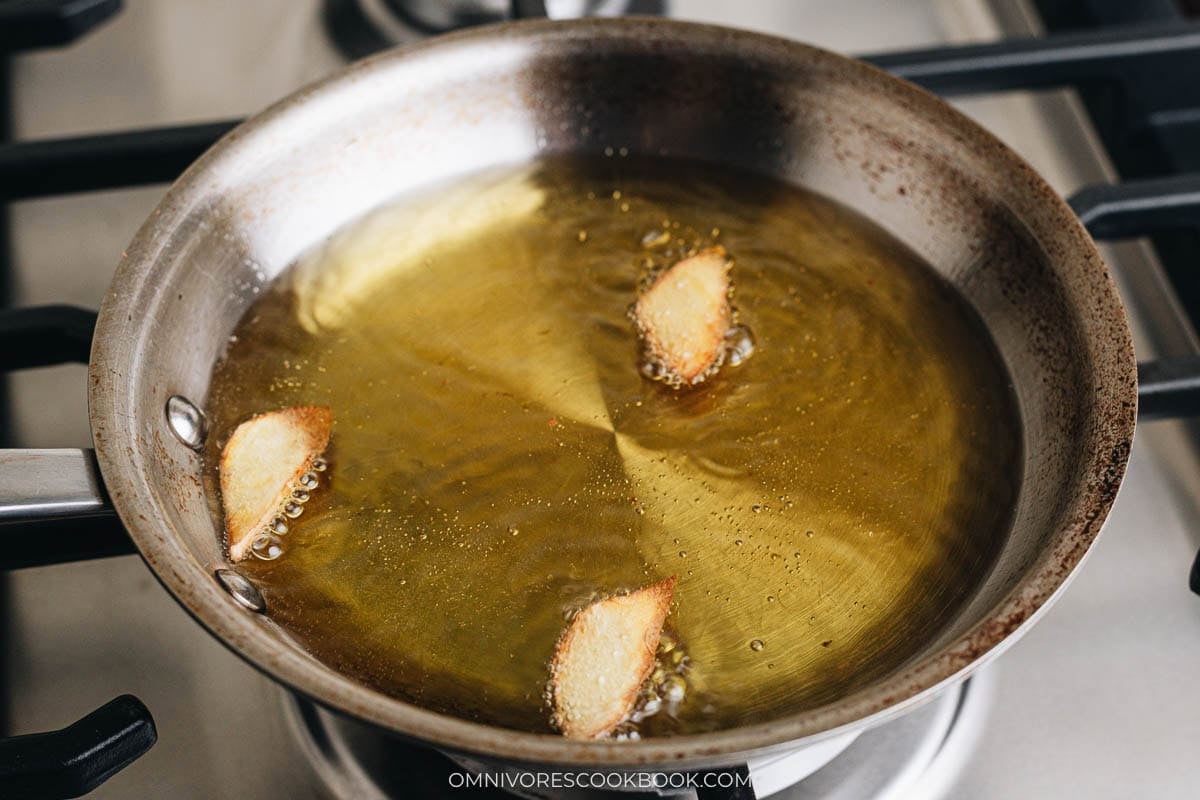
2. Heat the oil: Heat the oil in a wok or skillet over medium-high heat and add the sliced ginger. When the ginger turns golden brown and bubbles are rapidly rising around it, turn off the heat immediately. The oil should reach about 370°F (190°C); do not let it exceed 400°F (200°C).
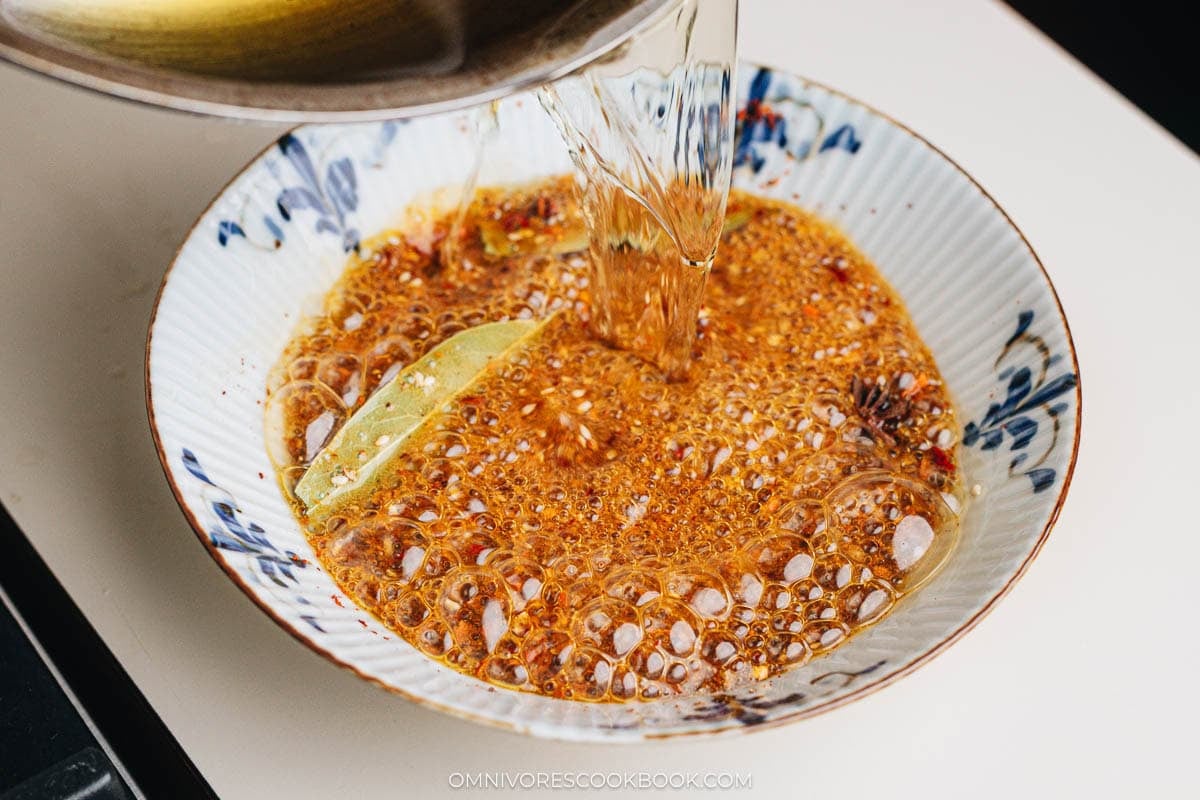
3. Pour the oil over the spices: Carefully pour the hot oil, or ladle it, into the bowl of spices. It will bubble hard for a few seconds and cook everything, so stir with a metal spoon while it bubbles to cook the spices through.
4. Remove the whole spices: Once the oil cools a bit, scoop out and discard the star anise and bay leaves. The oil is ready to use right away.
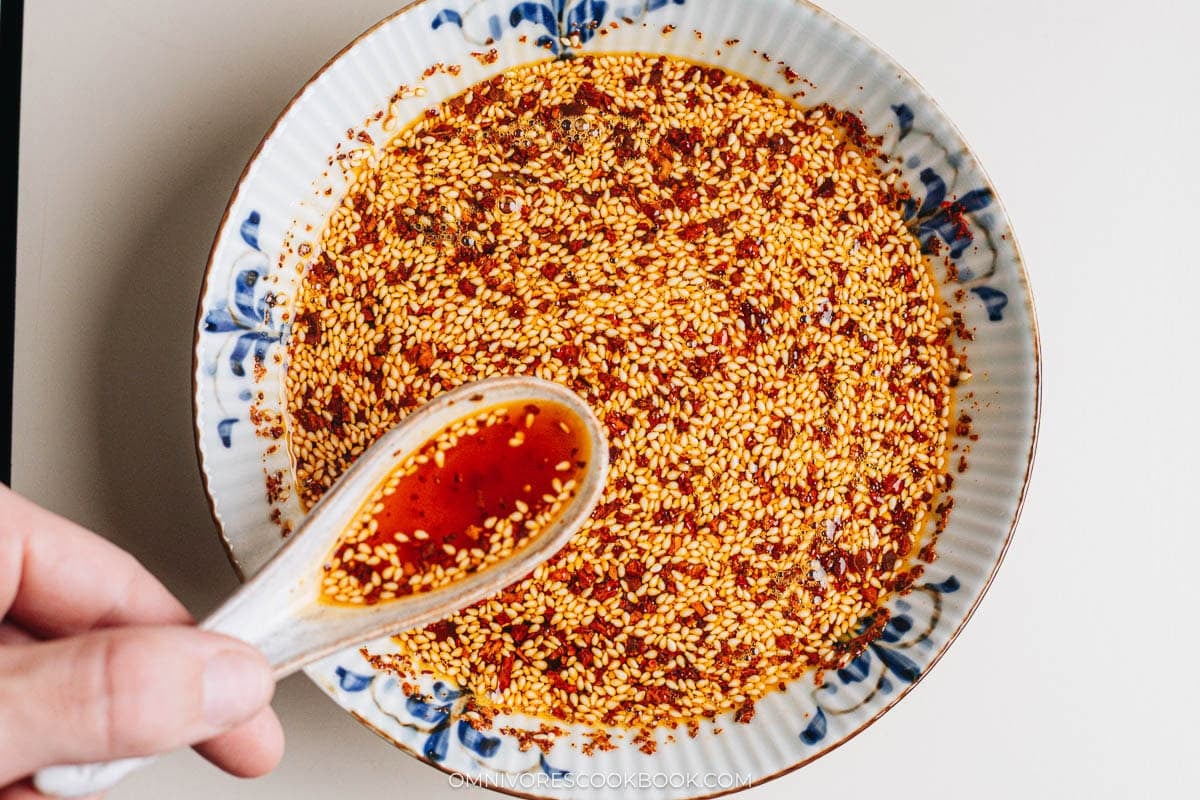
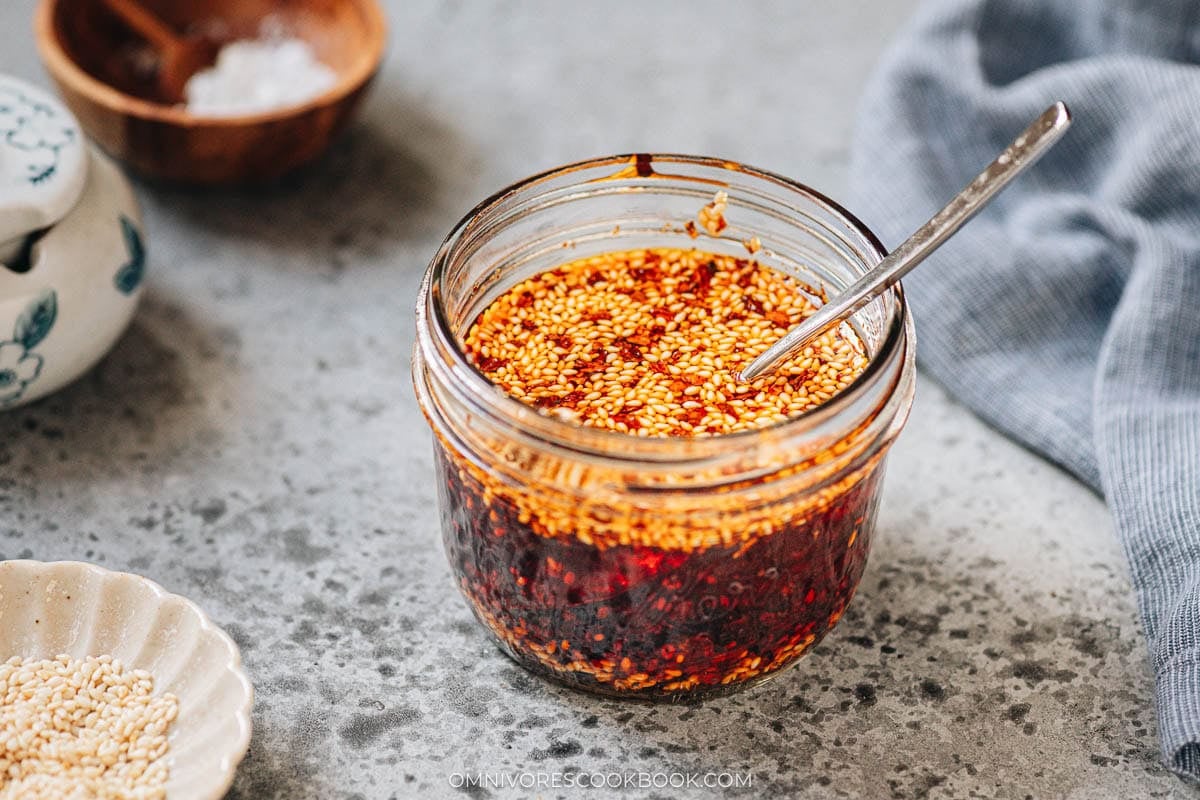
5. Let it rest: For the fullest flavor, let the oil sit for a day so the spices infuse into the oil.
Tips to Consider When Making Chili Oil
Use a ceramic bowl, not glass: I pour 370°F oil into the spices, and a ceramic bowl takes that heat without trouble. If you only have a glass jar, make sure it is labeled heatproof, because ordinary glass can shatter when the hot oil hits it.
Watch for the ginger cue: If you do not own an instant thermometer, the ginger is your gauge. Once the slice withers and goes golden, the oil is in the right range, and that is the moment to kill the heat.
Do not overheat the oil: The line between fragrant and bitter is temperature. Oil that climbs past 400°F scorches the flakes and the sesame seeds, and burnt spices make the whole jar bitter with no way to fix it.
Pick the right pan for pouring: I use a small saucepan with a long handle so I can pour in one steady motion, or I keep a ladle ready. A clumsy pour splashes hot oil, and this is the step where I slow down.
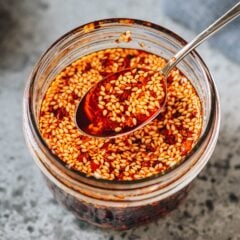
Stir in the flakes when you serve: The toasted flakes at the bottom of the jar are the best part. I scoop oil and flakes together so each spoonful brings smoky crunch, not just heat.
Make the aromatics your own: In China every region and every family has a formula, so treat the spice list as a starting point. This is my family’s version with Sichuan peppercorns for a numbing nuttiness and a pinch of five spice for savory depth, but a plainer chili-flake-only oil is just as valid.
How to Use Chili Oil
Chili oil lives at my table as a finishing spoonful, not a cooking fat, so I keep the jar and a small spoon out whenever noodles or dumplings are on the menu. I spoon it over a bowl of Lanzhou beef noodle soup right before I eat, letting the oil float on the broth and the flakes sink into the noodles.
When I want the chili oil to be the star rather than a garnish, I make a batch of Sichuan spicy wonton in chili oil, where the oil is the sauce and everything rides on getting it right. It is also the finish that makes proper Sichuan dishes sing, spooned over mapo tofu or stirred into a cold spicy cucumber salad. A jar in the fridge means any simple bowl is 30 seconds from tasting like a noodle shop.
For starting my day I use it the same way I did growing up. I stir a spoonful into a bowl of savory oatmeal or plain congee, and I drizzle it over roast vegetables to give a meat-free plate depth. It is the one jar that saves a bland dinner, which is why it never leaves my fridge.
Frequently Ask Questions
What kind of chili flakes should I use?
I use Chinese chili flakes imported from Sichuan for the best color and a fragrant, moderate heat, since they contain fewer seeds. Korean chili flakes (gochugaru) are my reliable second choice. They’re generally milder, and the chili oil will have a slightly lighter red color, but the flavor is still excellent.
Can I use whole dried chilies instead of flakes?
Yes, you can make your own flakes from whole dried chili peppers. I lightly toast the dried chilies first until they darken a little, then grind them into flakes. If I want a milder oil, I cut open half of the peppers with kitchen shears and discard the seeds before grinding.
Should I strain out the chili flakes or leave them in?
Both are common, and the preference varies across China. As a northerner, I grew up with jars that were mostly chili flakes with just enough oil to cover them, so I leave the flakes in for their smoky flavor and texture. But you can strain them out if you prefer a smooth, clear chili oil. Many restaurants in China serve the chili oil and the chili sediment separately, so diners can choose whichever they prefer.
How long does chili oil keep in the fridge and freezer?
Covered at room temperature the oil keeps for about 2 weeks, and in an airtight container in the fridge it lasts up to 6 months. I do not freeze chili oil.
Want to Save This Recipe?
Enter your email below & we’ll send it to your inbox. Plus get great new recipes from us every week!
Watch video
How to Make Chili Oil (辣椒油)
Ingredients
- 4 tablespoons Chinese chili flakes (*footnote 1)
- 1 teaspoon five spice powder
- 3 tablespoons toasted sesame seeds
- 1 teaspoon ground Sichuan peppercorn
- 1 whole star anise (Optional)
- 2 bay leaves
- 1 cup vegetable oil (or grapeseed oil)
- 2 to 3 piece thinly sliced ginger (Optional)
Instructions
- Combine chili flakes, five spice powder, sesame seeds, star anise, Sichuan peppercorns, and bay leaves in a heatproof ceramic bowl that can hold at least 2 cups liquid. Place the bowl on a heat resistant coaster.
- Heat oil in a wok (or a skillet) over medium-high heat. Add ginger. When the ginger starts to wither and turns golden brown, immediately turn off the heat. Remove and discard the ginger. The oil should reach 370 degrees F (190 C) and no higher than 400 F (200 C) if read with an instant thermometer.
- Carefully pour oil or use a ladle to transfer oil into the bowl of mixed spices. The oil will bubble for a few seconds and cook the spices. While the the oil is bubbling, use a metal spoon to stir gently to mix the spices, so they’ll cook thoroughly.
- When the oil cools down a bit, scoop out and discard the star anise and bay leaf.
- The oil is now ready to use! Its flavor will mature if you let it rest for a day, allowing the spices to infuse into the oil.
- The oil can be stored covered at room temperature for two weeks, or up to six months in the fridge in an airtight container.
Notes
Nutrition

Did you make this recipe?
I’d love to hear how it turned out for you! Please take a moment to leave a 5-star rating ⭐️ and share your thoughts in the comments further down the page. It really helps others discover the recipe too.
The recipe was originally published on August 7, 2014, and updated on Sep 10, 2026.
Beryl
This recipe turned out great – simple, and really elevates chinese food made at home (or takeout eaten at home:) ) I hope to find some good chinese peanut oil, and make my next batch with that!
AMbk
Thank you Maggie! I had tried to make chili oil following a different recipe elsewhere, and it ended up being a disaster. Following your steps, I was successful this time around. So excited to use this in my cooking! Delicious, fragrant and wonderful!
Tim
Hi – I’ve made once with canola. But would you use caiziyou since I have it? Thanks!
Maggie
Yes, Caiziyou will totally work!
A-Rho
Revolutionary. Will be making this for years to come.
Maureen
Thank you I love this
Anton
Thank you for sharing this recipe Maggie. I made it for Dan Dan noodles and it was delicious! I used Korean pepper flakes which is just the right amount of heat for me. I would say the star anise is necessary – it’s what makes this chili oil the best I’ve ever had!! And so easy, there’s no reason to buy store bought anymore.
Maggie
So happy to hear you like the recipe 🙂 I always have a jar in my fridge and I put it on many dishes to boost flavor.
Lawri Smith
Tried it and loved it. Thank you.
Terri Caldwell
I have several different chili oils but when I made this I was ready to throw the rest out! This is so amazingly good that I use it every day on everything. Make it!
Amber
Hello Maggie,
Have not tried this yet but am excited to get it going. One question before I begin… The peppercorns are purchased whole but the recipe calls for ground peppercorns. Could you explain this a bit more for me please? I’ve experienced these babies before and I really don’t want to add more than required ’cause I feel like that’d be a chili oil disaster for me. I’m eventually using the oil to make your Mapo Tofu.
Thanks!!
Amber
Maggie
Hi Amber, I usually use my coffee grinder to ground the Sichuan peppercorns. You can use a mortar and pestle as well. If you do not wish to have a strong peppercorn taste in the chili oil, you can simply use the whole peppercorns when pouring the hot oil, then you can fish them out afterwards. j
Amber
Cheers! Thank you.
Barbara
Hi! I made it and will remake it again 🙂 I used the same ingredients as your recipe and the sauce is really easy to make, full of flavours, and goes with so many dishes, thanks a lot !
Barbara
Sabena
The phrase “you can use korean chili flakes” is goodsend to me and I’m sure many others. Thank you!!! My chili oil looks and smells incredible. You are right, no more buying chili oil. Is it alright to add salt and sugar
Zoe
My FAVORITE chili oil recipe. I can’t go back to store bought. The anise seed pod really kicks the flavor up a notch and adds to the complexity.
Eric Nelson
Very easy to make. Not as hot as one would expect given the amount of chili’s. It is however extremely fragrant.
Instead of using a ceramic bowl, I used a 2 cup pyrex measuring cup which worked just fine since the borosilicate glass can easily take the heat. Doesn’t hurt to preheat the glass with not water to lessen the temperature drop.
Jacqueline
This is a wonderful chili oil recipe. This is my first attempt at making this and it came out great. Second attempt I left out one bay leave, and the star anise. Third attempt I left out half the toasted sesame. My forth attempt today I added one extra table spoon of chili, and only one teaspoon of 5 spice. powder.
ITS PERFECT.
I think adjusting to taste is the best way to decide how you like it.
Thanks so very much
Jacqueline
Natasha
Oh my god!!
My kitchen smells so amazing after this. I couldn’t find Korean or Chinese chilli near me so just went ahead with the local variety. Also added star anise and a stick cinnamon. The magic was in the temperature though. Have fallen in love with it. Can’t wait to try it in your sesame noodles.
Thankyou so much for making asian cuisine accessible. Live it. ❤️❤️
David J. Lisle
I’ll try your family recipe, nothing in it I don’t love.
Valerie
I am definitely trying my hand at this. I love Chinese chili oil but have only used the jar brands. This will be a treat. I also make an Italian chili oil–a recipe that has been passed down in my family. It even looks the same. What I find interesting is the crossover between Chinese cooking and Italian cooking. Very different flavors with some of the same ingredients. It seems like somewhere along the line there has been some influence between the two cuisines. Lovely website M. I’m making the string bean chicken tonight with a side of Italian pork dumplings (ravioli). Not really…but I do have the string bean chicken on the menu for tonight. LOL Oh, and the wok General Tso’s chicken was yummy and crunchy.
Leah Blake
Realily straight forward and delish. I look forward to making this.
kassie
I may have overlooked it, but I could not find your recommendation forsichuan chili peppers in your wonderful pantry list. If it is not here please consider adding a referenc to your pantry list. I have purchased may of the items from there and added to MY pantry, and now I can just reach in and make many of your great recipes!!!! I did purchase sichaun chilis from Amazon. They are plump, and not crumbly dry…..I have to chop them with a knife, which is fine!!
I made this exactly from the recipe and it is FANTASTIC. Thankyou. Today from your website I also made sweet chili sauce….too fabulous, using the same chilis!!
Jess O’Shea
So good!!! I just finished the oil and am making the wontons and am looking forward to making the beans tomorrow! Such great recipes Maggie Thankyou so much! Very excited to cook over the next few weeks.