
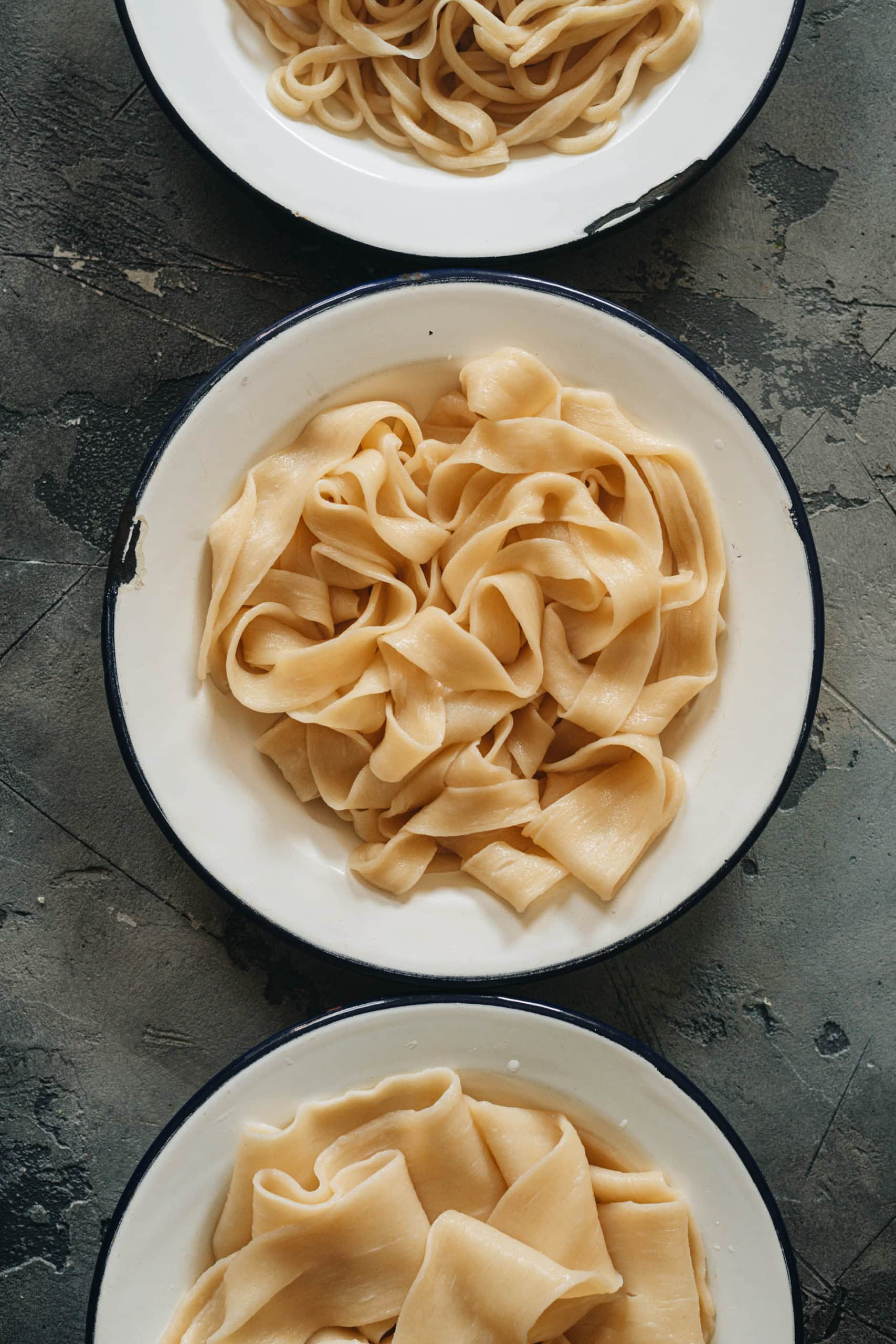
Hand pulled noodles, known as Lā Miàn 拉面, are a traditional Chinese noodle made by repeatedly stretching and folding wheat dough into long strands by hand. They are a staple of northern Chinese cuisine and are valued for their chewy texture and simple ingredients. Plus, noodles are one of the core elements of Chinese food culture, and they show up in many of my Authentic Chinese noodle recipes for that reason.
As you might already know, handmade noodles can be hard to find and often expensive outside of China, including here in New York. That is exactly why I decided to share this recipe, along with my expert tips from years of cooking Chinese food at home and developing recipes professionally.
Whether it is a hot bowl of noodles in a restaurant or freshly made noodles cooked at home, I love that this is one of the most affordable ways to prepare a filling and hearty one dish meal. With my recipe, I walk through the dough mixing, resting, and pulling process step by step using only flour, water, and salt, with a little active work once the dough has rested. Let us start.
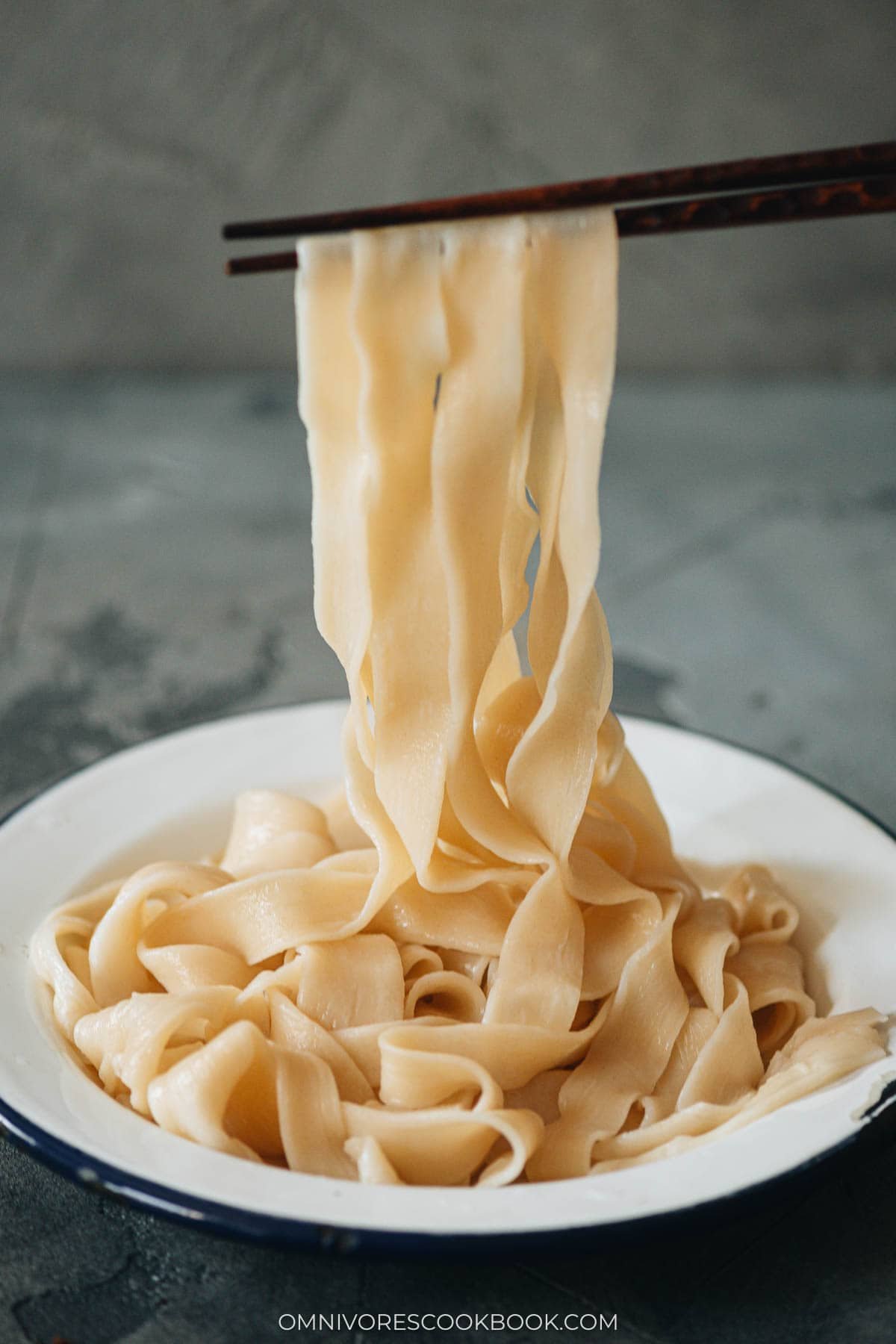
Why make hand pulled noodles at home
Even though noodles are inexpensive at restaurants, I still enjoy making them from scratch at home. The reasons are simple:
- Easy to make: Once I learned the technique, making hand pulled noodles at home became very simple.
- No additives: I like that homemade noodles use only basic ingredients without added preservatives.
- Better taste: Freshly made noodles taste far better than packaged dried ones.
There are countless types of noodles in China, and here I introduce the hand pulled variety known as 拉面, la mian. It might sound daunting to make this type of noodle at home, especially if you’ve ever watched a noodle dance in China. But the truth is, hand-pulled noodles are one of the easiest handmade noodles for beginners to make.
Hand Pulled Dough Method
There are two main approaches to making hand pulled noodles:
- In professional kitchens, cooks usually knead the dough for a very long time to build strong gluten, then rest it for an extended period so it can be pulled. That method works well in restaurants but is not very practical at home.
- After many test runs, I found that kneading just until the dough is smooth works much better for home cooks. By avoiding excessive gluten development, the dough needs much less resting time and is easier to handle. This approach uses minimal active kneading and produces a soft, springy dough that pulls easily.
How to make
1. Prepare the dough – 1 short rest
To make the dough without developing too much gluten, you don’t need to knead the dough for very long time and it will not be smooth after first kneading. But once the dough rest the first time, it only takes a few kneading to smooth out the dough.
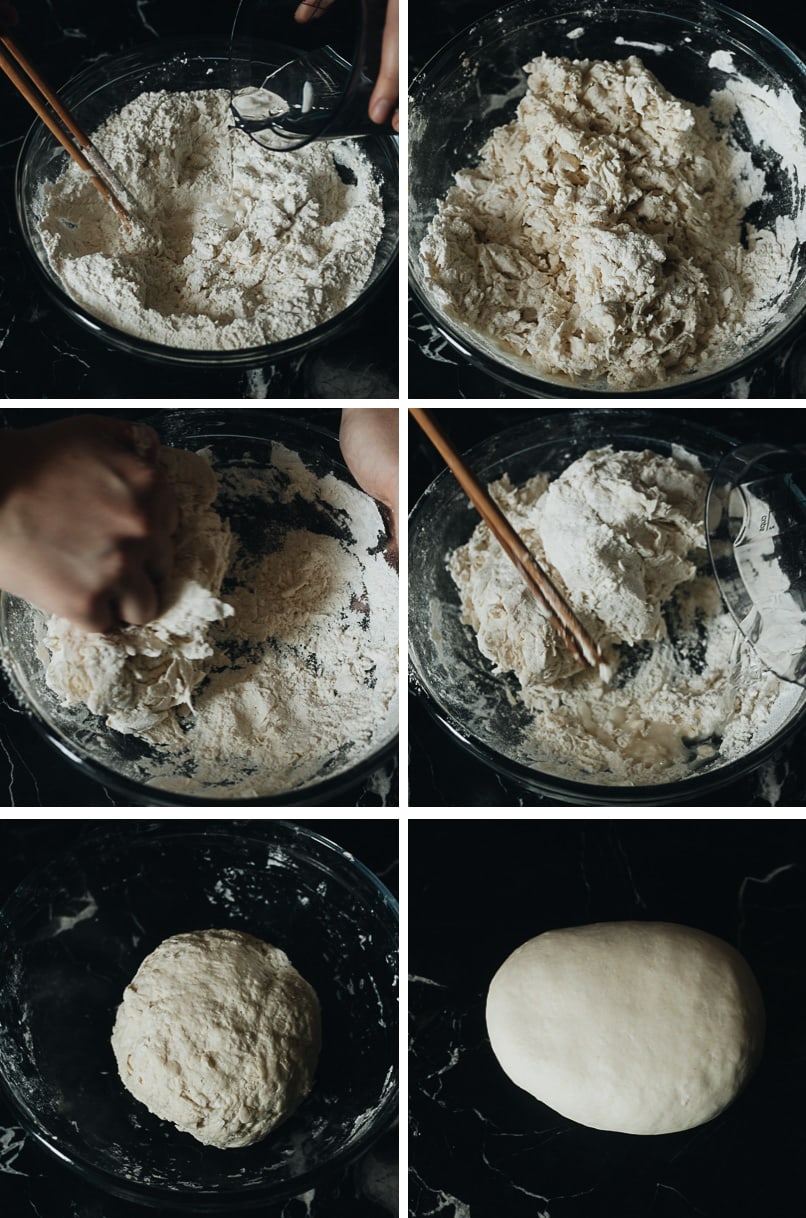
Mix the dough: Slowly drizzle the salt water into the flour while mixing. Continue until the water is fully incorporated and the flour forms shaggy threads.
Knead: Bring the dough together and knead, adding a small amount of water if dry flour remains. Continue kneading for about 2 minutes until a rough ball forms, taking care not to overwork the dough.
Rest: Let the dough rest for 20 minutes before kneading it again, for just 1 to 2 minutes, until the dough becomes smooth.
2. Shape the dough – 2nd resting
Roll out the dough depending on the type of noodles you want to make and let it rest for 2 hours to fully relax the gluten before pulling and cooking.
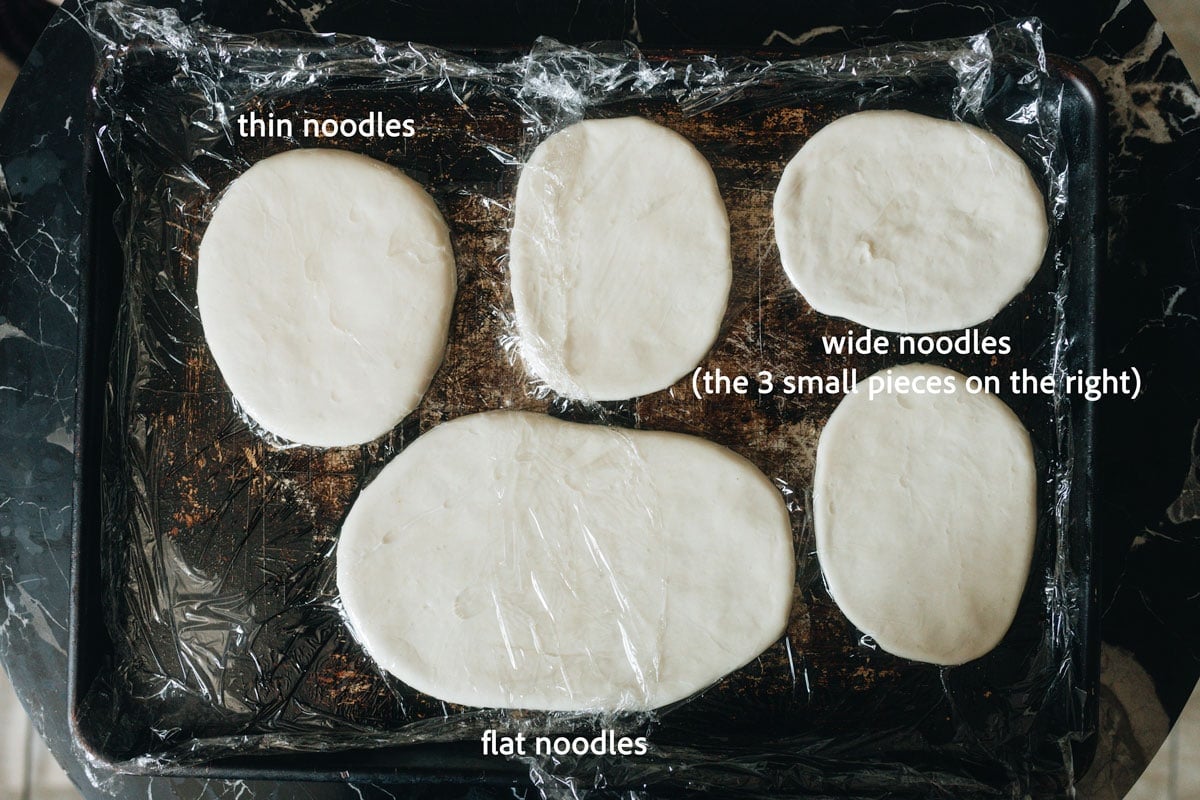
I’ve included three types of noodle doughs in this recipe, so you can choose the type you prefer:
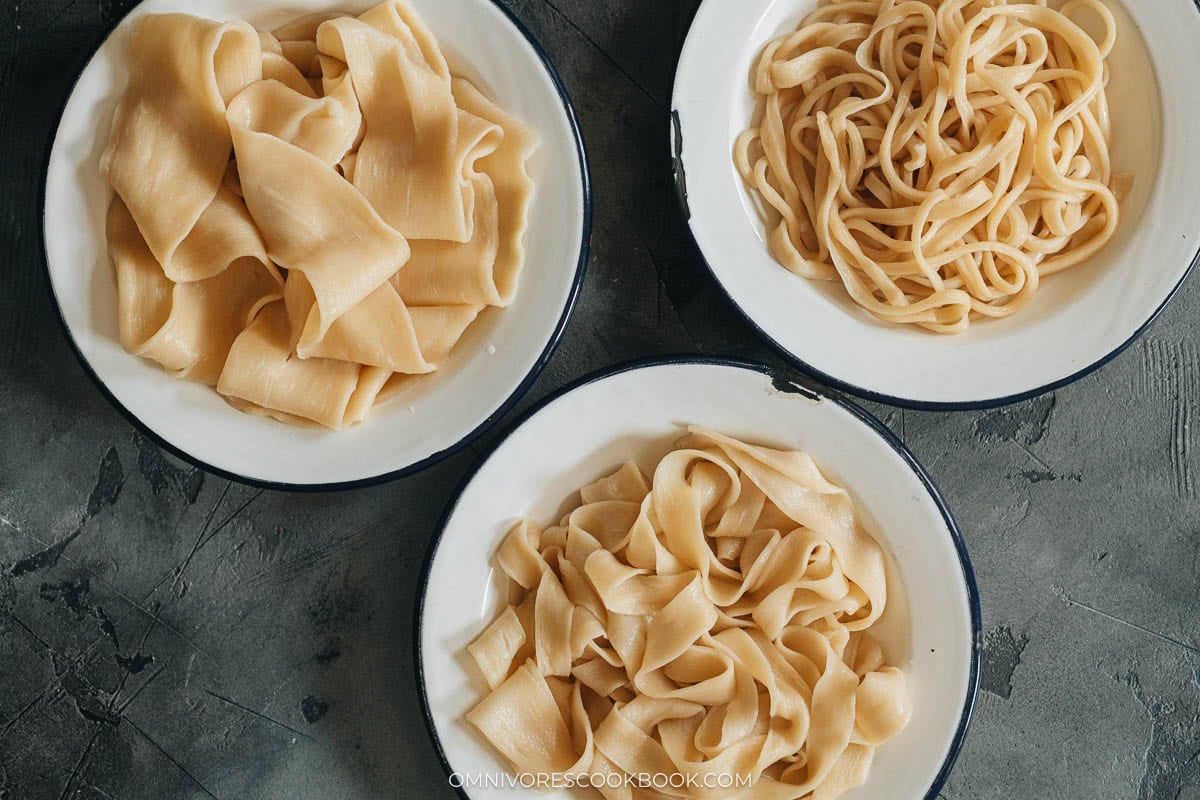
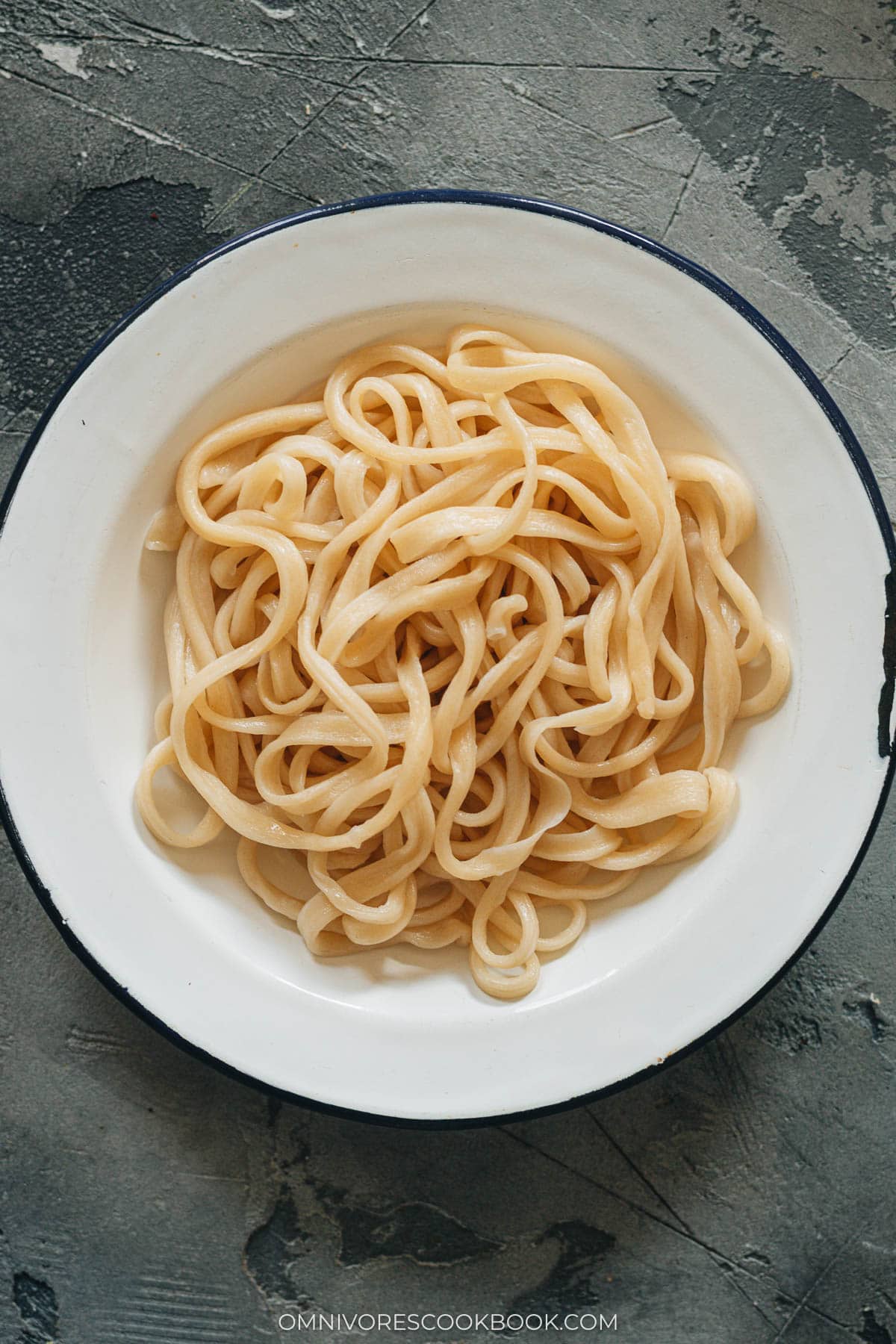
- Thin noodles: great for noodle soup, fried noodles, or lo mein noodles
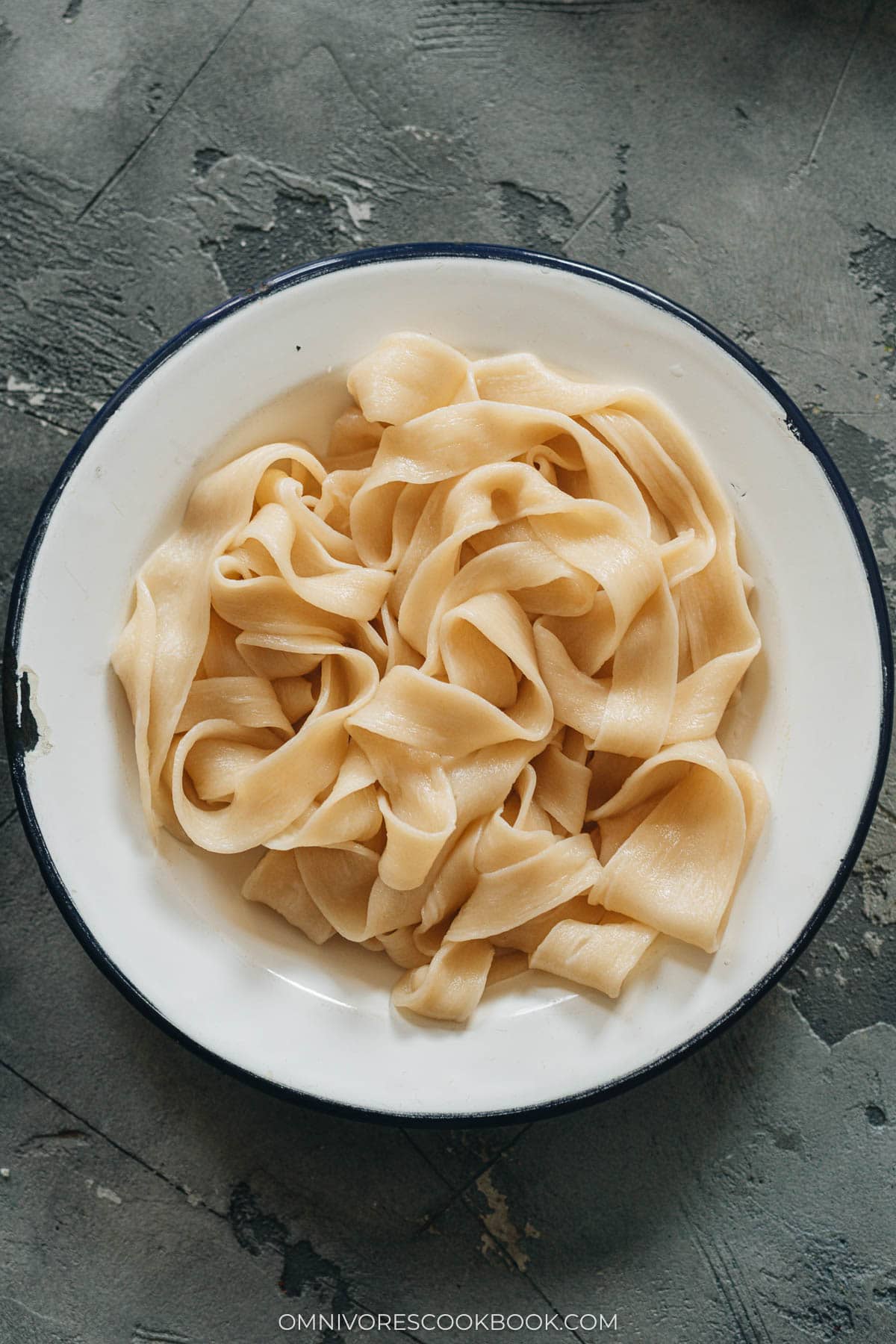
- Flat noodles: good for noodle soups or noodles served with a sauce
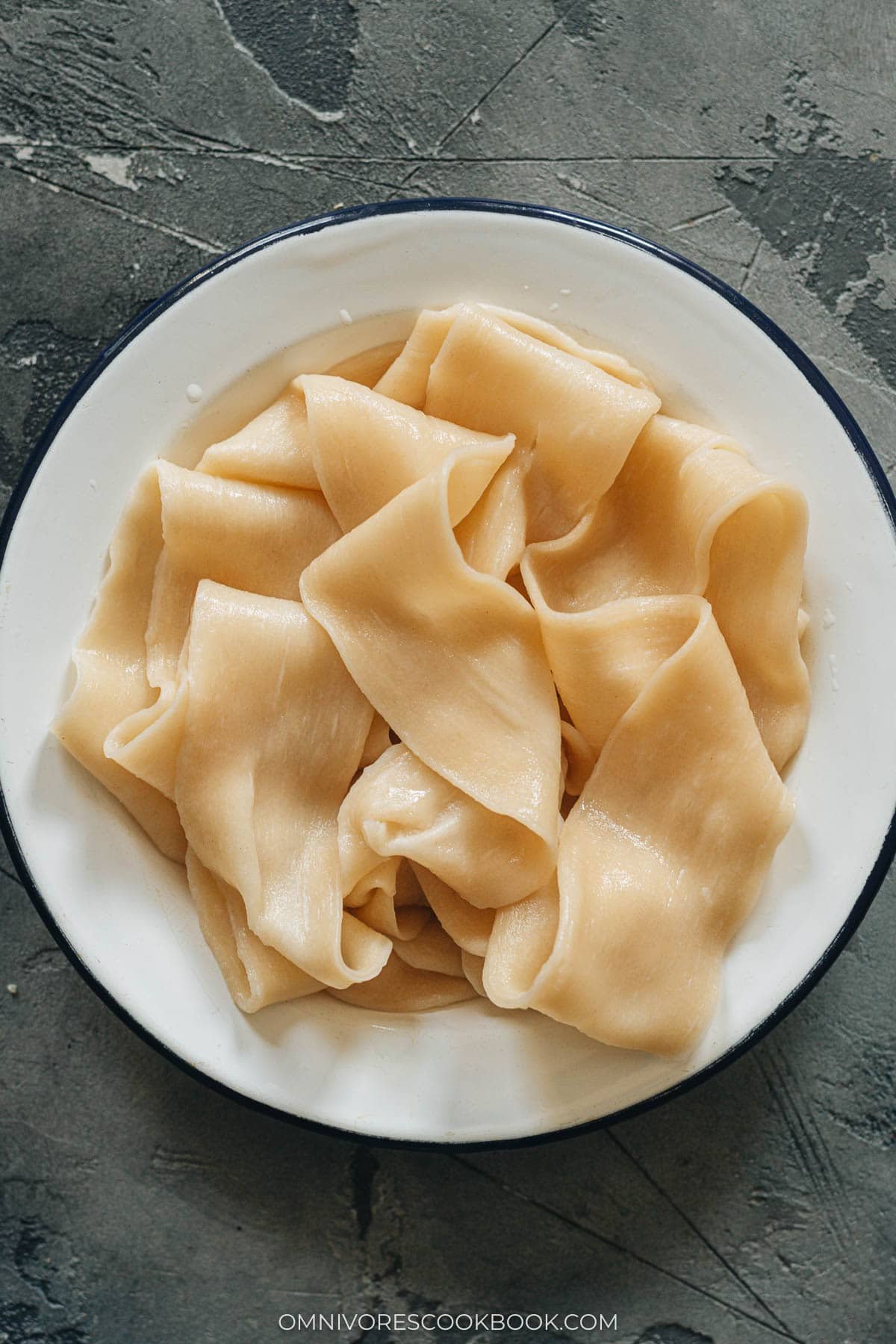
- Wide noodles: good with a super heavy sauce such as cumin lamb or da pan ji
Note: Oil the dough and cover it to prevent sticking and drying out.
3. Pull the noodles
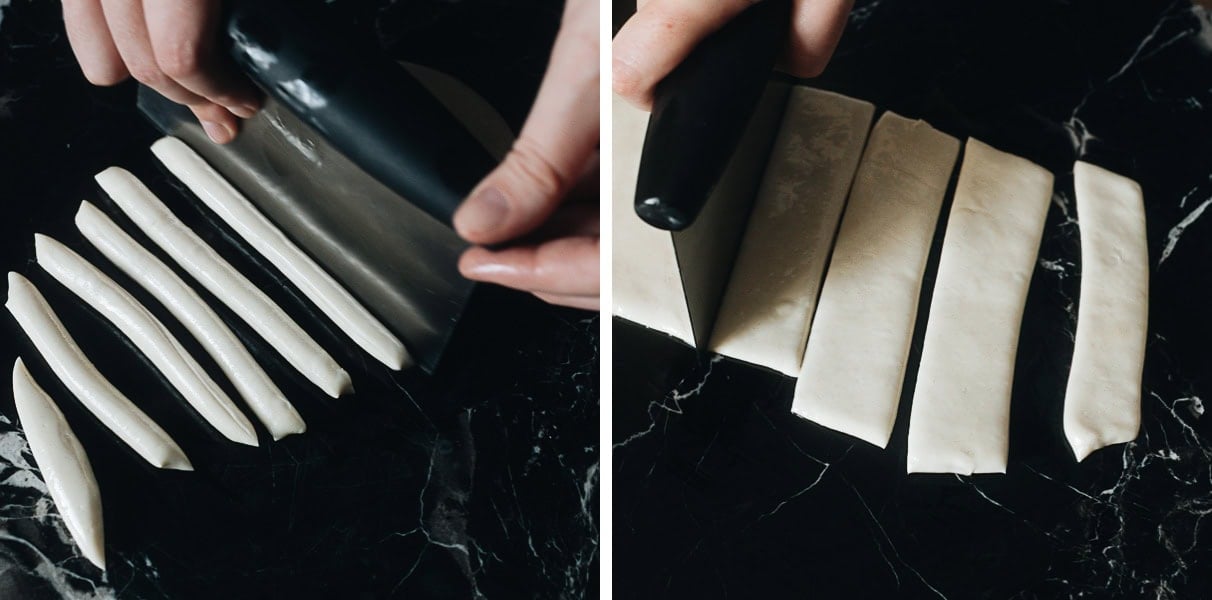
Cut the dough: Cut the dough into pieces based on the width of noodles you want to make. It’s important to keep the cut noodles covered with plastic wrap so they don’t dry out.
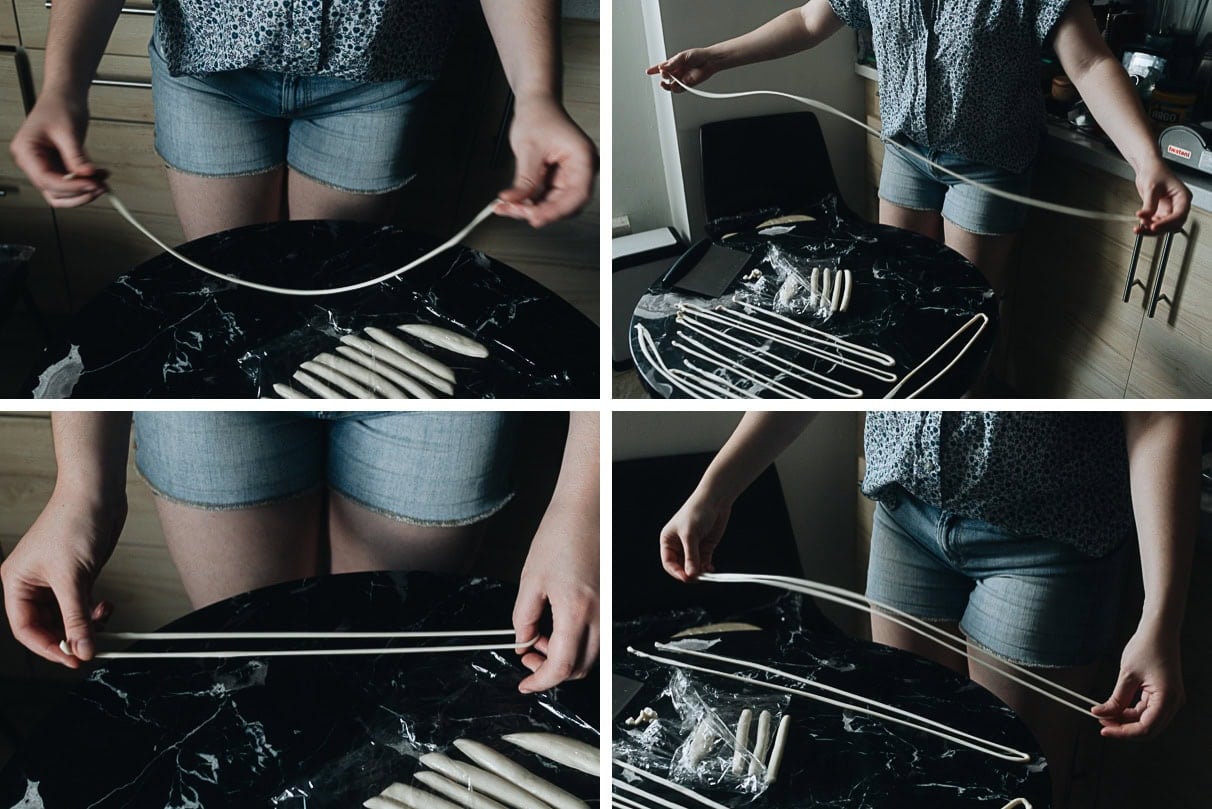
Pull: Pull the dough into a long thin strip in one motion, then continue pulling and bouncing it on the table to stretch it thinner. Fold the strand, then pull and bounce again until it reaches the desired thickness, except for flat or wide noodles, which do not need folding.
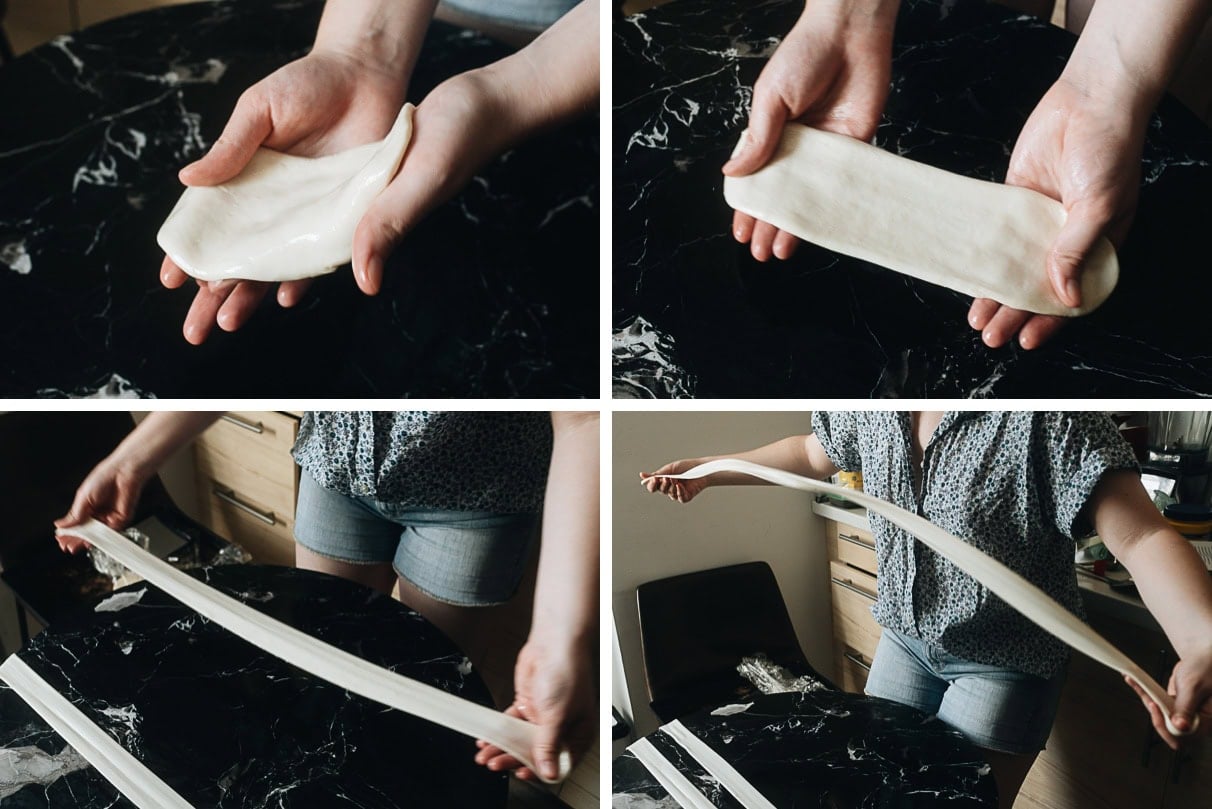
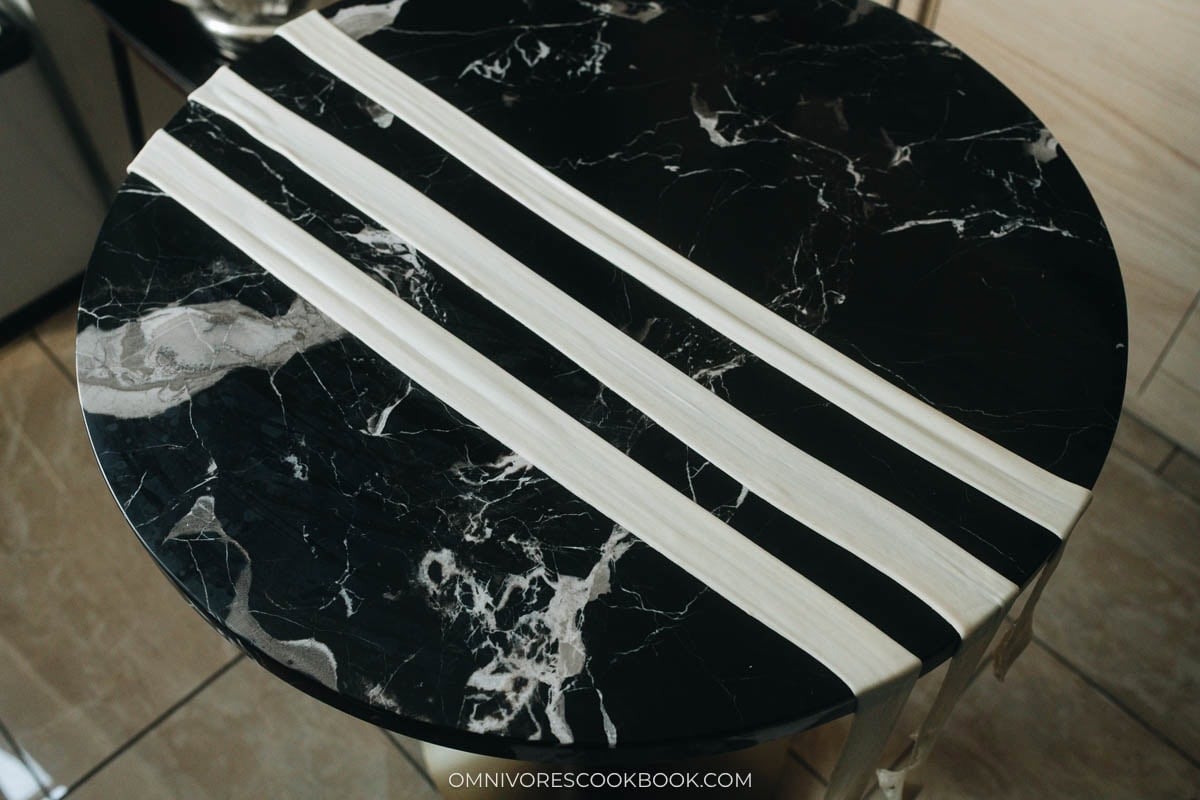
Rest: Place the pulled noodles on the work surface without overlapping. If space is limited, lightly dust them with flour so they do not stick when placed close together.
4. Cooking
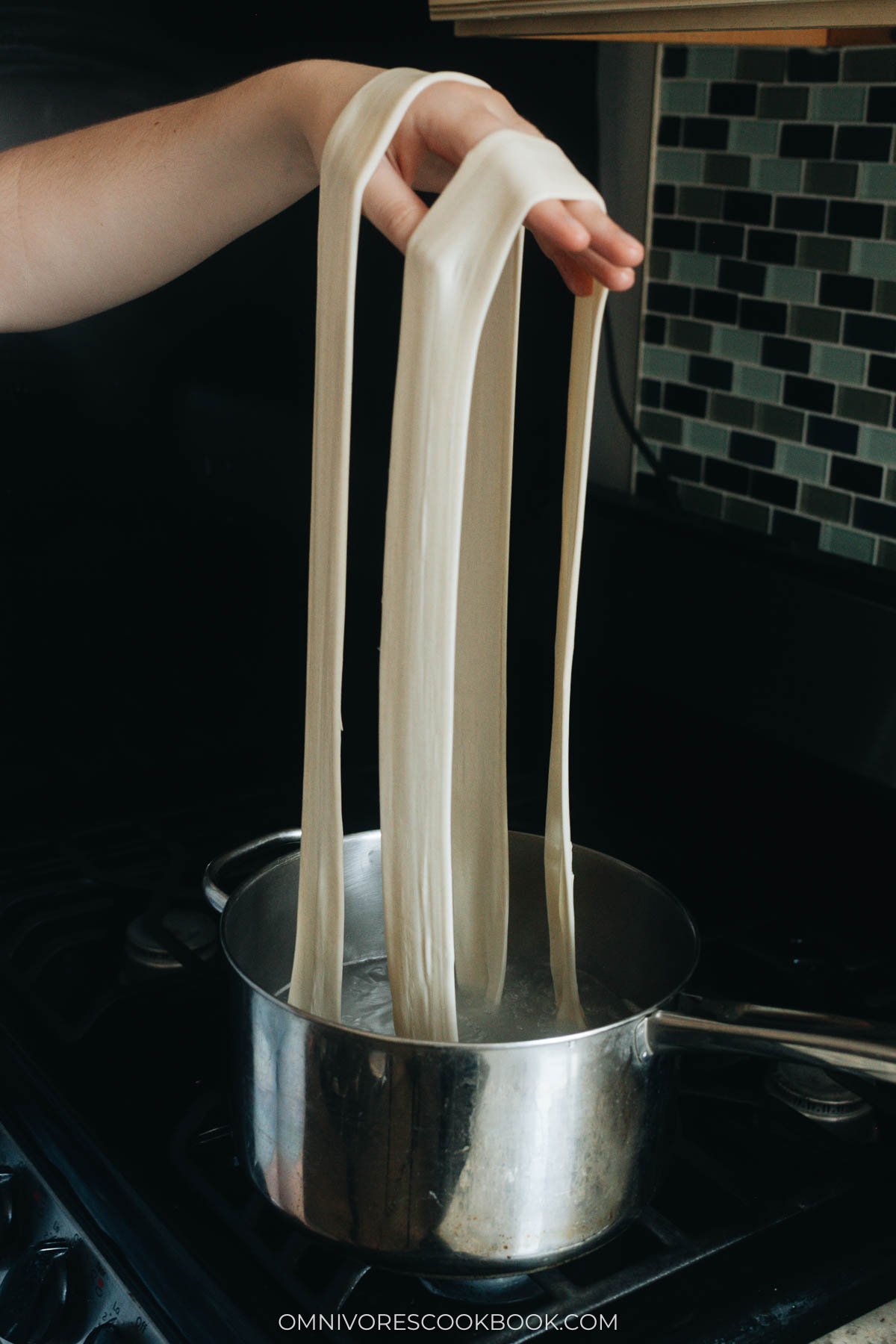
Boiling: Drop a few strands of noodles into boiling water at a time and cook until they are cooked through and springy, boiling slightly longer if a softer texture is preferred.
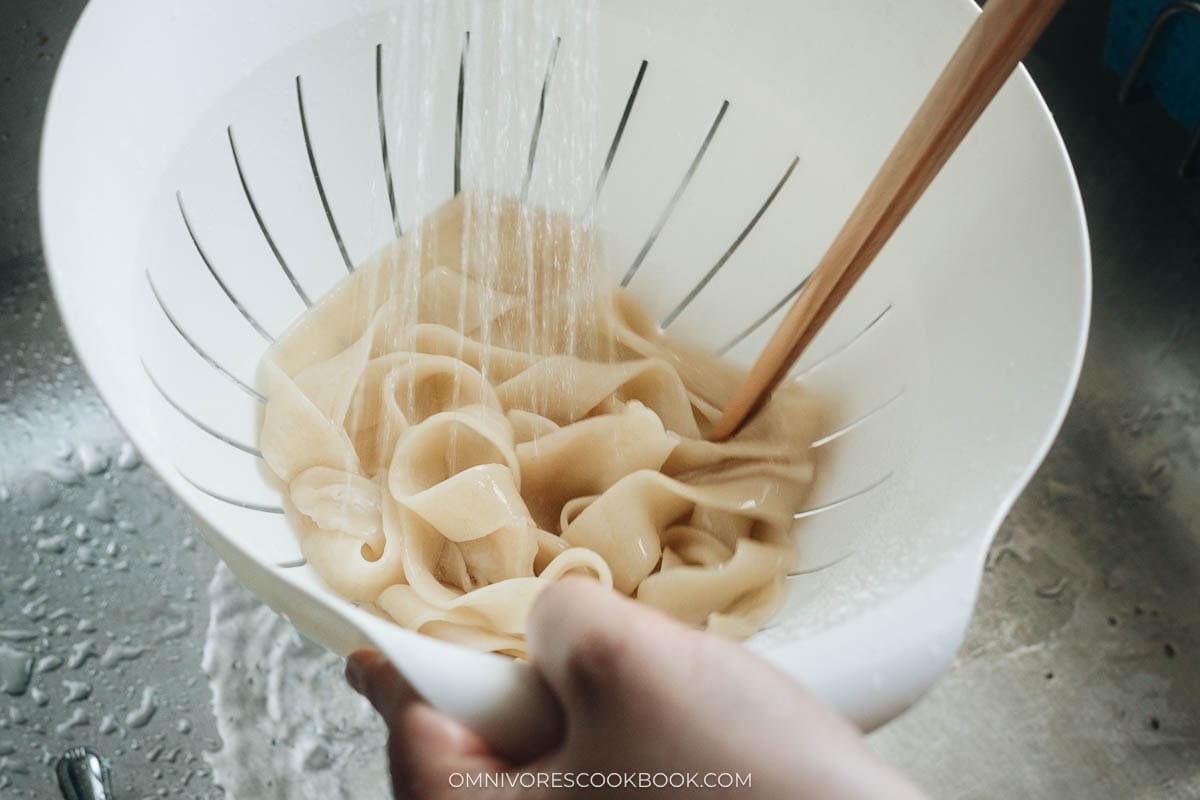
Rinse the noodles: Transfer the noodles to a colander and rinse with tap water to stop the cooking.
Recipe update notes
I created this recipe back in 2015 while I was still living in China. It’s a family recipe and I created a short hand pulled noodles video to show the process.
Over the years, I have received many positive comments and questions from readers. After moving to the US, I also realized that all purpose flour here is different from the flour commonly used in China, mainly because it has higher protein content.
That is why I decided to retest the recipe using various types of flour in the US and slightly refine the process, so the results are more consistent and closer to ideal each time.
Serving suggestions
When I serve hand pulled noodles at home, I keep the focus on the noodles by pairing them with simple sauces like my easy peanut nodles or my real deal sesame noodles. When I’m hosting, I enjoy using them in my Dan Dan Noodles recipe or Biang Biang Noodles to create a satisfying noodle focused spread.
Frequently asked questions
Can I store the raw hand-pulled noodles?
Unfortunately, NO. It’s very important to cook the noodles immediately once you’ve pulled them. In fact, the pulled noodles should be dropped directly into boiling water (that’s how they do it at restaurants). If you want to store the raw noodles, you must use starch (or flour) to coat them so they won’t stick together. But the dough will change in texture during this process.
If you want to store raw noodles, check out my rolled noodles recipe.
Can I store the cooked noodles?
YES! This is the best way to store them. You can slightly undercook the noodles if you plan on storing them. So they reach the perfect consistency once they’re reheated. You can see more notes on how to reheat in the recipe card below.
Can I store the noodle dough?
Yes. Once you roll out the dough and let it rest at room temperature for 2 hours, you can cover the dough and move it to the fridge. Cut, pull, and boil the noodles when you plan to serve them.
What brand and kind of flour did you use?
I tested with various brands and types of flour and finally achieved a consistent result no matter what brand we were using. In the pictures I used all-purpose flour from the King Author brand (11.7% protein content).
I also tried a mixture of 370 g (3 cups) of cake flour and 30 g (3 tablespoons) of bread flour. This mixture produces a slightly smoother dough (marginally). It’s possible to use different blend to achieve different texture, even 100% bread flour, but I do not recommend using 100% cake flour.
I saw professional hand-pulled noodles use alkaline water. Why don’t you use it?
Using alkaline water in the noodle dough increases the chewiness of the texture and it doesn’t affect the pulling process. I found that even if you skip the alkaline water, you will produce a great result with a chewy texture (without the noodles getting too tough). So I decided to skip this ingredient, which makes the recipes a bit more complicated.
Chinese Cooking Made Easy
Are you new to this website? This free email series is a great place to start. I’ll walk you through a few of my most popular recipes and show you how and why they work. You’ll quickly start to cook better Chinese food in your own kitchen.
Watch video
Hand-Pulled Noodles
Ingredients
- 2 2/3 cup all-purpose flour (*Footnote 1)
- 1/2 teaspoon salt
- 1 cup water , room temperature
- Vegetable oil to coat the dough
Instructions
Make the dough by hand (Option 1)
- Combine the water and salt in a small bowl. Stir to dissolve the salt.
- Add the flour into a large bowl. Bit by bit, pour the water into the flour, mixing with a pair of chopsticks or a spatula as you go.
- Once all the water is added, the dough should be in shaggy threads with little/no dry flour in the bowl. Begin pressing the dough together. If you find the dough is too dry and there’s still dry flour that’s hard to incorporate into the dough, drizzle more water onto the dry flour and mix it again, until there’s no dry flour left. Knead the dough until a rough, firm ball is formed, about 2 minutes.
- Cover the bowl with plastic wrap and let it rest for 20 minutes.
- Once the dough is rested, knead it again until it becomes smooth, 1 to 2 minutes.
Make the dough using KitchenAid (Option 2)
- Mix the flour and salt in the bowl of the KitchenAid mixer and add the dough hook. Turn it to the mix setting. Slowly drizzle the water down the side, all along the bowl. This should take about 1 minute. Once the water is incorporated, turn to setting 2 and knead until a rough dough ball is formed, another 2 to 3 minutes.
First rest
- Cover the dough with plastic wrap and let it rest for 20 minutes.
Second kneading
- Either knead in the machine on setting 4 for 30 seconds or by hand for 1 to 2 minutes. Then shape the dough.
- (Optional) If you plan to store/freeze the dough, coat the dough with oil and store it in a sealed plastic bag. Refrigerate for up to 2 days or freeze for up to 3 months.
Shape the dough
- FOR THIN NOODLES: Divide the dough to halves and roll each dough into a 1/2” (1 cm) thick oval.
- FOR FLAT NOODLES: Divide the dough to halves and roll each and roll each dough into a 1/4” (1/2 cm) thick oval.
- FOR WIDE NOODLES: Cut the dough into 8 pieces. Roll each piece into approximately 3”x5” (8×13 cm) ovals, 1/4” (1/2 cm) high.
Second rest
- Coat the dough(s) generously with oil and cover with plastic. Let rest for 2 hours.
Pull and cook the noodles
- Bring a medium-sized pot of water to a boil.
- FOR THIN NOODLES: Cut long the longer side of the oval, slicing the dough into 1/2” (1 cm) wide strips and rolling each piece slightly to the side with each cut to prevent them from sticking together. Cover the cut pieces with the plastic again to prevent them from drying out. Starting with the first strip you cut off, pick it up on both ends. (*Footnote 2) In one swift motion, tug the noodle about an arm’s length and gently bounce it on the working surface once or twice until it forms a long, thin noodle. Rest the noodle on your working surface as you fold it over, so that both ends are in one hand. Hook the other side with your thumb. Give it a couple light tugs and bounces until the noodles get longer and reach the desired thin shape. Then pull off the thick ends collected in one hand and lay the noodle out on the working surface. Repeat with the rest of your noodles.
- FOR FLAT NOODLES: Cut along the longer side of the oval, slicing the dough into 1 1/2” (3 cm) wide strips. Cover the cut pieces with the plastic again to prevent from drying out. Starting with the first strip you cut off, pick it up on both ends. (*Footnote 2) In one swift motion, tug the noodle to about an arm’s length and gently bounce it on the working surface once or twice. Rest the noodle on your working surface for 10-20 seconds, then give it a couple extra-light tugs and bounces until it forms a flat long noodle. Then pull off the thick ends and lay the noodle out. Repeat with the rest of your noodles. Drop the noodles into the boiling water, a few at a time, and cook for 1 to 1.5 minutes.
- FOR WIDE NOODLES: One at a time, grip the short ends of a strip (*Footnote 2) and pull it apart in one swift motion until the dough feels taut. It should be between 1 to 2 feet. Bounce it on the table a couple times. Pull off the thick ends and lay the noodle out, covering it with plastic to prevent drying out.
Cook the noodles
- Drop the noodles, a few pieces at a time, into the boiling water and cook for 1 to 1.5 minutes, until tender but still with a chewy texture. Do not cook too many noodles at a time! It’s hard to control the texture that way and the noodles might stick together.
Storage
- Store the cooked noodles: If you plan on reheating, you can slightly undercook the noodles (to al dente) to create a better texture once reheated. Store the noodles in an airtight container or a ziplock bag in the fridge for up to 3 days or in the freezer for up to 3 months.
- For frozen/refrigerated dough; let the frozen dough thaw in the fridge overnight. Transfer the refrigerated dough to room temperature. Rest for 2 hours. The dough will become super soft and can be gently shaped, rested for another 10 minutes or so, and pulled. Cook according to the instructions above.
Reheating cooked noodles
- To reheat, bring a pot of water to a boil and add the cooked noodles. Separate with a pair of chopsticks and cook until the noodles are just heated through.
- For a quicker and lazier reheating method (for leftovers), reheat the refrigerated noodles in the microwave until heated, then quickly rinse the noodles with tap water in a colander. Drain the water thoroughly before serving.
- If you plan to use the thin noodles for fried noodles, you don’t need to reheat them before using. Thaw them if frozen. Then run the noodles with tap water in a colander and separate gently with chopsticks. Drain thoroughly before using for stir fried noodles.
Notes
- If you do not have all-purpose flour, you can use 370 g (3 cups) cake flour + 30 g (3 tablespoons) bread flour instead.
- If you do not have a lot of space for the pulled noodles or if you’d like to try pulling a few noodles at a time (it takes practice but it’s possible!), you should dust the noodle dough with extra flour to prevent them from sticking together.
Nutrition

Did you make this recipe?
I’d love to hear how it turned out for you! Please take a moment to leave a 5-star rating ⭐️ and share your thoughts in the comments further down the page. It really helps others discover the recipe too.
Lilja Walter is a part of the Omnivore’s Cookbook team and worked closely with Maggie to develop and test this recipe.
Such
Hi! These look great and easy to try. Do they work in a stir-fry? Perhaps with some chilli oil, vinegar, soy and veggies? Or would you recommend that one eat them only in a broth? Would stir-frying ruin the texture?
Thanks!
Maggie
The noodles are a bit more fragile than packaged noodles, so I usually don’t use them in the stir fry. You can definitely try stir fry with them, but only add them add the end and give some gentle tosses. For the vinegar, soy sauce, chili oil, and veggies combo you mentioned, you can actually make a great noodle with hot sauce (like this https://omnivorescookbook.com/biang-biang-noodles). It is almost like making a stir fry, but you mix the sauce in your bowl instead of in the pan.
Happy cooking and let me know how the dish turns out 🙂
JANICE
You never cease to amaze me dear Maggie…I must try this. My mom always made her own noodles (pasta) and there’s nothing to compare as to homemade. We need to open a Asian food truck! Yay! Keep up the good work my friend.
Maggie
Homemade noodles are the best aren’t they? We do need to open a Asian food truck and spread the love of noodles 🙂
I’m glad to hear you decided to try this out. Happy cooking and have a wonderful week!
Gloria love
I have made noodles for years ( Polish mother) but I cut them different and it is a lot of work, can’t wait to try your method, thanks so much
Linda @ Roti n Rice
I have never tried making my own noodles. I will have to try it sometime. You make it look easy.
Frank A. Lojewski
Are you Maggie Vermillion (Zhu, Chu)? My wifeepoo is that red color Chu.
Anyhow, I have tried noodles with Canadian wheat flour and even after aging, still would not “pull”. This is probably due to the high protein content?! I read that cake flour is the better choice, something I am unable to obtain here. Any suggestions?
As to ribbon dance noodles, I saw one performed in Chengde, but this young man was not merely athletic, he was artistic enough to head a ballet group! But I did not bring a camera to the restaurant, darn!
Maggie
Hi Frank, I’m Maggie Zhu. Yep, the color red.
I’m sorry to hear the recipe didn’t work out for you. How long did you rest the dough? It always takes longer if your room is cold. To answer your question about the flour type, actually the flour with higher gluten content works better. We never used cake flour to make these noodles. The normal wheat flour (I use all purpose one) should work. The only solution I can think of, it’s to let the dough rest longer. It will get tenderer over the time, and become able to pull.
This is not the type of the noodle for the noodle dance. To make the dance noodles, you need to blend alkaline and oil into the dough, so it becomes resilient and holds together when being pulled faster (similar type of dough to Japanese ramen). It’s a bit trouble for everyday cooking, so I posted this version instead.
Isn’t it true that we spent money on a good camera, but it’s never next to us every time we need it? I mostly use phone these days. And for a fast noodle dance, I’d choose recording a video instead 😉
Anton
Hi Maggie, I’ve been looking for an opportunity for about a year to make noodle dough like in “noodle dance”. But I can’t find a suitable recipe on Russian-speaking sites (((the only thing that Chinese and Russian / American flour found was very different in gluten). I tried your recipe above and it worked out, it’s great, thanks a lot! However, if you can, you can teach or a blog about how to make noodles from dough with butter and alkaline water?
Sorry for my english. Translated through Google transliteration.
diane rose brown
hello meg, is it possible to purchase fresh or frozen dough pre-made? for the arthritic or just plain lazy person? Diane
Maggie
Hi Diane, I dough you can find the fresh pre-made dough. The best way is to using a mixer (I use my KitchenAid) to knead the dough. You simply need to add the three ingredients and turn on the machine. The dough will be ready in 15 minutes.
Meg
I made these last night and wow, they were amazing. Your recipe and instructions are perfect. I’m hooked. There is a Chinese restaurant local to me that makes the most amazing pork belly noodle soup with hand pulled noodles and I’d eat that every day if I could so it was the best feeling to be able to make them at home!
Maggie
Hi Meg, I’m so happy to hear you tried this recipe and liked it! I always wonder people are so busy these days, so they probably don’t have time to make noodles from scratch. The fresh ones taste really different don’t they? I have a pork belly recipe here: https://omnivorescookbook.com/recipes/authentic-pork-belly-bun I believe the broth and the pork will be a nice addition to these noodles 🙂 I want to try the pork belly noodle soup too. It sounds so delicious!
yudi huang
Hii Maggie, I’m Yudi. I would like to make hand pulled noodles and vegetarian dishes by asian and chinese food recipes.
I hope you will be pleased me to see and use your practiced recipes.
I see your web give a step by step to cooking with detail. I’m so interested.
And permit me to rewrite it on my book and permit me to try it too. Thank You
Maggie
Hi Yudi, I’m happy to hear you like my recipes and would like to try them out! Of course you can rewrite the recipe, as long as you use your own words. Let me know how the cooking goes 🙂 Have a nice day!
Leon
Thank you very much for this recipe.
My first attempt failed. I chose the option to let the dough rise overnight in the fridge. This made the dough very firm and difficult to pull, even after bringing back to room temp.
The second attempt was much better. I let the dough rise at room temp, which made the dough much more pliable. However, I couldn’t get the dough as thin as yours. Though elastic, the dough would lose it’s width and become thin noodles when stretched. I will experiment with a flatter dough cut into thicker strips next time.
I should add that a roaring boil was essential to cooking the noodles. I started with a large pot that couldn’t hold a boil and I was left with a dissolved exterior. The roaring boil gave the noodles a chewy texture.
Thanks again for the recipe. I really enjoy and appreciate your blog!
-Leon
Maggie
Hi Leon, thanks so much for the feedback! These suggestions are super helpful.
I didn’t explain it well, about storing the dough in the fridge. I was meant to say – let the dough to rest at room temperature first, and then transfer and store in the fridge if you won’t use it at the same day.
The “roaring boil” description is very accurate. I have updated these two points in the recipes. Many many thanks for this input!
To create wide noodles, you do need to cut them to wide strips. They do become thin when stretched. Have you tried to let the dough to rest a bit longer? You should able to get thin dough, if you pull them slowly and gradually, from one end to another.
Keep me updated if you will cook this again! I’m really glad you tried my recipes 🙂
Have a super day!
Kathy
I had problems with the dough as well. I let it rest for over 2 hours at room temperature (after kneading well until it was smooth) and the dough only stretched so far, then broke. I found I could very, very carefully make thick-ish noodles by cutting very narrow strips and gently stretching, but there was no way I could make thinner noodles (or flat ones). Thicker strips broke pretty quickly. The dough was slightly stretchy, but fought against pulling. I used AP flour (in the US) with a little bit of cake flour to decrease the amount of protein.
Maggie
Hi Kathy, I’m sorry to hear the recipe didn’t work out for you. Could you let me know the brand of the flours (both AP and cake) you used? I might be able to get them and retest the recipe for troubleshooting.
For this recipe we tested three American flour brands and they all worked. I wonder if it’s caused by the brand.
Lokness @ The Missing Lokness
I don’t know how I completely missed out on this recipe! WOW! Just wow! I agree that handmade noodles are much better than store bought! Totally need to give this a try some day!
Sarah
Hi Maggie! This recipe is great! I am from the Shanxi province, and my family loves hand-making our noodles. 🙂 So happy to see you like hand-made noodles too. The video is very helpful!
Prash @ YummilyYours
WOW! WOW! you make it look so simple! I am going to try this soon but a small batch though may be just the 3-4 strips of dough? I am quite skeptical about me pulling it off! 😀 I will let you know how it turned out with pictures! 🙂
Maggie
Hi Prash, yes, you can definitely try half batch (200 grams flour). This one is really easy and I’m pretty sure you’ll pull the noodles successfully for the first try. Definitely let me how how it goes and really looking forward to see the pictures! Hope the cooking goes well 🙂
Michelle @ Vitamin Sunshine
Wow– you make that look so easy! Homemade noodles are the best 🙂 And Asian noodle soups.. oh my!
Christine | No Gojis No Glory
$3-$4 for a big bowl of noodles?! Try $7-$12 here; and that’s in “China town” where it’s supposedly cheaper. I think I can get like two spring rolls for $3.00. lol But this is really cool Maggie, and I had no idea it was so easy. Would this work using wheat flour?
Janette@culinaryginger
I’m always in awe when I see hand pulled noodles being made and well done for being able to do this. I want to try this, but I would need someone right there to guide me.
Allie | Baking a Moment
Wow- who knew hand pulled noodles could be so simple! So much great info here; love the video too!
Patty
I love these! Your boyfriend and I ended up making hand-pulled noodles when I, too, failed to make a dough-block hearty enough for my noodle-knife a few years ago. The chicken-mushroom stew recipe you gave him to accompany it was phenomenal.
Maggie
Hey Patty, it’s interesting to hear that you came across the same situation 🙂 Also thank you for letting me know that the noodles go well with the chicken and mushroom stew. I never thought of this combination, but will definitely try out! By the way, I’m still looking for a way to work out the tough dough to make these hand shaved noodles. Will let you know when I figure that secret out!
Thomas
It wasn’t the recent chicken mushroom stew, but the family secret pork-mushroom-yellow-flower-shrimp one, with chicken in place of the pork. Who knows, maybe we’ll see that recipe here soon? 😉
Maggie
Oh I see, I understood it wrong. Yep, that one will up on the blog soon! 🙂
Nagi@RecipeTin Eats
NO WAY!! YOU ROCK! I have never ever made my own noodles but now I am going to try! You’re a legend Maggie!! 🙂
Marissa | Pinch and Swirl
This method is entirely new to me, Maggie!! I’m so intrigued. Thank you for going to so much trouble to show us all how to make these!!
Shinee
Awesome tutorial, Maggie. Thank you! Can’t wait to make my very own hand pulled noodles.
Rachelle
Wow! I love hand pulled noodles and these look delicious! Do you have any recipe recommendations for how to serve them? I love them with spicy sauces and in meaty soups.
Do you recommend eating these cold at all? One of my favorite dishes is noodles served cold with spicy oils and other dressings.
Also, what temperature do you recommend the water be at when adding it to the flour? Some recipes call for very cold/hot water, but I didn’t know if that mattered for this dough.
Thanks!
Maggie
Hi Rachelle, I’m so glad to hear you like hand pulled noodles! I have a new noodle soup recipe coming this Friday. It uses a beef broth with chili oil. I will drop you another note when the recipe is published. I also have a recipe that uses tomato and pork stock as broth. You can find it here.
Yes, you can definitely serve these noodles cold. What you can do is, after boiling the noodles, rinse them with cold water immediately, so the noodles will cool down fast and still be fresh. I like to add chili oil and peanut sauce in the noodles! (I have a cold noodle recipe here.)
Sorry I forgot to specify about the water. You should use room temperature water in this one. Thanks for reminding me this and I will add this information into the recipe now!
Many thanks again Rachelle, it’s a great idea to add some noodle sauce recipes in this post, so I can show my readers how to serve the hand pulled noodles. Really glad you pointed it out 🙂
Happy cooking and let me know how the noodles turn out! 🙂
Maggie
Hi Rachelle, just want to let you know that I’ve posted a beef noodle soup, which you can use to serve the hand-pulled noodles. You can find the recipe here => http://104.236.198.25/recipes/lanzhou-beef-noodles
Hope this will be helpful.
Francisco
Hey! Thanks for sharing this! It’s really lovely to learn to do new things, I’m from Argentina and I’ll soon be enjoying the very same noodles you make over there!! That’s crazy, so thanks a lot!!!
Anyway, I wanted to ask you, is this recipe viable with rice flour? Or is it meant to be done with wheat??
I really want to eat alternative (to westerners such as me) pasta as I find wheat to have several issues, such as celiac cuisine and others.
Thanks!!!
Maggie
Hi Francisco, this recipe is designed for wheat flour and unfortunately rice flour won’t work. Rice flour is gluten-free, so it uses a totally different process to make into rice noodles. Would love to look into developing a rice noodle recipe.