

Char siu, which means fork roasted, is a Cantonese roast meat you see hanging in the windows of barbecue shops, glossy and dark red at the edges. Restaurants cook it on long forks over an open fire, and my recipe reworks that method for a home oven and broiler so you get the same sticky glaze and charred edges without any dedicated equipment.
I grew up in Beijing eating char siu at a busy dim sum restaurant called Jin Ding Xuan (金鼎轩), where, unlike in the Cantonese south, one restaurant serves both the roast meats and the dim sum. My usual order was a combo roast platter of char siu and Cantonese roast duck, a few plates of dim sum, and gai lan in oyster sauce, with a bowl of Cantonese wonton noodle soup added when I was extra hungry. After moving to the US I started roasting char siu at home for guests, first on the outdoor grill in Austin, Texas and later in the oven after we moved to New York.
I recently reworked this recipe around a fattier pork shoulder instead of a leaner loin, and I reduce the glaze in a wide pan so it thickens and clings to the meat instead of sliding off. Keeping the sugar lower than most restaurant char siu is key because I prefer it less sweet, and I use maltose to achieve a glossy sticky coating. I recommend to marinate the pork overnight and roast it the next day using my directions below, and you will pull out tender red edged strips your whole family will love.

Ingredients
The one ingredient I would not skip here is maltose, and the rest of the list is a standard Cantonese barbecue marinade. Here is what I use to make this Char siu recipe:

Pork: I recommend using pork shoulder for this recipe because the extra fat keeps the meat juicy through a hot roast and gives me a better result than a leaner pork loin. If I only have loin, I watch it closely and pull it earlier so it does not dry out.
Marinade and glaze base: I mix soy sauce, Shaoxing wine, hoisin, and oyster sauce with sugar, molasses, grated garlic, five spice powder, and salt into one bowl of sauce. I marinate the pork in part of it and set the rest aside, untouched by raw meat, to cook down into the glaze later.
Color: I add a small amount of red food coloring for the classic char siu red, though it is optional. Traditionally the color comes from red yeast rice, so I only use food coloring because that ingredient is hard to find.
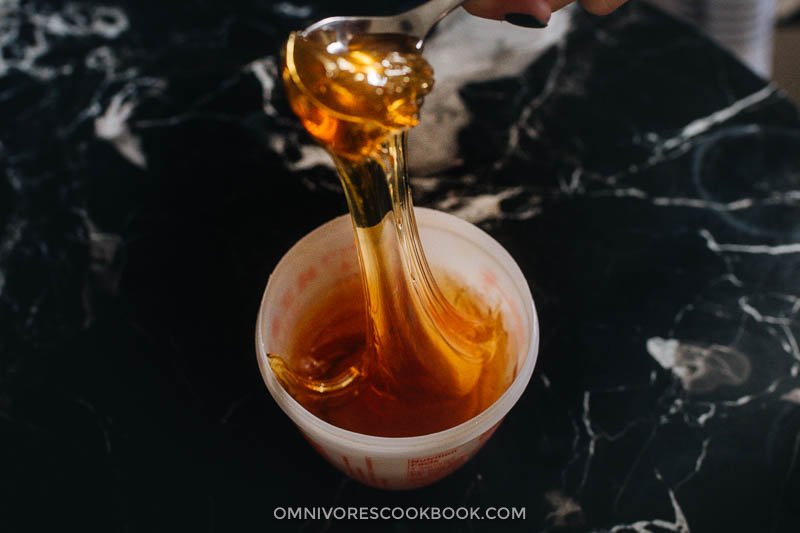
Maltose: I use maltose because it makes the glaze glossy and sticky, and it clings to the pork in a way honey cannot. Honey works as a substitute, but the glaze turns out looser, so I brush on extra or pass more at the table when I use it.
How to Make
1. Cut the pork: Cut the pork along the grain into long strips about 2 to 3 inches (5 to 7.5 cm) wide and 1 to 1 1/4 inches (2.5 to 3 cm) thick. The pieces do not need to be a perfect match, but keep the thickness consistent so they roast at the same rate.

2. Marinate a day ahead: In a large bowl, combine the soy sauce, hoisin sauce, oyster sauce, Shaoxing wine, sugar, molasses, garlic, five spice powder, salt, and food coloring, if using. Stir well. Transfer the pork to a large ziplock bag, pour in 1/2 cup of the sauce, and save the remaining sauce in a jar in the fridge for the glaze. Squeeze out as much air as possible, seal the bag, and massage it so the pork is coated all over. Marinate in the fridge overnight.

3. Make the glaze: Soak the maltose jar in hot water until the top loosens, and warm a tablespoon in the hot water too. Grease the spoon with a thin layer of oil, then scoop 2 tablespoons of maltose into a 9 inch skillet along with the reserved sauce. Heat over medium, stirring to melt the maltose, until it comes to a simmer. Simmer and stir constantly for 3 minutes, until the sauce coats the back of a spoon, then transfer it to a bowl and set aside.

4. Roast the pork: Preheat the oven to 450°F (230°C), or 425°F (220°C) convection. Line a baking tray with a rack and pour a thin layer of water into the tray without touching the rack. Spread the marinated pork on the rack and brush both sides with glaze.
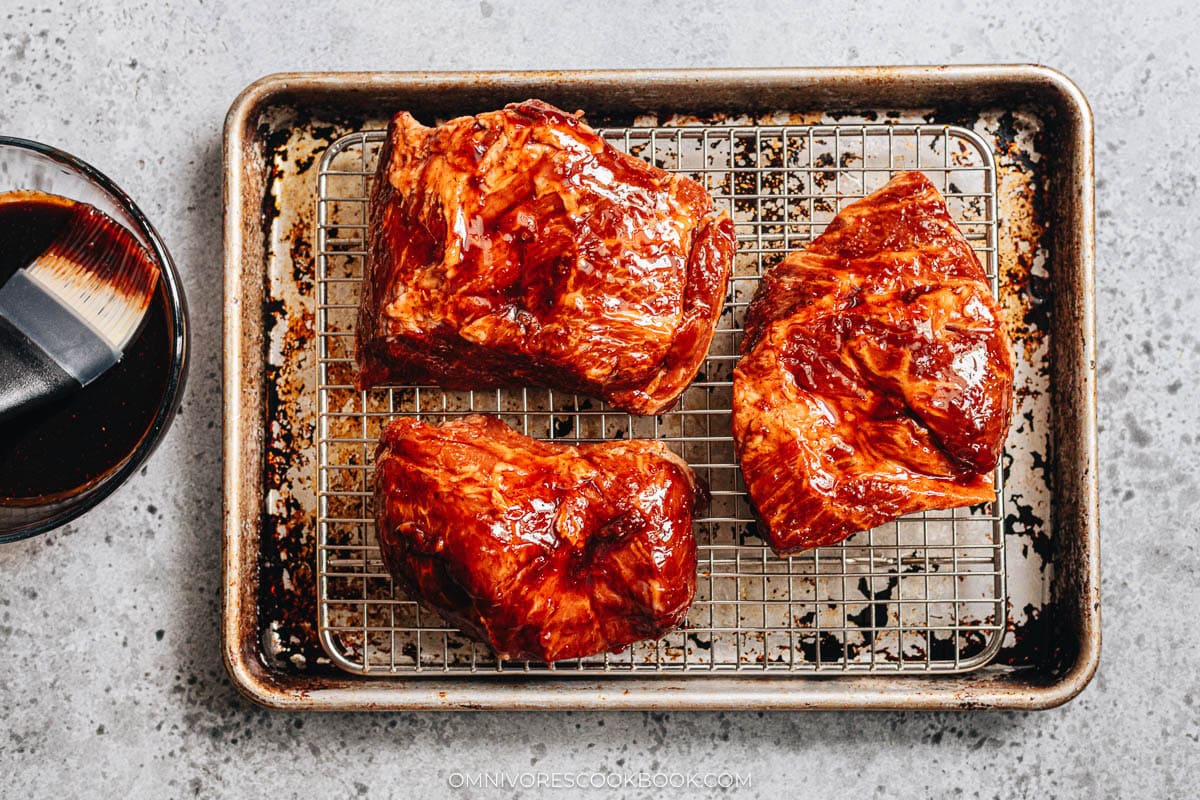
Bake for 5 minutes, glaze both sides again, and bake for another 5 minutes. Check the thickest part with a thermometer, which should read 140°F to 150°F (60°C to 65°C), and roast longer if needed.
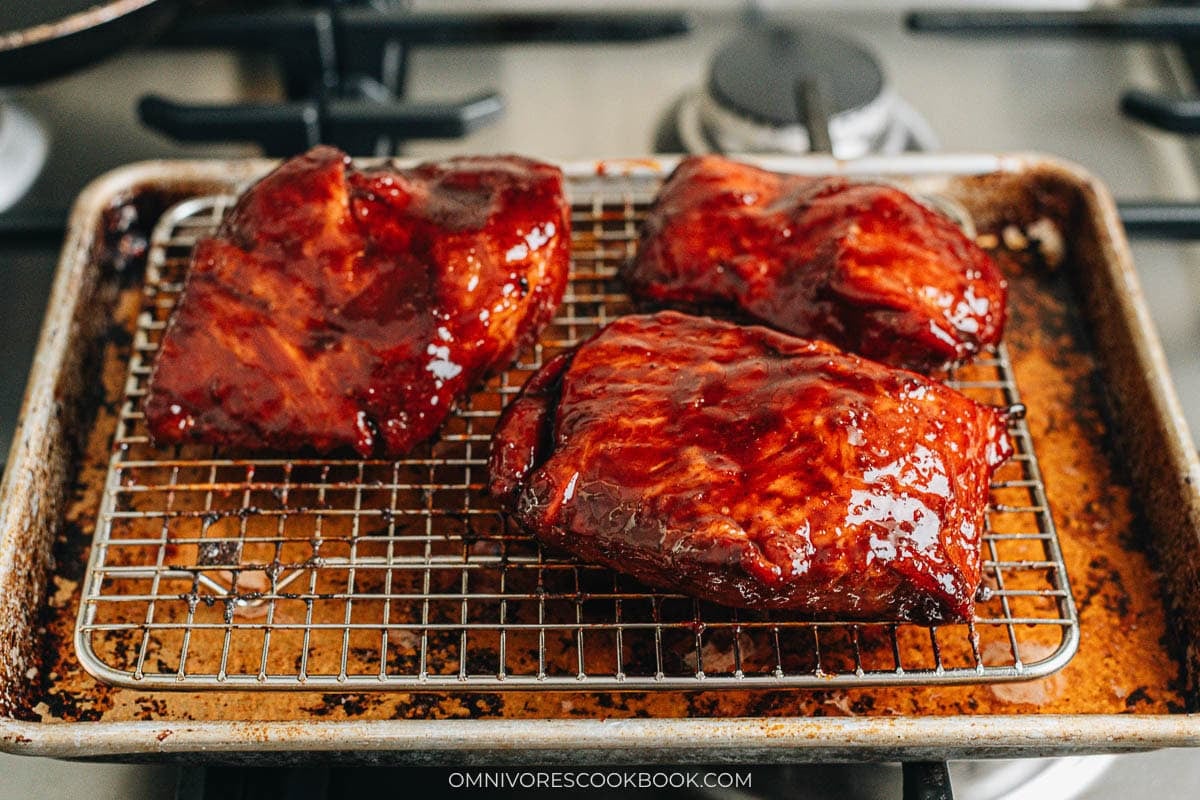
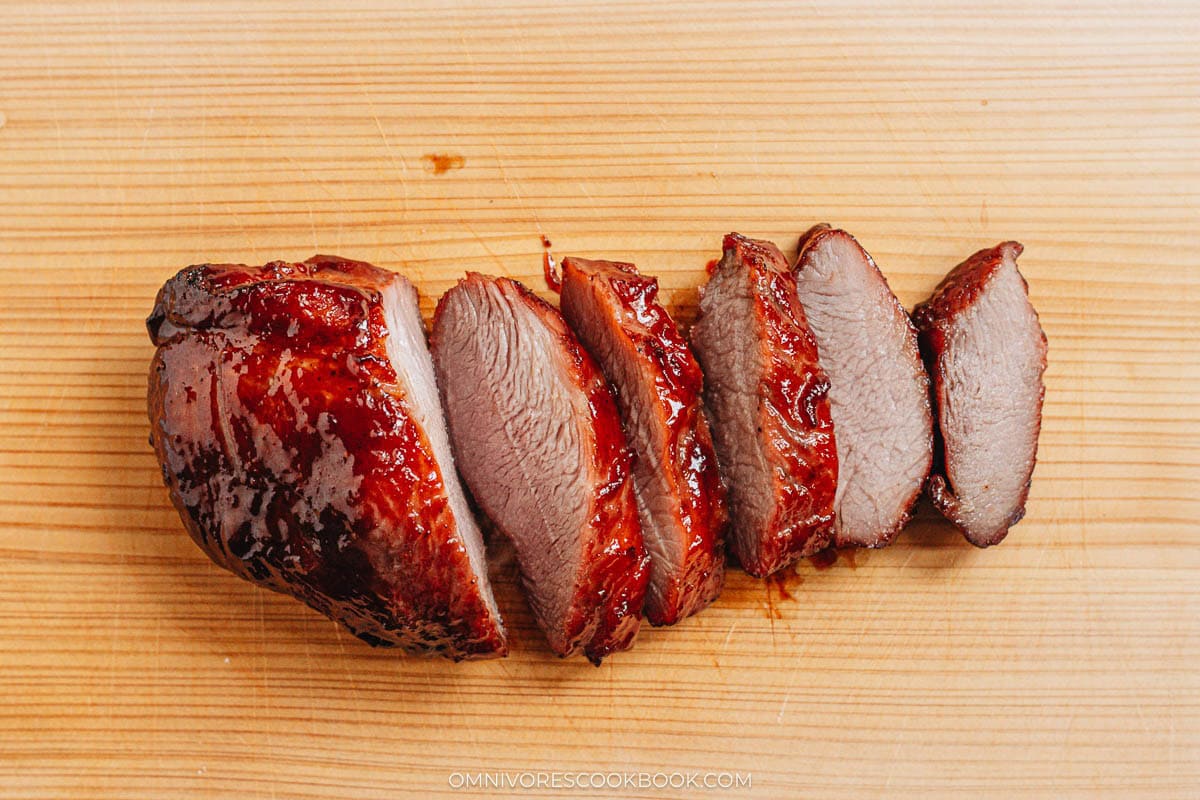
5. Broil the pork: Turn on the broiler and glaze both sides of the pork. Broil for 3 minutes, then flip. If the pork still looks wet, skip the glaze so the broiler can dry the coating and help it stick, or brush on a little more if the surface looks dry. Broil for another 3 to 4 minutes, until the pork is glossy with charred edges and the thickest part reads 150°F to 155°F (65°C to 68°C).
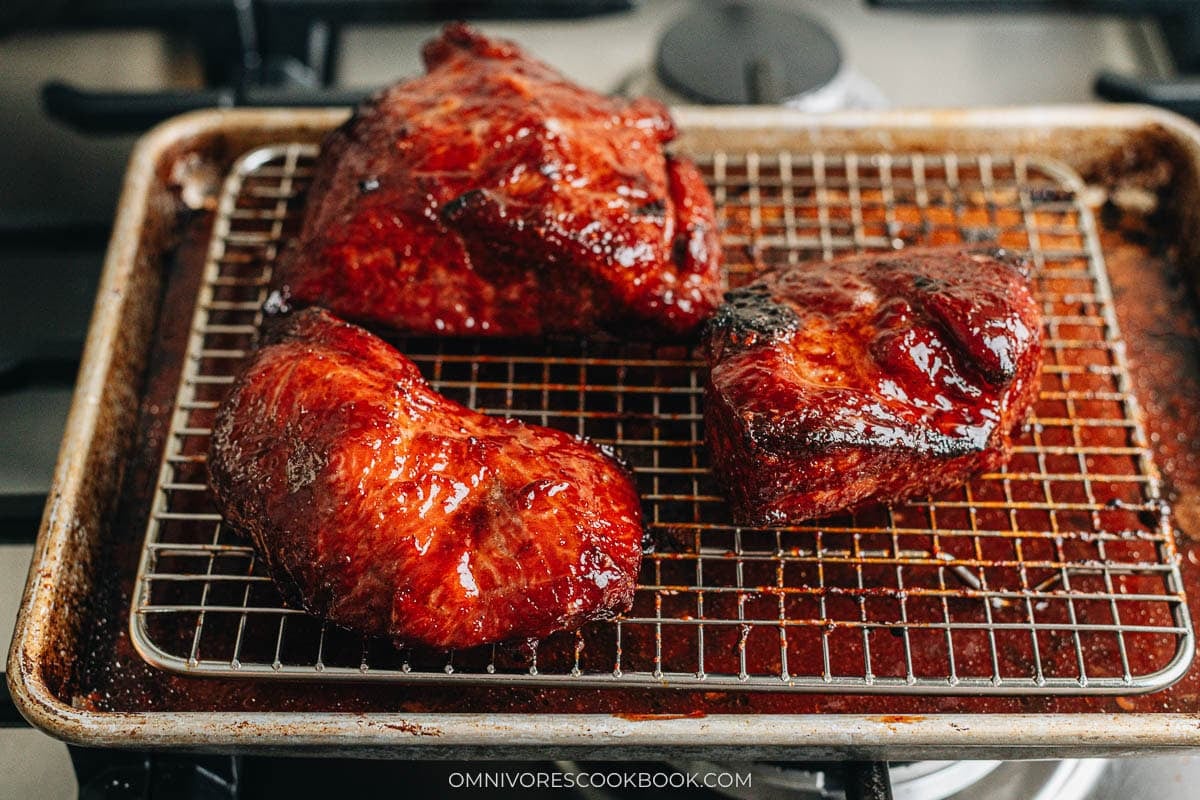
6. Rest and slice: Transfer the pork to a plate and let it rest for 10 to 15 minutes. Slice it crosswise and serve.
My Cooking Tips
Marinate overnight, or up to 2 days: A short marinade does not give the sauce time to work into a thick cut of pork. I marinate overnight at a minimum, and I have gone as long as 2 days with a better result each time.
Pour water into the roasting tray: I add a thin layer of water under the rack to catch the sugary drippings during the high heat roast and broil. Without it, the drippings scorch on the hot tray and fill the kitchen with smoke.
Follow the seams and cut along the grain: With a whole shoulder, I divide it into large pieces along the natural seams, then cut those along the grain. Slicing the cooked strips crosswise afterward gives me tender, across the grain serving pieces.
Heat the maltose jar and spoon: Maltose is thick and semi solid at room temperature and almost impossible to scoop cold. Warming the jar loosens it, and a warmed, oiled spoon lets it slide straight into the pan.
Look for charred edges, not a uniform color: Good char siu is glossy in the middle with darker caramelized edges. I let the broiler char those edges rather than pulling the pork the moment the surface turns red.
Serving Suggestions
I slice char siu across the grain into thin, glossy strips and serve it warm over steamed rice, with a plate of chinese broccoli with oyster sauce alongside to cut the richness. When I am hosting, I love serving this as part of a Cantonese roast spread and let my friends pick at it while the rest of dinner finishes.
Char siu is at its best fresh, but I almost always roast extra for the leftovers. I fold it into char siu lo mein or my delicious fried rice with char siu during the week, and when I have time I chop it into the filling for steamed char siu buns. I save the cooked glaze separately and stir it straight into those bun fillings instead of making a new batch.
Frequently Ask Questions
How do I know when the char siu pork is done?
I use an instant read thermometer in the thickest strip. After roasting I look for 140°F to 150°F (60°C to 65°C), and after broiling it should reach 150°F to 155°F (65°C to 68°C). The temperature keeps rising while the pork rests, so I stop a little early to keep it juicy, and I am more careful with a leaner loin than with a fattier shoulder.
Why did my glaze slide off the pork?
A runny glaze is usually one that was not reduced enough, so I simmer the reserved sauce with the maltose until it coats the back of a spoon before brushing it on. Under the broiler I also read the surface before adding more: if the pork still looks wet and heavily coated, I let the heat dry and caramelize what is already there instead of piling on more, which is what turns the coating sticky enough to hold.
How do I store char siu and reuse the leftover glaze?
I store the pork and the cooked glaze in separate containers in the fridge for 4 to 5 days, or in the freezer for up to 2 months. To reheat, I brush the pork with some of that glaze and roast it at 350°F (176°C) until heated through, which brings back the sticky surface. The glaze is safe to keep because I reserved it before it touched the raw pork, and it saves me a step when I make char siu bun filling.
Want to Save This Recipe?
Enter your email below & we’ll send it to your inbox. Plus get great new recipes from us every week!
Watch video
Char Siu (Chinese BBQ Pork, 叉烧肉)
Ingredients
- 2 to 2.5 lbs pork shoulder (or pork loin) (*Footnote 1)
Sauce
- 1/4 cup soy sauce
- 1/4 cup Shaoxing wine
- 1/4 cup hoisin sauce
- 1/4 cup oyster sauce
- 1/4 cup sugar
- 2 tablespoons molasses
- 2 teaspoon garlic , grated
- 1 teaspoon five spice powder
- 3/4 teaspoon salt
- 1/4 teaspoon red food coloring (Optional) (*Footnote 2)
- 2 tablespoons maltose (or honey) (*Footnote 3)
Instructions
- Prepare the pork: Cut the pork along the grain into long strips about 2 to 3” (5 to 7.5 cm) wide and 1 to 1 1/4” (2.5 to 3 cm) thick. (*Footnote 4)
Marinade
- In a large bowl combine the soy sauce, hoisin sauce, oyster sauce, Shaoxing wine, sugar, molasses, garlic, five spice powder, salt, and food coloring (if using). Stir to mix well. Transfer the pork into a large ziplock bag. Pour 1/2 cup of the mixed sauce into the bag, saving the remaining sauce in a jar in the fridge to make the glaze later. Squeeze out as much air as possible and seal the bag. Massage the bag a few times so the pork pieces are covered evenly with the sauce. Transfer to the fridge and marinate overnight.
Prepare the Glaze
- Soak the maltose jar in hot water, until the top loosens. You can also place the tablespoon in the hot water to heat up slightly. Grease your tablespoon with a thin layer of oil. (*Footnote 5)
- Transfer 2 tablespoons of maltose into a 9” skillet. Add the rest of the mixed sauce into the same pan. Heat over medium heat and stir to melt the maltose, until brought to a simmer.
- Simmer, stir constantly, for 3 minutes to thicken the sauce until it coats the back of a spoon. Once done, transfer the sauce to a bowl and set aside.
Roasting
- Preheat the oven to 450ºF (230ºC), or 425ºF (220ºC) convection.
- Line a baking tray with a grilling rack, pour a layer of water into the tray without touching the rack.
- Spread the marinated pork onto the grilling rack. Brush both sides with glaze.
- Bake for 5 minutes.
- Then glaze both sides of the pork, and bake for another 5 minutes.
- Measure the temperature of the thickest part of the pork with a thermometer, it should register from 140ºF to 150ºF (60ºC to 65ºC). Roast longer if needed.
Broil
- Turn on the broiler. Glaze both sides of the pork. Broil for 3 minutes.
- Flip the pork. You can skip the glazing if the pork still looks wet, because you want the final broil to dry out the glaze a bit more so it sticks to the pork. But you can glaze again if the pork looks a little dry.
- Broil for another 3 to 4 minutes. The pork should look glossy, with a thick glaze coating the surface and charred edges.
- You can test the doneness by inserting a thermometer into the thickest part of the pork. It should read 150ºF to 155ºF (65ºC to 68ºC) (*Footnote 6).
- Transfer the pork to a big plate and let rest for 10 to 15 minutes.
- Then slice the pork and serve. (*Footnote 7)
Storage & other uses
- Store the leftover pork and the glaze separately in the fridge for 4 to 5 days, or in the freezer for up to 2 months. When reheating the pork, glaze it again and roast at 350ºF (176ºC) until heated through. You can use the leftover glaze in char siu buns filling as the sauce instead of making it from scratch.
Notes
- Pork shoulder is highly recommended for the juiciest, most flavorful char siu. Pork loin creates a leaner result and should be monitored carefully to avoid overcooking.
- Traditionally, Chinese chefs use red yeast rice to give char siu its signature red color. Because red yeast rice can be difficult to find, I use a small amount of red food coloring. If you prefer a natural ingredient, check out my char siu chicken recipe, where I use red fermented tofu (furu) to add color, or simply omit the food coloring.
- Maltose is a very sticky syrup that stays semi-solid at room temperature and remains thick when heated. It is the key ingredient to give the char siu pork that glossy coating. These days it’s quite easy to find it on Amazon if you don’t live close to a Chinese market, and I highly recommend getting it for the best result. Honey is an OK replacement, but the glaze will be much looser and won’t stay on the pork as well.
- If using boneless pork shoulder, follow the natural seams where the bone was removed to divide the shoulder into large pieces. Cutting along the grain matters, because you’re eventually slicing the cooked strips crosswise. Cutting the initial slabs along the grain means the final serving slices will be across the grain. The sliced pieces won’t be very even in the shape but that’s OK. Try to keep the thickness the same though, so they roast at the same speed.
- Maltose is a very thick syrup and it’s hard to scoop at room temperature. Heating the jar loosens its texture, and heating the spoon makes it easier to scoop. The oil coating helps the maltose slide off the spoon and into the pan.
- The temperature of the pork will keep rising after resting, so I prefer to stop a bit earlier to prevent the pork from drying out. If you use pork loin, it’s important to stop cooking at this stage because the cut is lean and will dry out if over cooked. Pork shoulder handles higher temperatures better and will still taste very good if you roast it a little longer.
- If using maltose, the glaze should thicken and cling to the pork well. If using honey, the glaze will be thinner and may not stick as well. In that case, you can brush the pork with additional glaze after roasting, or serve some of the leftover glaze alongside the pork.
Nutrition

Did you make this recipe?
I’d love to hear how it turned out for you! Please take a moment to leave a 5-star rating ⭐️ and share your thoughts in the comments further down the page. It really helps others discover the recipe too.
The original recipe was published on Jan 25, 2016 and updated by Oct 16, 2019. I updated this recipe again on August 28, 2026.
Jeffrey
Love this recipe! Very good flavor and glaze on the pork. The one thing I changed is instead of pork loin , I used pork butt well trimmed to take off excess fat and cut into 2 inch squared thickness. Pork butt seems to hold the glaze better and the texture is better.
Maria
Have made this twice. Great flavor – labor intensive but worth it. And didn’t seem quite as hard the second time around.
Bean
Tried this tonite. OMG. This has the best flavor. The pork was not dry at all. I will def make this again!!
Nick
Hello Maggie… . this looks great. However, I am not a fan of hoisin sauce. Can you recommend an alternative such as Gochujang?
Kind regards,
Nick
Maggie
The filling actually doesn’t taste like hoisin sauce. For another alternative, chee hou sauce is a great option: https://amzn.to/2wcv9de It’s similar to hoisin but in a good way. You could potentially increase the oyster sauce and molasses (+2 tablespoons oyster sauce and +2 tablespoons molasses).
KKFM
Hi Nick, I too am not a fan of hoisin sauce, and the flavor of the sauce was not strongly hoisin. I would recommend trying it as is (I did use a little less sugar).
Dan Friedman
Great marinade. Can I use Korean corn syrup instead of the maltose, or should I just use honey as you suggest?
Maggie
I’ve only used Korean rice syrup, but if the corn syrup has the similar sticky thick texture it might be a better option than the honey. Glad you like the marinade!
Phil
I made this for my son and his wife and my Shanghaiese wife. Was the star of the dinner.
REALLY yummy. Almost as good as the Hong Kong dimsum. 🙂
Nancy Layton
Love your recipes and accompanying back stories & histories!
Bruce T
This version of Char Sui really lends itself to being grilled on a BBQ. I kept it at 400-450 deg F all the way, and added one more flip to put more baste on the two sides. Ultimate compliment was from a Malay friend who said ‘just like home’!. I did add 3 cloves of garlic, minced, to the recipe as we like garlic. One downside was that the strips came out more dark red than I wanted, still trying to figure out how to make the uncharred spots a more intense red. The 3 lbs only lasted two days between friends and family!
Sara Price
My family loves this recipe. We make it with chicken due to food issues and it’s amazing. The marinade unthickened also makes an incredible jerky marinade. Thank you for having this site and posting all these amazing recipes.
Jeffrey
Hi Maggie,
Firstly, I love your site, you are my cooking hero. I’ve made your mapo dofu over 10 times as well as the eggplant with garlic sauce and dry-fried green beans.
Second, this morning I put together the marinade/sauce before drinking my coffee and put all of it in the bag with the raw pork instead of just 1/2 cup. Is this a disaster? Should I pour out some of the sauce or just leave it in and make more?
Sorry to bug you with such a silly question.
Maggie
Hi Jeffrey, no worries at all! You can just leave the marinade in and make more for the glazing. I think your pork will come out well 🙂
Jeffrey
Thanks!
Phil
I made these for CNY Eve. I invited my son and daughter in law for a Chinese dinner
The end result was very good using pork loin. I used honey as I did not have Maltose so the marinade was a bit runny but the flavor was there. Marinated it over night
Excellent recipe, reminded me of my time in Hong Kong. Just wish my Shanghaiese wife would eat pork, I’d make it more often
Melanie Sparkes
Hi what an excellent recipe. The quantities were spot on for the glaze and it tastes and looks exactly like it should! Thank you
Ronen
We just bought a few whole chickens from a local farmer, and I was wondering what to do with one of em’ at the end of the weekend. Turns out this recipe works out amazingly well with a whole chicken as well(Or maybe I’m missing and there’s a recipe for it on your website with a chicken as well?😅).
Turned out extremely juicy in the inside and a bit smokey on the outside(guessing it’s the water in the bottom of the baking dish?). And the taste was absolutely amazing,
Fantastic recipe, thank you again:)
Maggie
Hi Ronen, I’m so glad to hear you liked the recipe! The chicken idea sounds great. I’ve never tried it before but now I can’t wait to test it myself!
Thanks for sharing 🙂
Katheirne
I’m excited for this recipe! Do you have any recommendations on what to use other than maltose for diabetics to also get that glaze? Would agave work?
Maggie
Hi Katherine, I’ve never tried this recipe with agave. I think honey works better (low Gi, higher than agave but still much lower than maltose) because it has a thicker texture.
Kevin McCarthy
As always, this recipe knocks it out of the PARK! I used your Black Bean Sauce to make your Hoisin sauce, which I then used in the recipe with the other ingredients. I always have the black bean sauce and Hoisin prepared here at home from your recipes and recommend to everyone! Maggie’s BBS and Hoisin are the BEST ever, take it to the bank!! None better anywhere, they are on a level all by themselves!
This Char Siu came out brilliantly! Followed the directions to the letter, the amounts made were perfect, and it came out so tasty, moist, glaze-y and just delicious! I’m about to make some Char Siu Chow Mein, and I saved off what amounts to about a pint of Char Siu liquid for that gravy and scallion biscuits!
Thank you Maggie for so many amazing recipes, they are always top notch, I’m grateful for your selfless sharing. Have you considered doing a hardcover book release??? You’d be a best seller and I’d be #1 in line!!
Maggie
Hi Kevin, so happy to hear you like the recipe! Can’t wait to hear your feedback on the char siu chow mein and the gravy and biscuits. Happy cooking!
PS. I’d love to do a hardcovered cookbook in the future when an opportunity presented 🙂
Larry Vitor
Great recipe! The maltose really made the difference for me. Dealing with that lump of maltose is worth the trouble. I had a few packages of Chinese spareribs In the house and used those for the recipe and they were great.
One thing, I bought meat hooks from Amazon so I can hang my Char Siu pork with a pan with some water under it to catch the drippings. And I also got hooks there to hang ducks and chickens in the oven.
Maggie
Hi Larry, I’m so glad to hear you liked the recipe! It’s such a smart idea to roast the ribs using meat hooks. I imagine the meat will roast more evenly and the bottom side less soggy. Do you have a link to the Amazon product you bought? I want to try it out but I’m not sure if my oven is big enough. Curious about your setup.
CATHERINE LEE
Can this be cooked on a charcoal bbq grill? This is my favorite pork ever, I so want to make it! I don’t have an oven though.
Maggie
100% sure you can. Actually the result should be better because it’s easier to glaze the pork while grilling. You might need to check the grilling time depending on the cut you make. I’m thinking grilling with indirect heat first to let the pork cook through like 80%, then glaze (multiple times) and grill at the end maybe a bit of time over direct heat to give it the char. The glaze is very sugary so I would brush them at a later stage to prevent it from burning.
Sandi
Could you tell me what type of soup is in the last picture before the recipe? Do you already have a recipe somewhere? I am going to try this pork recipe tonight – it looks so delicious! I just found your website today, and can’t wait to try some new dishes!
Maggie
Hi Sandi, sorry for the slow reply. I made the noodle soup long time ago and cannot remember clearly. But I’m pretty sure it’s a very simple chicken broth-based soup with some ginger and soy sauce added in. It was extra rich because I used homemade broth at the time. If you’re interested in making it, you can either use my soy sauce noodle base (https://omnivorescookbook.com/soy-sauce-noodles) or wonton soup (https://omnivorescookbook.com/recipes/wonton-soup) base. Both will work with. Just top the char siu on it!
maureen denney
My niece just made your Char Siu for me, and I loved it! I will make it for my family this weekend, and I anticipate their delight. Thank you for sharing your recipes with the world.
Maureen
Linda Douglas
Maggie, thank you for your description of making char suit. I am making some today. I live near El Paso and there are NO decent Chinese restauranfs here.
A transplanted Kentuckian in Tests,
Linda Douglas