

Char siu, which means fork roasted, is a Cantonese roast meat you see hanging in the windows of barbecue shops, glossy and dark red at the edges. Restaurants cook it on long forks over an open fire, and my recipe reworks that method for a home oven and broiler so you get the same sticky glaze and charred edges without any dedicated equipment.
I grew up in Beijing eating char siu at a busy dim sum restaurant called Jin Ding Xuan (金鼎轩), where, unlike in the Cantonese south, one restaurant serves both the roast meats and the dim sum. My usual order was a combo roast platter of char siu and Cantonese roast duck, a few plates of dim sum, and gai lan in oyster sauce, with a bowl of Cantonese wonton noodle soup added when I was extra hungry. After moving to the US I started roasting char siu at home for guests, first on the outdoor grill in Austin, Texas and later in the oven after we moved to New York.
I recently reworked this recipe around a fattier pork shoulder instead of a leaner loin, and I reduce the glaze in a wide pan so it thickens and clings to the meat instead of sliding off. Keeping the sugar lower than most restaurant char siu is key because I prefer it less sweet, and I use maltose to achieve a glossy sticky coating. I recommend to marinate the pork overnight and roast it the next day using my directions below, and you will pull out tender red edged strips your whole family will love.

Ingredients
The one ingredient I would not skip here is maltose, and the rest of the list is a standard Cantonese barbecue marinade. Here is what I use to make this Char siu recipe:

Pork: I recommend using pork shoulder for this recipe because the extra fat keeps the meat juicy through a hot roast and gives me a better result than a leaner pork loin. If I only have loin, I watch it closely and pull it earlier so it does not dry out.
Marinade and glaze base: I mix soy sauce, Shaoxing wine, hoisin, and oyster sauce with sugar, molasses, grated garlic, five spice powder, and salt into one bowl of sauce. I marinate the pork in part of it and set the rest aside, untouched by raw meat, to cook down into the glaze later.
Color: I add a small amount of red food coloring for the classic char siu red, though it is optional. Traditionally the color comes from red yeast rice, so I only use food coloring because that ingredient is hard to find.
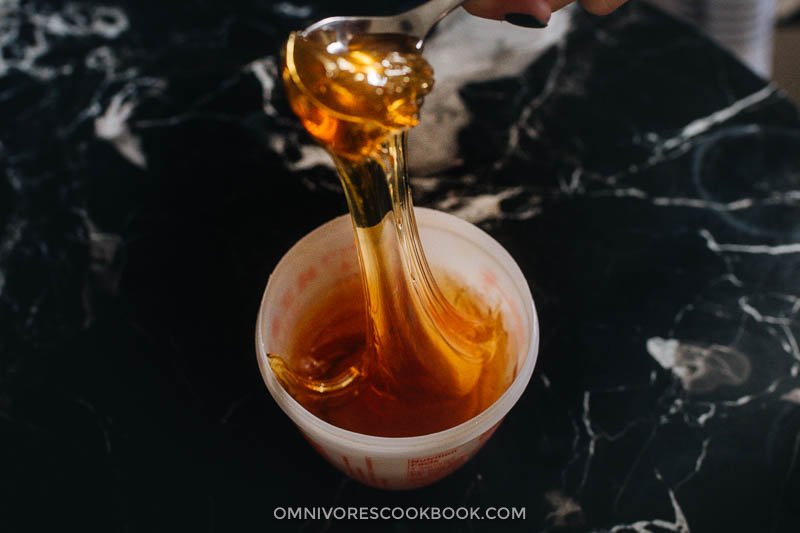
Maltose: I use maltose because it makes the glaze glossy and sticky, and it clings to the pork in a way honey cannot. Honey works as a substitute, but the glaze turns out looser, so I brush on extra or pass more at the table when I use it.
How to Make
1. Cut the pork: Cut the pork along the grain into long strips about 2 to 3 inches (5 to 7.5 cm) wide and 1 to 1 1/4 inches (2.5 to 3 cm) thick. The pieces do not need to be a perfect match, but keep the thickness consistent so they roast at the same rate.

2. Marinate a day ahead: In a large bowl, combine the soy sauce, hoisin sauce, oyster sauce, Shaoxing wine, sugar, molasses, garlic, five spice powder, salt, and food coloring, if using. Stir well. Transfer the pork to a large ziplock bag, pour in 1/2 cup of the sauce, and save the remaining sauce in a jar in the fridge for the glaze. Squeeze out as much air as possible, seal the bag, and massage it so the pork is coated all over. Marinate in the fridge overnight.

3. Make the glaze: Soak the maltose jar in hot water until the top loosens, and warm a tablespoon in the hot water too. Grease the spoon with a thin layer of oil, then scoop 2 tablespoons of maltose into a 9 inch skillet along with the reserved sauce. Heat over medium, stirring to melt the maltose, until it comes to a simmer. Simmer and stir constantly for 3 minutes, until the sauce coats the back of a spoon, then transfer it to a bowl and set aside.

4. Roast the pork: Preheat the oven to 450°F (230°C), or 425°F (220°C) convection. Line a baking tray with a rack and pour a thin layer of water into the tray without touching the rack. Spread the marinated pork on the rack and brush both sides with glaze.
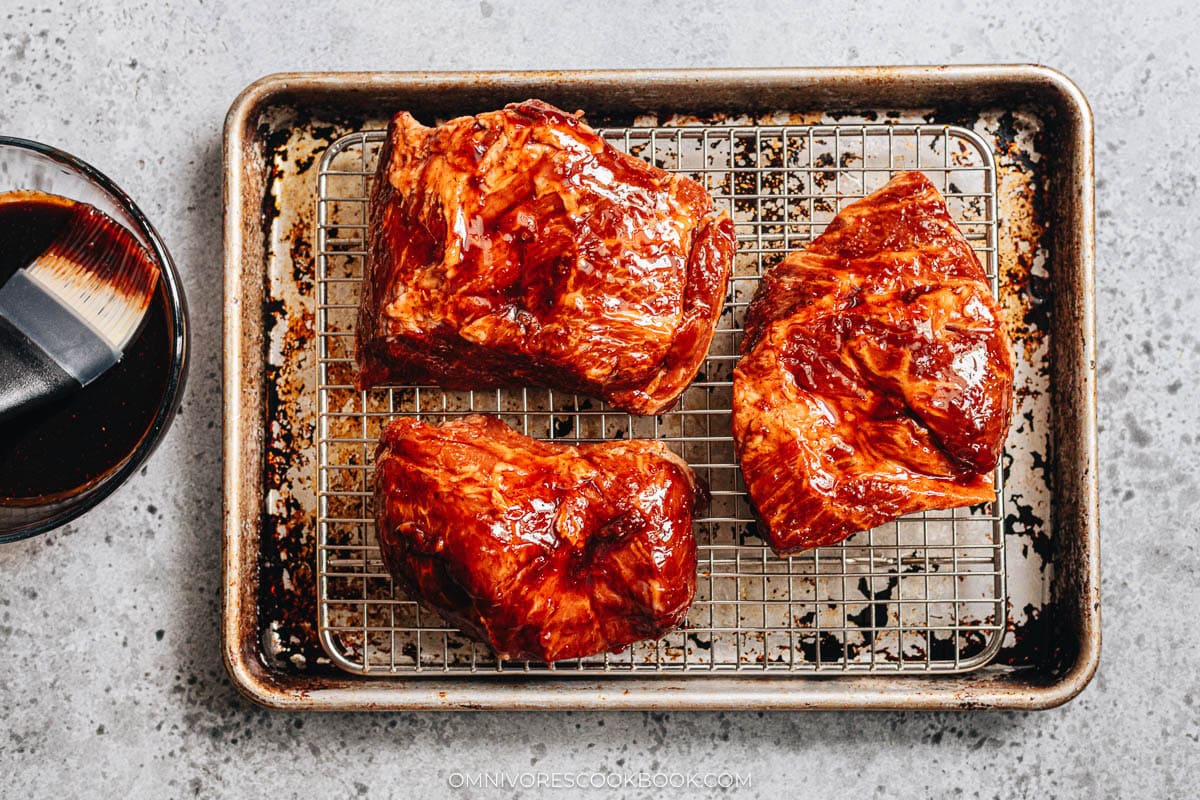
Bake for 5 minutes, glaze both sides again, and bake for another 5 minutes. Check the thickest part with a thermometer, which should read 140°F to 150°F (60°C to 65°C), and roast longer if needed.
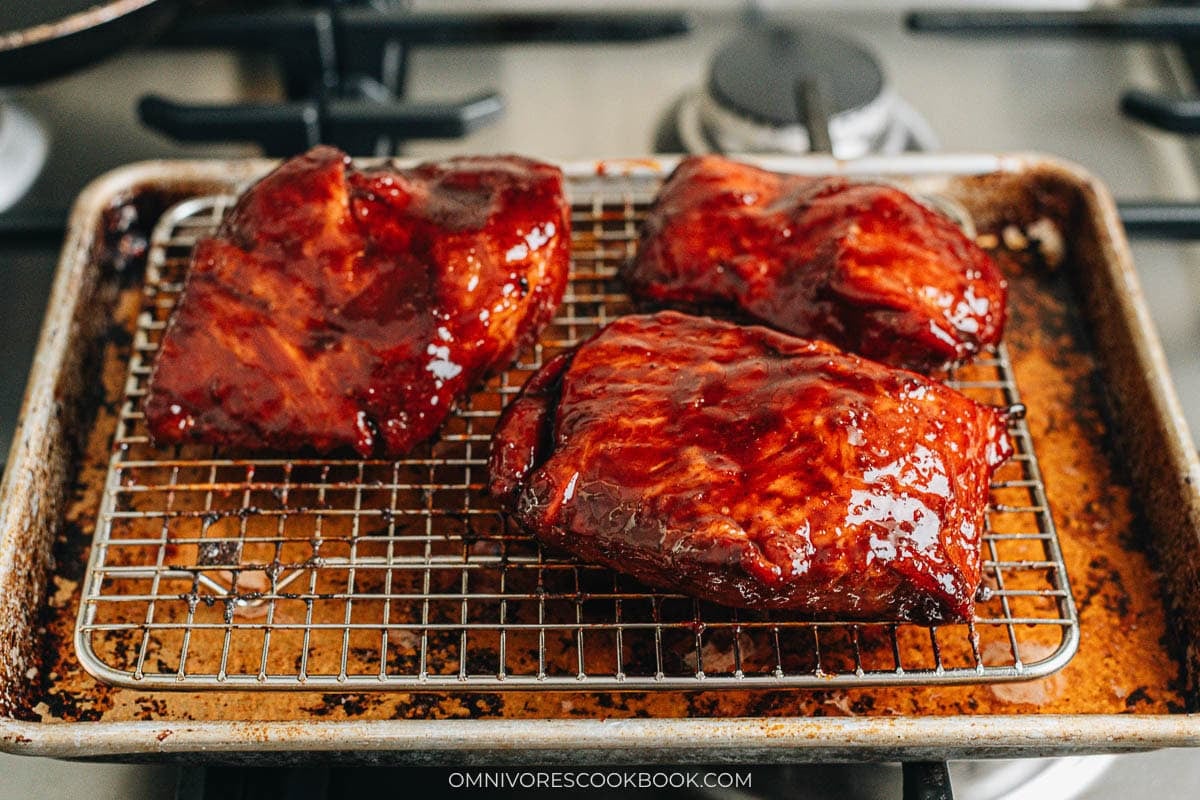
5. Broil the pork: Turn on the broiler and glaze both sides of the pork. Broil for 3 minutes, then flip. If the pork still looks wet, skip the glaze so the broiler can dry the coating and help it stick, or brush on a little more if the surface looks dry. Broil for another 3 to 4 minutes, until the pork is glossy with charred edges and the thickest part reads 150°F to 155°F (65°C to 68°C).
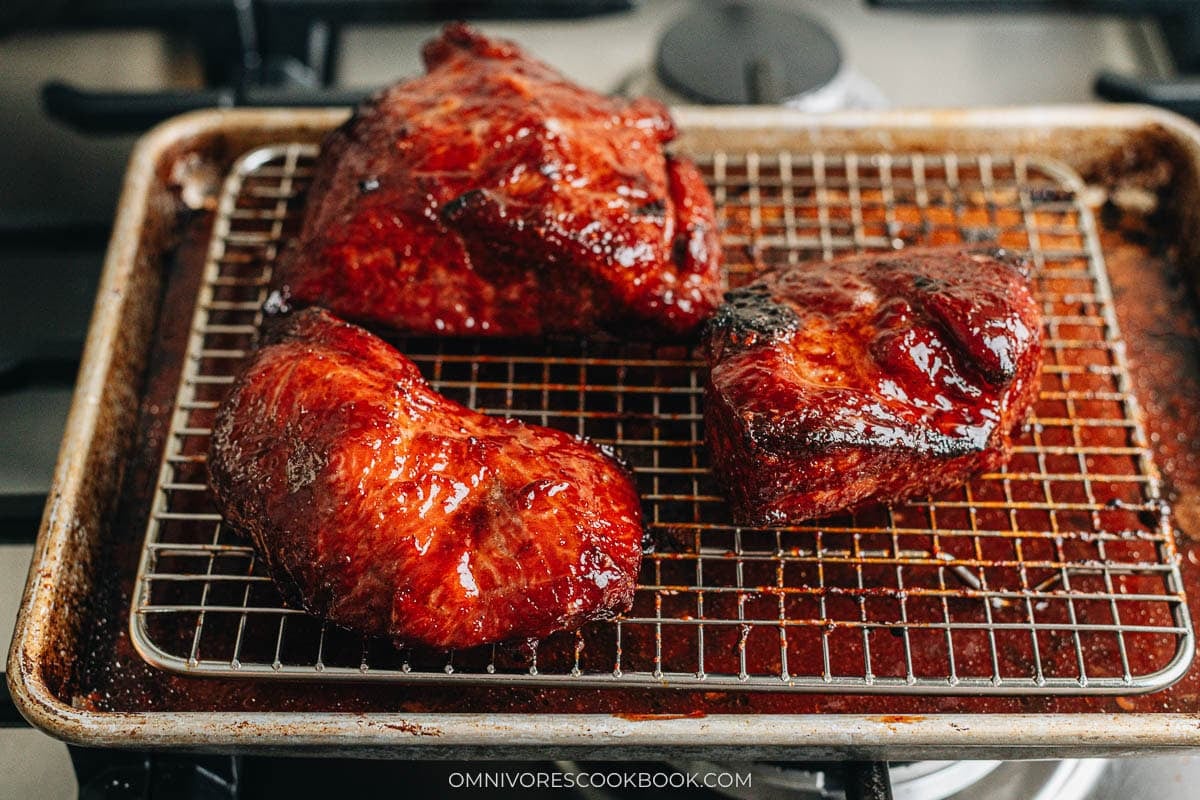
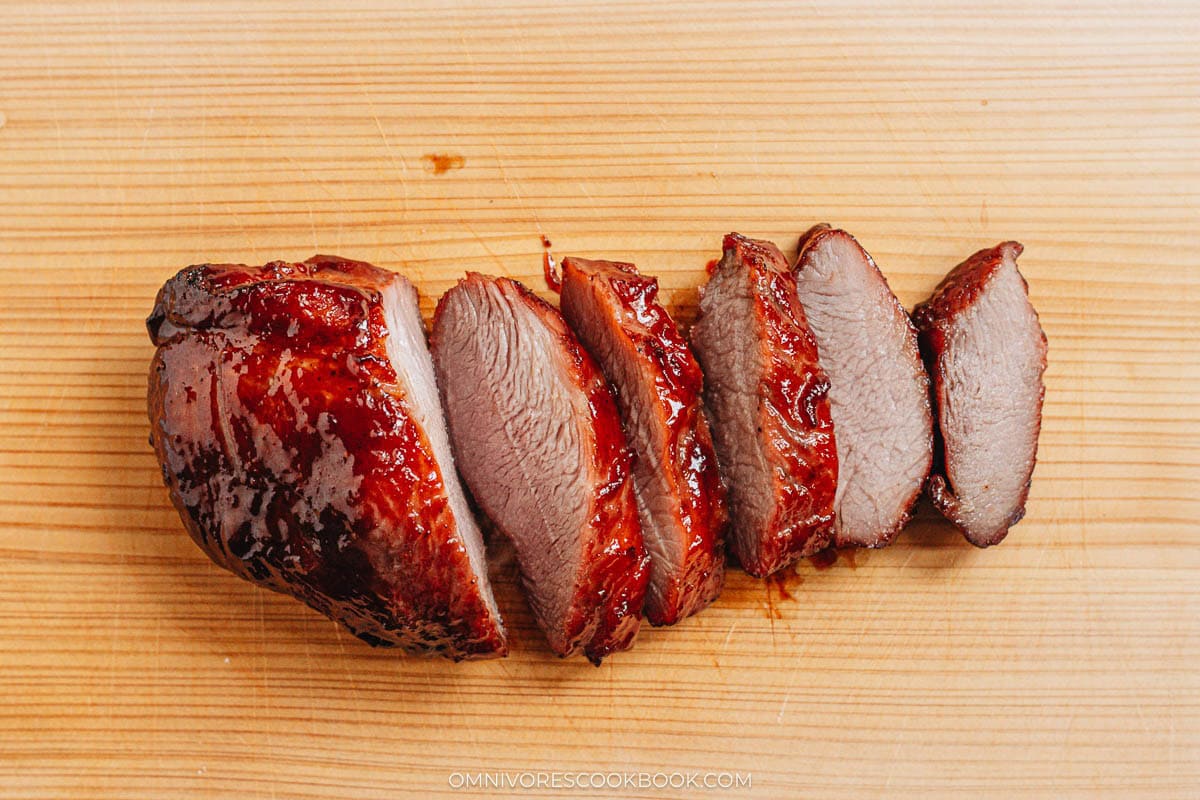
6. Rest and slice: Transfer the pork to a plate and let it rest for 10 to 15 minutes. Slice it crosswise and serve.
My Cooking Tips
Marinate overnight, or up to 2 days: A short marinade does not give the sauce time to work into a thick cut of pork. I marinate overnight at a minimum, and I have gone as long as 2 days with a better result each time.
Pour water into the roasting tray: I add a thin layer of water under the rack to catch the sugary drippings during the high heat roast and broil. Without it, the drippings scorch on the hot tray and fill the kitchen with smoke.
Follow the seams and cut along the grain: With a whole shoulder, I divide it into large pieces along the natural seams, then cut those along the grain. Slicing the cooked strips crosswise afterward gives me tender, across the grain serving pieces.
Heat the maltose jar and spoon: Maltose is thick and semi solid at room temperature and almost impossible to scoop cold. Warming the jar loosens it, and a warmed, oiled spoon lets it slide straight into the pan.
Look for charred edges, not a uniform color: Good char siu is glossy in the middle with darker caramelized edges. I let the broiler char those edges rather than pulling the pork the moment the surface turns red.
Serving Suggestions
I slice char siu across the grain into thin, glossy strips and serve it warm over steamed rice, with a plate of chinese broccoli with oyster sauce alongside to cut the richness. When I am hosting, I love serving this as part of a Cantonese roast spread and let my friends pick at it while the rest of dinner finishes.
Char siu is at its best fresh, but I almost always roast extra for the leftovers. I fold it into char siu lo mein or my delicious fried rice with char siu during the week, and when I have time I chop it into the filling for steamed char siu buns. I save the cooked glaze separately and stir it straight into those bun fillings instead of making a new batch.
Frequently Ask Questions
How do I know when the char siu pork is done?
I use an instant read thermometer in the thickest strip. After roasting I look for 140°F to 150°F (60°C to 65°C), and after broiling it should reach 150°F to 155°F (65°C to 68°C). The temperature keeps rising while the pork rests, so I stop a little early to keep it juicy, and I am more careful with a leaner loin than with a fattier shoulder.
Why did my glaze slide off the pork?
A runny glaze is usually one that was not reduced enough, so I simmer the reserved sauce with the maltose until it coats the back of a spoon before brushing it on. Under the broiler I also read the surface before adding more: if the pork still looks wet and heavily coated, I let the heat dry and caramelize what is already there instead of piling on more, which is what turns the coating sticky enough to hold.
How do I store char siu and reuse the leftover glaze?
I store the pork and the cooked glaze in separate containers in the fridge for 4 to 5 days, or in the freezer for up to 2 months. To reheat, I brush the pork with some of that glaze and roast it at 350°F (176°C) until heated through, which brings back the sticky surface. The glaze is safe to keep because I reserved it before it touched the raw pork, and it saves me a step when I make char siu bun filling.
Want to Save This Recipe?
Enter your email below & we’ll send it to your inbox. Plus get great new recipes from us every week!
Watch video
Char Siu (Chinese BBQ Pork, 叉烧肉)
Ingredients
- 2 to 2.5 lbs pork shoulder (or pork loin) (*Footnote 1)
Sauce
- 1/4 cup soy sauce
- 1/4 cup Shaoxing wine
- 1/4 cup hoisin sauce
- 1/4 cup oyster sauce
- 1/4 cup sugar
- 2 tablespoons molasses
- 2 teaspoon garlic , grated
- 1 teaspoon five spice powder
- 3/4 teaspoon salt
- 1/4 teaspoon red food coloring (Optional) (*Footnote 2)
- 2 tablespoons maltose (or honey) (*Footnote 3)
Instructions
- Prepare the pork: Cut the pork along the grain into long strips about 2 to 3” (5 to 7.5 cm) wide and 1 to 1 1/4” (2.5 to 3 cm) thick. (*Footnote 4)
Marinade
- In a large bowl combine the soy sauce, hoisin sauce, oyster sauce, Shaoxing wine, sugar, molasses, garlic, five spice powder, salt, and food coloring (if using). Stir to mix well. Transfer the pork into a large ziplock bag. Pour 1/2 cup of the mixed sauce into the bag, saving the remaining sauce in a jar in the fridge to make the glaze later. Squeeze out as much air as possible and seal the bag. Massage the bag a few times so the pork pieces are covered evenly with the sauce. Transfer to the fridge and marinate overnight.
Prepare the Glaze
- Soak the maltose jar in hot water, until the top loosens. You can also place the tablespoon in the hot water to heat up slightly. Grease your tablespoon with a thin layer of oil. (*Footnote 5)
- Transfer 2 tablespoons of maltose into a 9” skillet. Add the rest of the mixed sauce into the same pan. Heat over medium heat and stir to melt the maltose, until brought to a simmer.
- Simmer, stir constantly, for 3 minutes to thicken the sauce until it coats the back of a spoon. Once done, transfer the sauce to a bowl and set aside.
Roasting
- Preheat the oven to 450ºF (230ºC), or 425ºF (220ºC) convection.
- Line a baking tray with a grilling rack, pour a layer of water into the tray without touching the rack.
- Spread the marinated pork onto the grilling rack. Brush both sides with glaze.
- Bake for 5 minutes.
- Then glaze both sides of the pork, and bake for another 5 minutes.
- Measure the temperature of the thickest part of the pork with a thermometer, it should register from 140ºF to 150ºF (60ºC to 65ºC). Roast longer if needed.
Broil
- Turn on the broiler. Glaze both sides of the pork. Broil for 3 minutes.
- Flip the pork. You can skip the glazing if the pork still looks wet, because you want the final broil to dry out the glaze a bit more so it sticks to the pork. But you can glaze again if the pork looks a little dry.
- Broil for another 3 to 4 minutes. The pork should look glossy, with a thick glaze coating the surface and charred edges.
- You can test the doneness by inserting a thermometer into the thickest part of the pork. It should read 150ºF to 155ºF (65ºC to 68ºC) (*Footnote 6).
- Transfer the pork to a big plate and let rest for 10 to 15 minutes.
- Then slice the pork and serve. (*Footnote 7)
Storage & other uses
- Store the leftover pork and the glaze separately in the fridge for 4 to 5 days, or in the freezer for up to 2 months. When reheating the pork, glaze it again and roast at 350ºF (176ºC) until heated through. You can use the leftover glaze in char siu buns filling as the sauce instead of making it from scratch.
Notes
- Pork shoulder is highly recommended for the juiciest, most flavorful char siu. Pork loin creates a leaner result and should be monitored carefully to avoid overcooking.
- Traditionally, Chinese chefs use red yeast rice to give char siu its signature red color. Because red yeast rice can be difficult to find, I use a small amount of red food coloring. If you prefer a natural ingredient, check out my char siu chicken recipe, where I use red fermented tofu (furu) to add color, or simply omit the food coloring.
- Maltose is a very sticky syrup that stays semi-solid at room temperature and remains thick when heated. It is the key ingredient to give the char siu pork that glossy coating. These days it’s quite easy to find it on Amazon if you don’t live close to a Chinese market, and I highly recommend getting it for the best result. Honey is an OK replacement, but the glaze will be much looser and won’t stay on the pork as well.
- If using boneless pork shoulder, follow the natural seams where the bone was removed to divide the shoulder into large pieces. Cutting along the grain matters, because you’re eventually slicing the cooked strips crosswise. Cutting the initial slabs along the grain means the final serving slices will be across the grain. The sliced pieces won’t be very even in the shape but that’s OK. Try to keep the thickness the same though, so they roast at the same speed.
- Maltose is a very thick syrup and it’s hard to scoop at room temperature. Heating the jar loosens its texture, and heating the spoon makes it easier to scoop. The oil coating helps the maltose slide off the spoon and into the pan.
- The temperature of the pork will keep rising after resting, so I prefer to stop a bit earlier to prevent the pork from drying out. If you use pork loin, it’s important to stop cooking at this stage because the cut is lean and will dry out if over cooked. Pork shoulder handles higher temperatures better and will still taste very good if you roast it a little longer.
- If using maltose, the glaze should thicken and cling to the pork well. If using honey, the glaze will be thinner and may not stick as well. In that case, you can brush the pork with additional glaze after roasting, or serve some of the leftover glaze alongside the pork.
Nutrition

Did you make this recipe?
I’d love to hear how it turned out for you! Please take a moment to leave a 5-star rating ⭐️ and share your thoughts in the comments further down the page. It really helps others discover the recipe too.
The original recipe was published on Jan 25, 2016 and updated by Oct 16, 2019. I updated this recipe again on August 28, 2026.
Tony Gabud
Tried recipe word for word,the taste was fantastic the pork tender and the wife loved it,quick stir fry of vegetables along with some udon noodles made this meal complete,loving how easy this was from start to finish
Phyllis
Just a follow-up to my Feb 1, 2018 post… After making 2 port tenderloins (1 lb. each) I cut up the second one into strips (as in pork lo mein) and froze in 3 portion separate baggies. The next couple of times I made lo mein, and stir fried veggies, I took a baggie out of freezer and let it defrost a bit, then threw in towards the end of stir frying to warm up with rest of dish. It was perfect!! It’s great to know you have something handy like this in the freezer, so I’ll do the same thing next time I make this recipe!
Phyllis Lenkowsky
This came out sooo delicious- tasted just like in Chinese restaurant! it was my second time making it! I buy pork tenderloins when I can find about a 2 -3 pound package (which conains 2 tenderloins) . The first night we (my husband and I) have it sliced with rice and vegeables (napa and bean sprout stir fry) on the side. The second night I slice the remaining half of the first tenderloin into strips and make pork lo mein or stir fry with vegetables. So I’m going to experiment and cut up the remaining tenderloin into strips and freeze it in 2 or 3 portion baggies and use for other stir fry dishes.! Will see how that works because it’s just too much to use all at once (unless you have more than 2 to feed!)
Also, I have the book mentioned in another comment “The Gourmet Chinese Regional Cookbook” by Calvin and Audrey Lee, copyright 1976, given to me by my Mom! I’ve used many of the stir fry recipes over the years and earned how to do Chinese stir fry from these recipes! Also enjoyed the informative history about the various regions and cooking styles. About 2 or 3 years ago I started rereading it since my son is living in Shanghai and wanted to learn about cooking there. It’s amazing how so much of the book is still so current! The only thing changed is that Chinese products are so much more available! Thank you for all the information and recipes on your website! Looking forward to trying new things and learning!
Maggie
Hi Phyllis, thanks so much for leaving such a thoughtful comment and I’m so happy to hear you enjoyed the dish! It’s really smart of you to cook a big batch. I believe the meat freezes well so no worries there. I love to add them into fried rice, noodles and stir fried veggies. It is just a great way to make a fast meal with lots of veggies.
I actually located the “The Gourmet Chinese Regional Cookbook” later and now I have a copy. You’re totally right that the book is still so current and the recipes are classic 🙂
Hope you have a great week ahead and can’t wait to hear what you’ll cook the next!
L. Ness
I have found that good, quite sweet char siu (aka Chinese BBQ pork) does not need much soy sauce, if any.
Nor is 5 spice required. Too many odd flavors….
For 1.5 pounds of pork (preferably shoulder), about 5 tbsp of honey, 4 tbsp of sugar, and a tsp of salt (with a sprinkling
of ground ginger and also garlic) makes a fine marinade. 2 tbsp of Shaoxing rice cooking wine and a little water to thin just a bit completes the mix. I make enough marinade to nearly cover the meat as it sits fairly crowded into a 6×6 container + lid.
I have had great success first slicing the meat in a semi-frozen state (cuts easily and retains its shape) and then holding it together on thin bamboo skewers. That allows the marinade to actually provide great color throughout (using 1/3 – 1/2 tsp of red coloring). Then it’s into the fridge for 20-24 hours! I cut the skewers to length so the assemblies fit into the container.
40 minutes baked (flipped once so 20 minutes each side @350) and then broiled both sides to develop the char/glaze, and the
finished product is very tasty; restaurant style, if you will, which is what MOST folks seem to be searching for.
Soy sauce just doesn’t do it here, at least not much of it; perhaps a tbsp if any. Pork when cooked has a good flavor all on its own, and this famous appetizer is no good if not sweet; honey and sugar are the keys, otherwise one is just making spicy, dull tasting pork.
Try it, you’ll like it….I have photos if you wish to see….
L. Ness
I made this again, but used a pork tenderloin. Everything else I did about the same,
and it turned out well.
Do you think restaurants or wholesale outlets color their product after it is cooked and
sliced? I have to wonder, because even 36-48 hours in the fridge does not allow the color
from the marinade to penetrate whole chunks of pork….
They are holding back, not telling the entire story I fear….
So I pre-slice and go from there, though I just might try coloring lightly after cooking a
bunch; not bright red, but probably a few drops of red and a drop of blue.
It could work!
Maggie
Yes, I believe Chinese restaurant uses food coloring. Also, they use maltose instead of honey or sugar, which allows the marinade to coat the meat better. If you really want the color, I would highly recommend to get some maltose from an Asian market and go from there 🙂
Concerned Netizen
Thanks for sharing.! I find using fermented tofu is a great way to get the color. I understand many Chinese chefs use fermented red rice yeast, but it is quite expensive.
Betty G
I am making this now. It smells really authentic! What degree range do you recommend cooking this to? I saw that you used a digital meat thermometer. Thank you for all the beautiful and inspiring pictures.
Betty G
Hi Maggie,
Reading through the recipe again, I found the degrees 140 to 150. Then baste for another 5 minutes. I will try to do this. Thank you!
Maggie
Hi Betty, thanks for trying out this recipe and I’m glad to hear you’ve found the answer of the cooking temperature. Did the char siu pork come out well? I hope you enjoyed the dish 🙂
Betty G
Hi Maggie,
The char siu was , wow. I can’t believe it was that quick to cook that. It was messy, but worth making. I made it once as stated in the post. The next time I cheated and added a slathering of the thick commercial Lee Kum Kee Char Siu Sauce in the last 5 minutes. I was wanting that thick sweet sauce you get at chinese bbqs. My oven was not as powerful as yours I think. I could not get that blackened char that I saw in your post. I raised the meat up the second time to 8 inches away from the flame and made sure I selected high broil. Some ovens have low and high. It had more sizzling this time. The family of 6 ate 3 lbs. of that for dinner. Yum. and thank you for sharing!
Maggie
Hi Betty, thanks for letting me know your cooking result! Yes, I admit the cooking requires quite some effort and is messy. That’s the downside of the home oven.
If you want the thick sweet sauce texture, try to find maltose if you go to an Asian market the next time and use it instead of sugar. You can double the amount of maltose too, to make the sauce sweeter. Maltose has a better adhesive effect and will produce a beautiful shiny glaze. I just recently found it and can’t wait to try it again in this recipe, so I can get a better sauce 🙂
Rik
Char siu is probably one my absolute favorite things. I put a little spin on the recipe though. Pork tenderloin was on sale so I used that, and rather than the red food coloring, I used a splash of grenadine with some red pepper flakes which made for a nice red/pink halo in each cut. Also threw in a splash of bourbon over the wine, because it was all I had hanging around (next time I’ll make sure I have some proper wine on hand – whether it be sherry or shaoxing), as well as a nice tbsp or so of molasses for good measure. Turned out phenomenal! Will definitely be a staple of my grill from this point forward!
Maggie
I’m glad to hear you like this recipe Rik! Thanks for sharing your knowledge of replacing red food coloring. Me too, I’m not a big fan of using too many chemicals in my food, so I prefer the natural food coloring you said. I think adding bourbon works just as well. I use it too, sometimes vodka, when I ran out of Shaoxing wine.
We’ll be grilling some baby back ribs soon and I’ll be trying out some of the tips you shared. Looking forward to it 🙂
Jamie
This recipe is absolutely fabulous. The marinade and cooking method make this recipe a keeper! Yum!
Maggie
I’m glad to hear you enjoyed the dish Jamie! Thank you for taking time to leave a comment 🙂
Kimmy
Greetings from Singapore,
Having chanced upon your site, I was able to cook up a number of selected dishes from your recipes including this BBQ Char Siu.
I have stayed and worked in Hong Kong for more than 12 years and are familiar with authentic and aromatic as well as typical and traditional dishes there having had most of my meals in restaurants, tea houses, dim sums and street hawker fares. I loved them all.
My favorites are the roasted goose, char siu, cheongfun , tarts, naiwong pao, and braised beef briskets ( gao lum) , etc.
I am very impressed with your detailed description and guides on each of your recipe including accompanying sauces and dips, etc.
I have also improved my making of dumplings as a result of your guidance on your site. Thank you.
May I sign off wishing you and your loved ones, good health, happiness and prosperous year ahead.
Best.
Maggie
Hi Kimmy, thanks so much for taking time and leaving a comment! I’ve only been to Hong Kong twice, but me too, I really love the roasted goose and duck, cheongfun, tarts, and beef briskets. I am still trying to learn more about Cantonese cuisine and challenge these dishes at home. Some of the recipes do take some time and effort to make!
I’m glad to hear you find my posts helpful and it always brighten by day when I hear someone tried out my recipes 🙂
You too, hope you have happy and prosperous year ahead! Take care and have a great day 🙂
Atia
This recipe looks amazing! I’m doing it right now! One question, do you know if it’s possible to freeze some of the leftovers?
Thanks!
Maggie
Hi Atia, yes, you can freeze the leftovers without problem! If you have more glaze left, save them as well you can pour them over the char siu while reheat.
Happy cooking and hope the dish turns out well!
Lila
I am wondering if you could use pork tenerloin as well. Is a tenderloin too lean for this cooking method?
Maggie
Hi Lila, sorry I just saw your question! Yes you can use a tenderloin for this recipe. It is a tender lean cut, so it will turn out well as long as you don’t over cook it.
RossC
How wonderful to run across this recipe…
Back at the end of the 1970’s when I was a young 40 years old, my wife and my mother thought I should learn to do more than grill beef and stuff..
They gifted me a wok, some basic tools and a book…
The book, “The Gourmet Chinese Regional Cookbook” by Calvin and Audrey Lee became my introduction to Chinese cooking..
From the South China section of that book , the very first thing I made was a dish we ordered constantly in our favorite Chinese restaurant.. “Chinese Roast Pork”… I made that recipe and others from that book for many years..
As the years went by I moved on to cooking ‘regular American’ dishes but I remember how wonderful that roasted pork was and how much fun and pride I felt with making the perfect Chinese Roast Pork for family and friends ..
When I read your recipe I dug out that first cook book I ever received and looked up the pork recipe.. To my great joy I find that that recipe only differs from yours in a few small ways..
It calls for brown bean sauce (which was very hard to find at the time) instead of hoisin and oyster sauce.. It calls for light brown sugar instead of granulated sugar and I oven roasted it by hanging the pork from the oven rack over a pan of water… Other than that, its like reading that wonderful book all over again, 37 years later..
How wonderful to be reconnected to recipes which connected me to cooking in general and to Chinese cooking in particular…
Thank you… :o)
Maggie
Hi Ross, thanks for leaving such a detailed comment and share your Chinese food experience! The cookbook sounds amazing. I never expected there was a detailed book on Chinese regional cuisine back then. I just ordered a copy from Amazon and can’t wait to read it!
Re hanging the pork in the oven: how you managed to do that? It is actually the proper way that Cantonese restaurants use, with a hook. I can’t find a way to do it so I need to place the pork on the roasting pan.
Hopefully you’ll find more Chinese recipes to try out from my blog 😉 Happy cooking and have a great holiday!
RossC
I’m happy you found a copy of the Lee’s book…The Chinese Roast recipe is on page 203, in my edition..Its been bookmarked for over 30 years.. It would be good to know if the book fits in with what you do…
I was given small hooks by a butcher friend.. You can find them now on in a restaurant supple store or on by searching for ‘small meat hanging hooks’ on Amazon..
And yes, I am finding many wonderful Chinese recipes on your blog… :O)
Maggie
Hi Ross, thanks for sharing the tip on how to hang the pork in the oven!
The book just arrived a few days ago and I love it! It’s nice to see a Chinese cookbook that covers Chinese cuisine by regions, because each region has so many different cooking habits and signature dishes.
Happy New Year!
Marilyn Jacobs
Hi –
Loved this dish. I have tried different recipes for Char Siu and this is my favorite for the flavor marindade and techniqe of cooking at high temperature. I got a large pork loin on sale and made this in 2 batches. Is it possible to freeze this after it is cooked?
Thanks so much.
Marilyn Jacobs
Indianapolis, IN
Sarah
So we should use the broiler, but the pork is not being placed right under the broiler element since it says “Place oven rack in the lower third of the oven,….”? Or is the broiler element in your oven in the bottom of the oven? Thank you!
Maggie
Hi Sarah, the broiler element in my oven is on the top. I turned on the broiler but keep the oven rack very low, because I want the sauce to caramelize during the whole process, while cooking through the pork, and not to burn the surface. I’ve tried several methods for this recipe. I found out if you bake the pork and turn on the broiler at the end, the result wasn’t good enough, since you can only apply the sauce one or two times before it burn the surface. The key is to apply sauce as many times as possible during the roasting, so it forms the coating outside the pork. I hope this is not too confusing!
circe801
made this tonight. easier (and better) than my previous method. i think the marinade’s a little better as well. made some veg llo mian to go with it. thanks, maggie!!
Maggie
Glad to hear your dish turned out well! These char siu will go great on the lo mian. Good choice 🙂
You’re the most welcome and have a fantastic day!
Caroline from Portland
Maggie – Your Char Siu Recipe is the Bomb Diggity. Even my Chinese parents LOVED it. It’s a keeper. Thanks!
Maggie
I’m so glad to hear it Caroline! Have a great week ahead 🙂
Kevin | Keviniscooking
Love this line you wrote, “Combining the local BBQ culture with my Chinese culture, I chose to share this Chinese BBQ char siu recipe with you today, to celebrate Chinese New Year!” So apropos!
This looks so good I want to lick my laptop screen and agree, this is so versatile. Happy New Year and thanks Maggie!
Boastful Food
Wow! Beautiful dish! Will have to pin to try out later. Have always wanted to try my hand at char siu. Thanks for sharing:)
Tamara
I was excited to see this recipe Maggie! I make Char Siu Bao (only for special occasions like birthdays) as it is a family favorite. I think the Char Siu recipe I’ve used took longer, though, so I’m pinning yours, and will give it a try next time!
simon
Thanks for sharing your recipe! Char Siu is simply amazing! One of my favorite marinades! IT’s perfectly suitable for BBQ so you made a good decision 😉
Tom Andersen
Thanks Maggie. I just printed this one to save.
Made a BIG note at the bottom to Refer to Bookmarks: Chinese BBQ Char Siu Maggie to view pictures!
Thanks for another Mouth watering Experience!!!!
Maggie
So glad you like this one too Tom 🙂 It’s so easy to cook and you can use the leftover char siu in many dishes!
Kit Graham
I love the step by step photos. This recipes looks really do-able!