
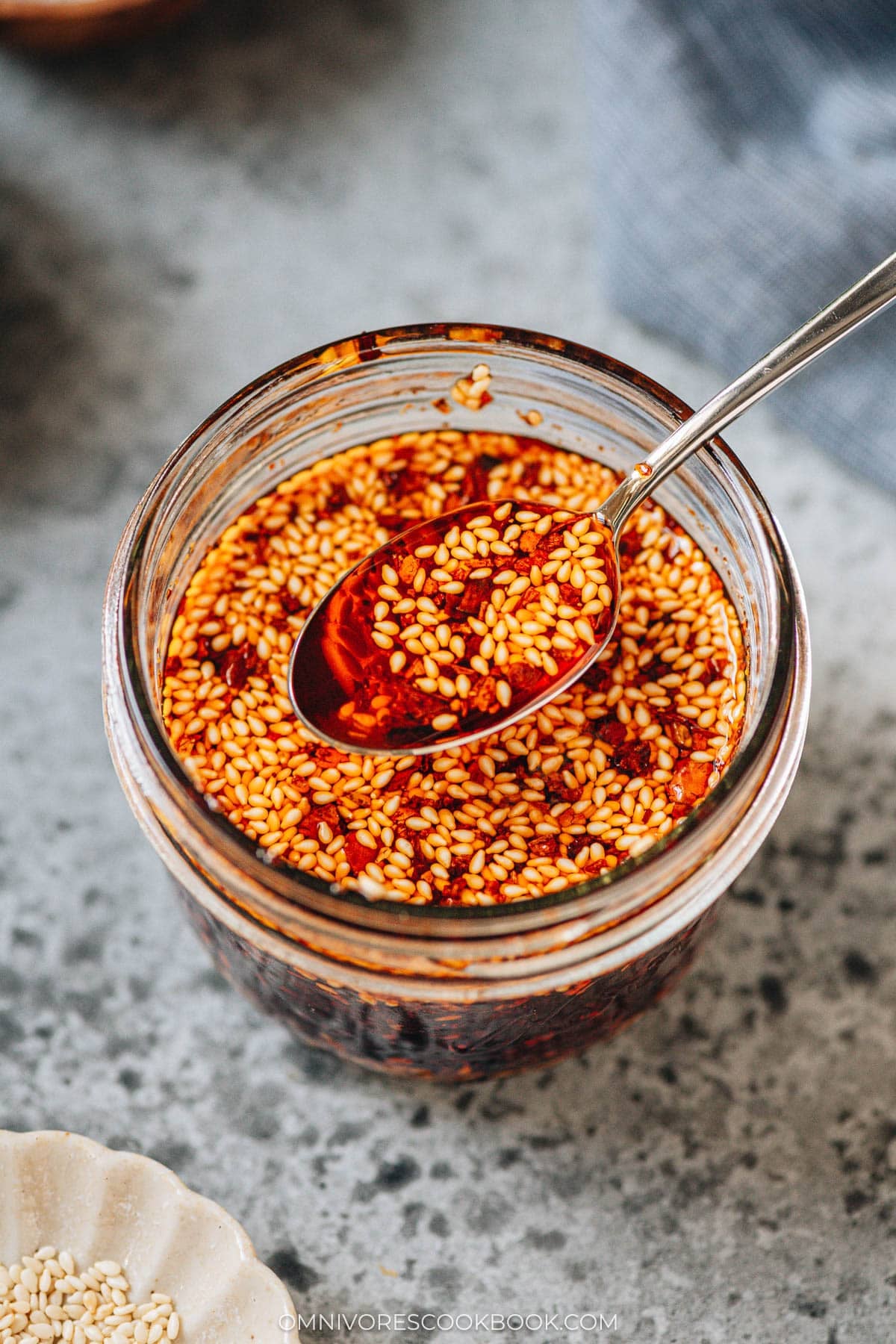
For a Chinese family, chili oil sits on the table next to the soy sauce and the black vinegar, and it shows up at every small noodle shop and dumpling counter I have ever walked into. It is a cousin to the jarred chili crisp you see on shelves now, but thinner and made for spooning over a finished bowl rather than eating by the spoonful. Once you start reaching for it, you will want it on almost everything.
When I say chili oil, I mean the homemade version, because it tastes far better than anything in a jar and keeps just as long in the fridge. The freshness is the whole point, a nutty fragrance that bottled oil loses on the shelf, with no additives or MSG. I use mine the way I grew up using it, stirring in the toasted flakes at the bottom so every bite of dan dan noodles or sesame noodles picks up those crispy and smoky bits I love.
I make this in three moves: I combine the flakes and spices in a heatproof bowl, heat the oil until it is hot but not smoking, then pour it over the spices and let it bubble. The only thing to watch is the oil temperature, and I will walk you through a ginger trick for that if you do not own a thermometer. Pour your first batch the next time a bowl of noodles needs waking up, my directions below take you from cold pan to finished jar in 10 minutes.
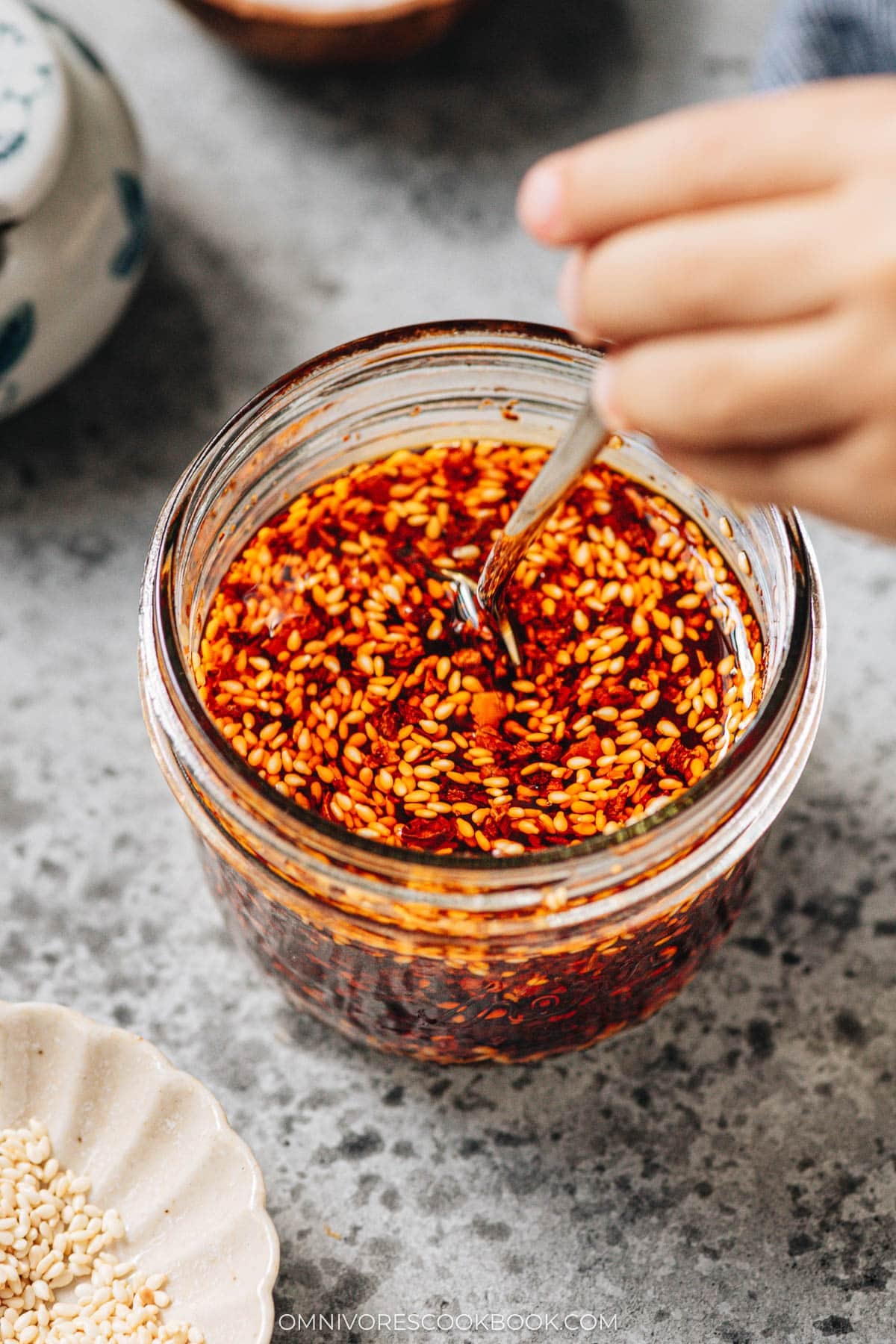
Ingredients
These are the ingredients to make chili at home and the one thing I will not compromise on is the chili flakes, since they set the color and the heat of the whole jar.
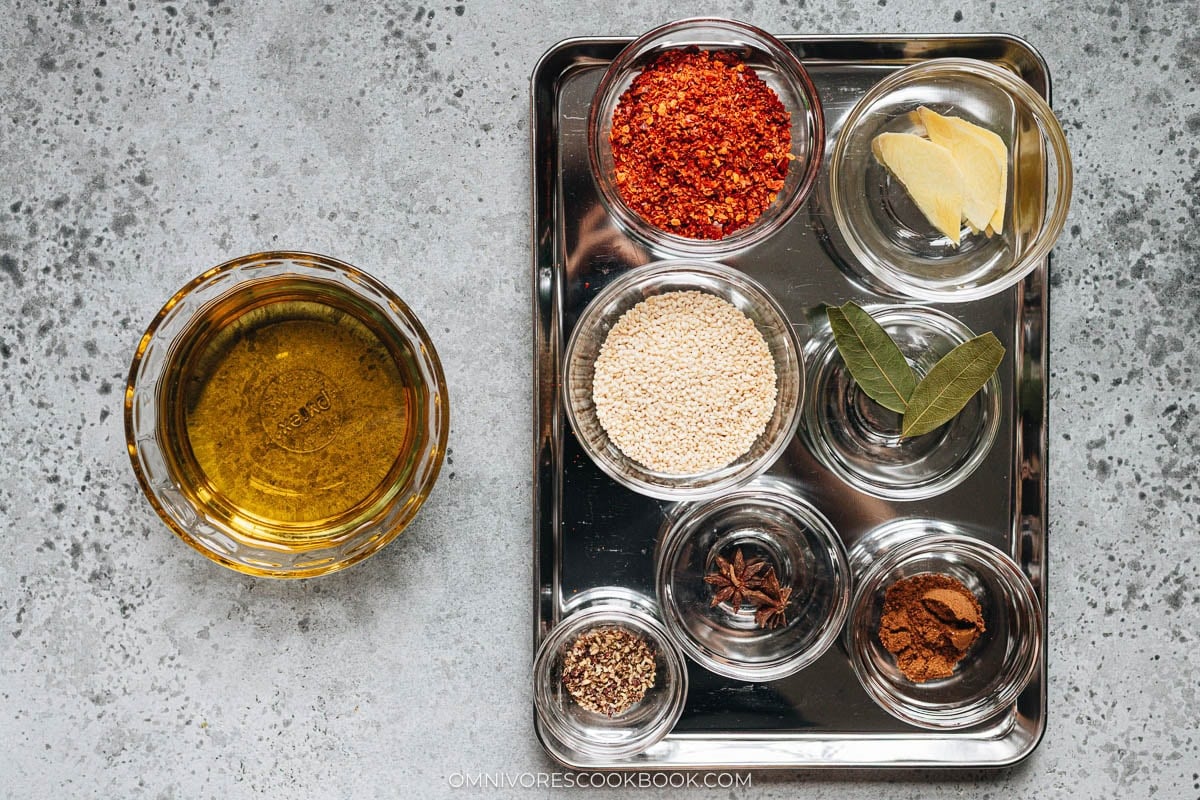
Chili flakes: I highly recommend Chinese chili flakes from The Mala Market, which is very fresh chili flakes imported from Sichuan. They have a vibrant red color and fewer seeds, so the oil comes out fragrant rather than punishingly hot. I use Korean chili flakes as my backup, and while the red color comes out a little softer, the taste holds up.
Aromatic spices: I mix in five spice powder, ground Sichuan peppercorn, a whole star anise, and a couple of bay leaves to give the oil depth beyond straight heat. The star anise and bay leaves come out later, so they perfume the oil without taking over.
Toasted sesame seeds: I add toasted sesame seeds for a nutty layer that plays against the chili, and they crisp up a little more when the hot oil meets them.
Oil: I use a neutral oil like vegetable or grapeseed so nothing competes with the spices. I want the chili and sesame to lead, not the oil itself.
Ginger: I drop in a piece of thinly sliced ginger while the oil heats, and it does double duty, perfuming the oil and telling me when the oil is hot enough to pour.
How to Make
1. Combine the spices: Put the chili flakes, five spice powder, sesame seeds, star anise, Sichuan peppercorn, and bay leaves in a heatproof ceramic bowl that holds at least 2 cups. Set the bowl on a heat resistant coaster before you start the oil.
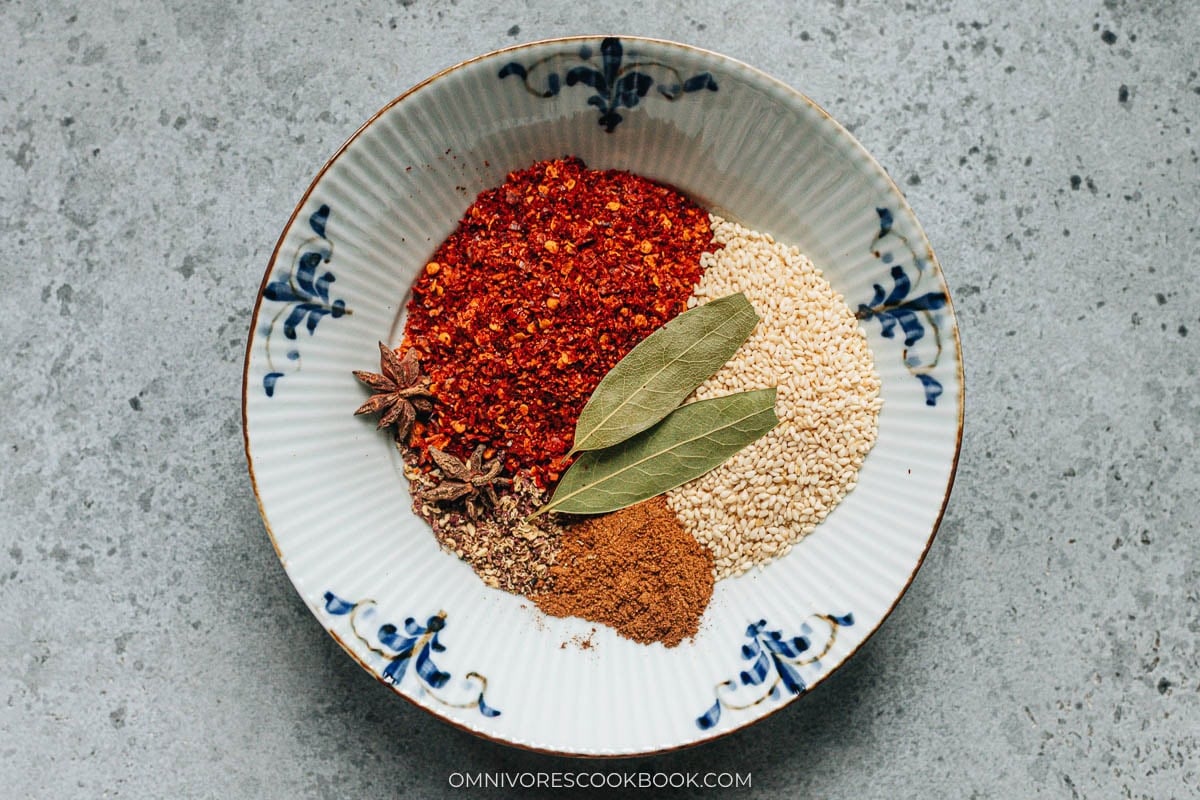
2. Heat the oil: Heat the oil in a wok or skillet over medium-high heat and add the sliced ginger. When the ginger turns golden brown and bubbles are rapidly rising around it, turn off the heat immediately. The oil should reach about 370°F (190°C); do not let it exceed 400°F (200°C).
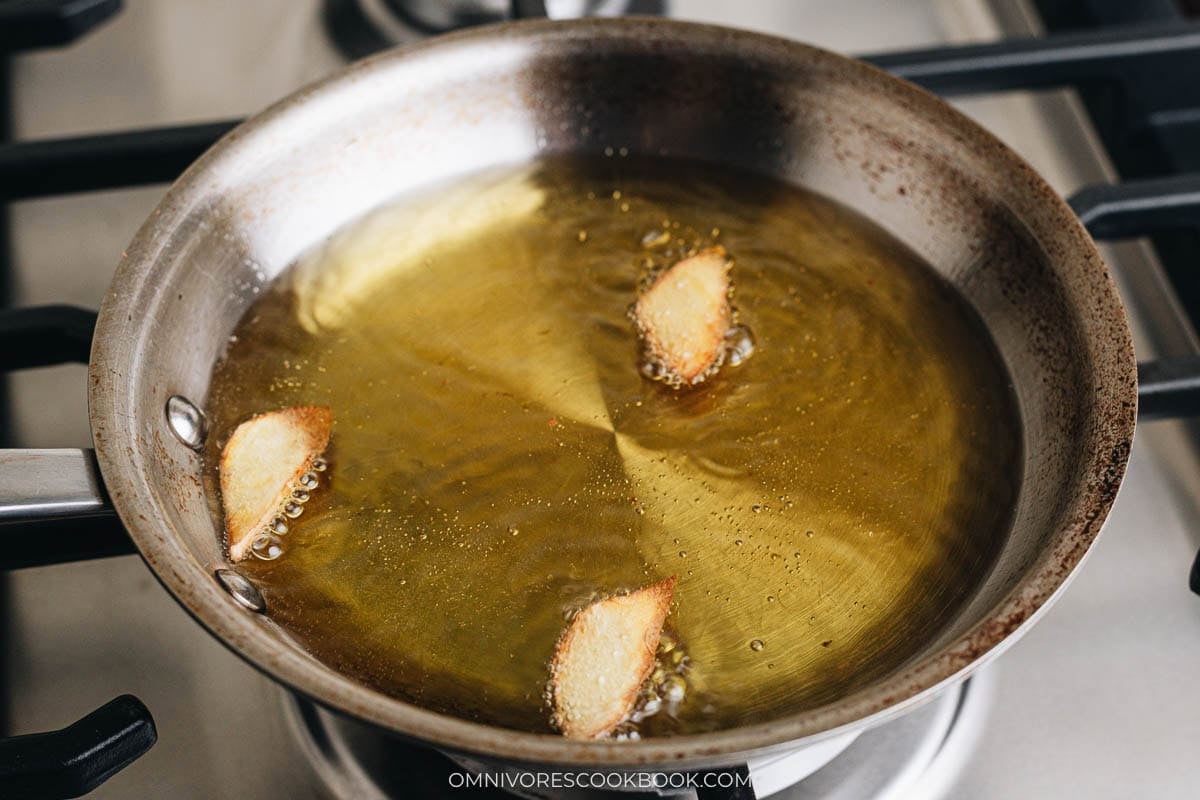
3. Pour the oil over the spices: Carefully pour the hot oil, or ladle it, into the bowl of spices. It will bubble hard for a few seconds and cook everything, so stir with a metal spoon while it bubbles to cook the spices through.
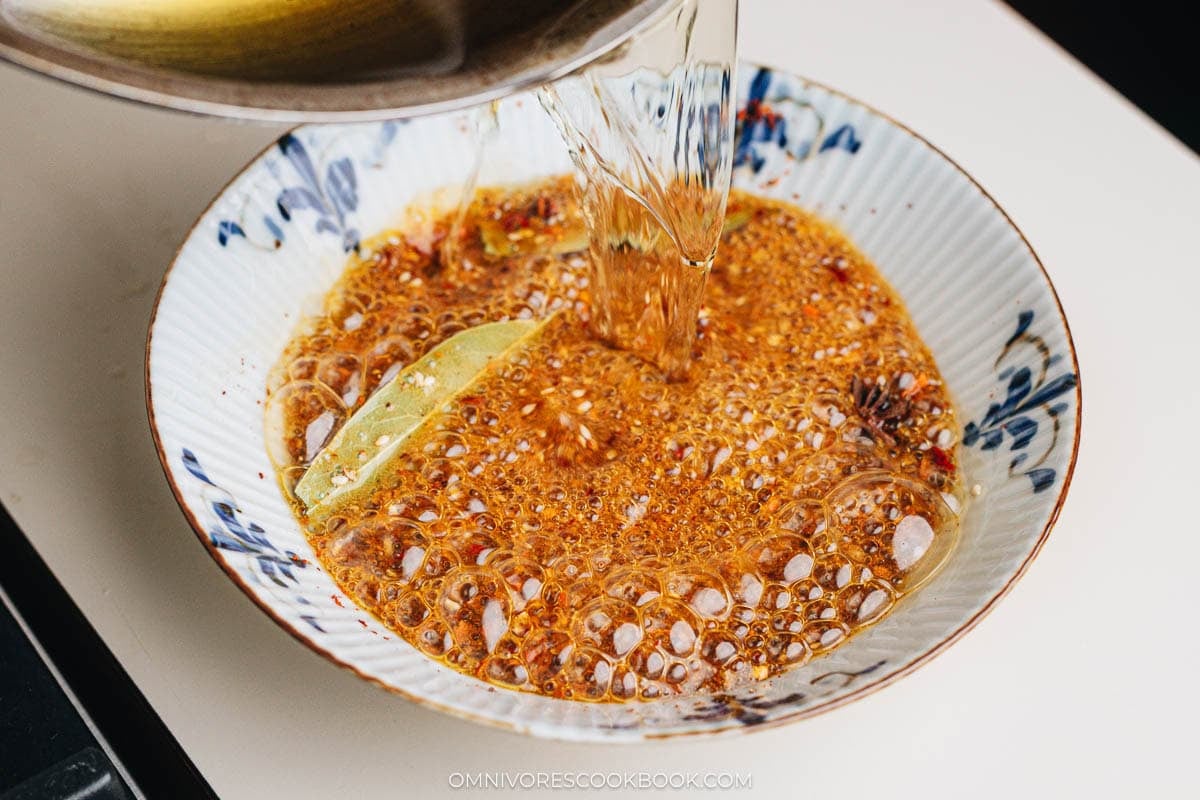
4. Remove the whole spices: Once the oil cools a bit, scoop out and discard the star anise and bay leaves. The oil is ready to use right away.
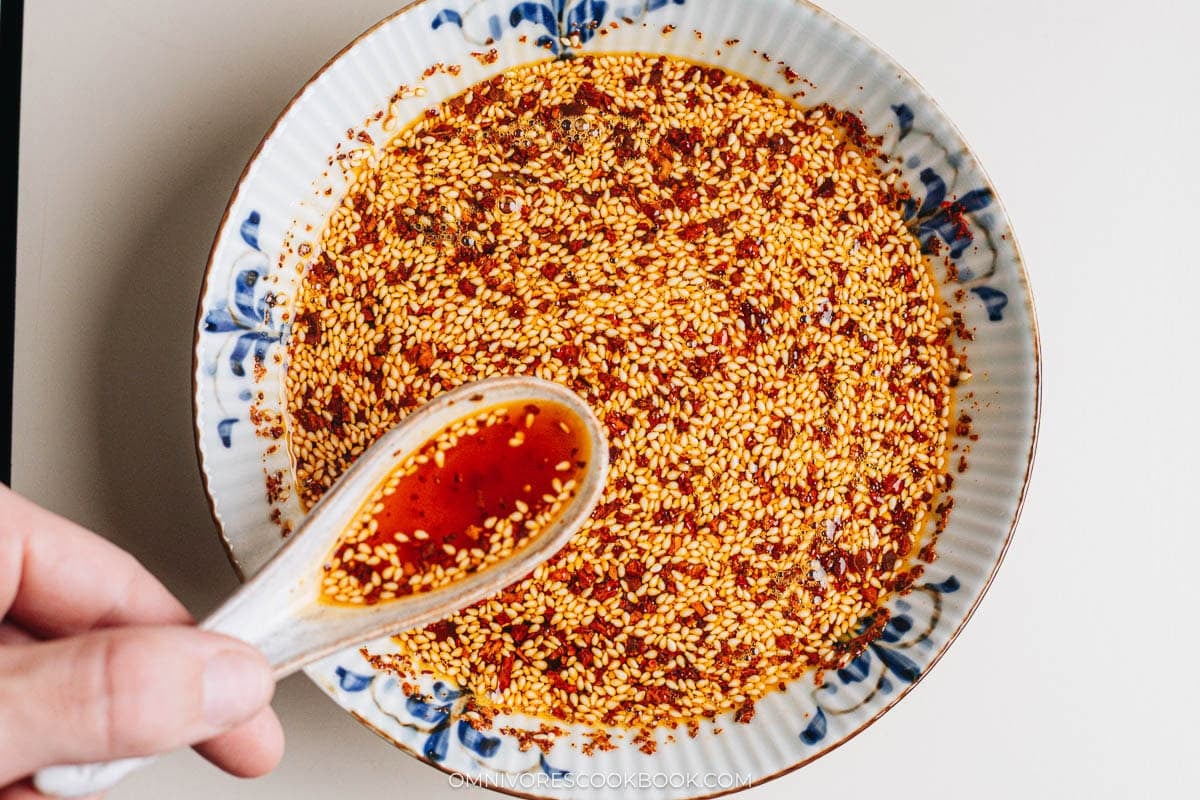
5. Let it rest: For the fullest flavor, let the oil sit for a day so the spices infuse into the oil.
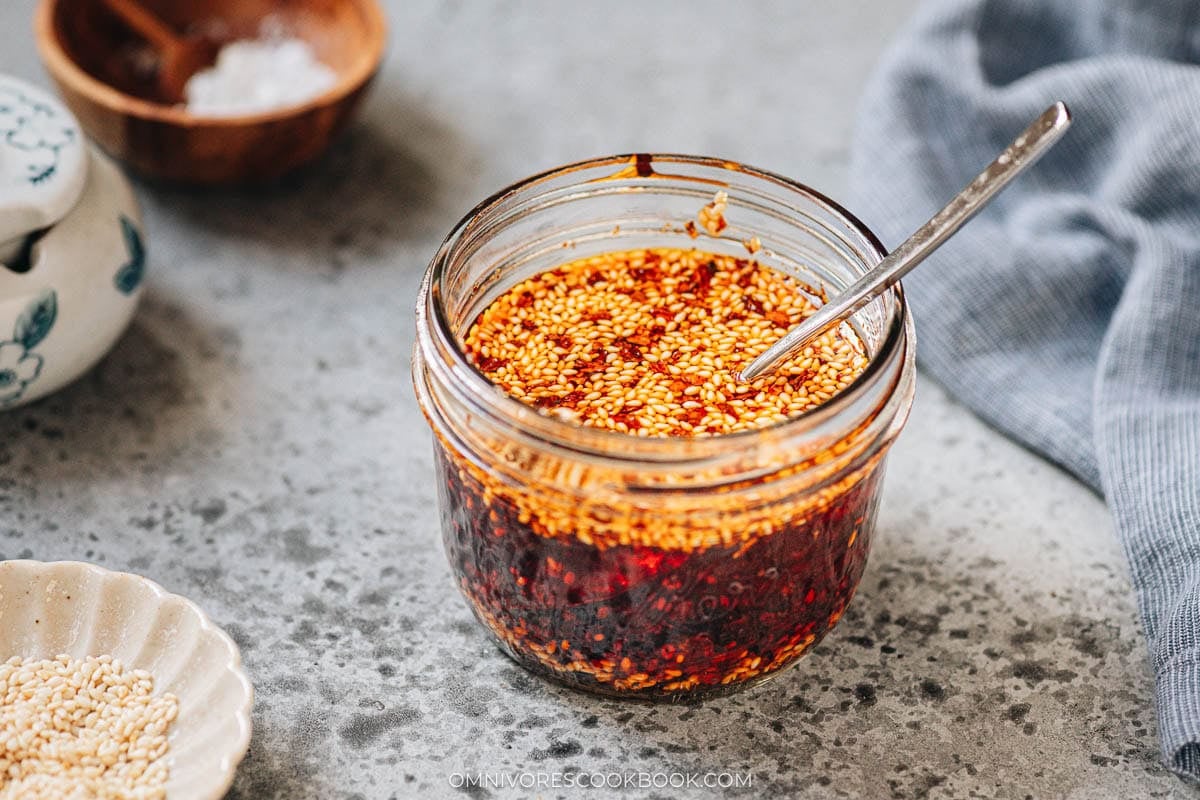
Tips to Consider When Making Chili Oil
Use a ceramic bowl, not glass: I pour 370°F oil into the spices, and a ceramic bowl takes that heat without trouble. If you only have a glass jar, make sure it is labeled heatproof, because ordinary glass can shatter when the hot oil hits it.
Watch for the ginger cue: If you do not own an instant thermometer, the ginger is your gauge. Once the slice withers and goes golden, the oil is in the right range, and that is the moment to kill the heat.
Do not overheat the oil: The line between fragrant and bitter is temperature. Oil that climbs past 400°F scorches the flakes and the sesame seeds, and burnt spices make the whole jar bitter with no way to fix it.
Pick the right pan for pouring: I use a small saucepan with a long handle so I can pour in one steady motion, or I keep a ladle ready. A clumsy pour splashes hot oil, and this is the step where I slow down.
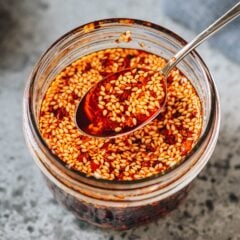
Stir in the flakes when you serve: The toasted flakes at the bottom of the jar are the best part. I scoop oil and flakes together so each spoonful brings smoky crunch, not just heat.
Make the aromatics your own: In China every region and every family has a formula, so treat the spice list as a starting point. This is my family’s version with Sichuan peppercorns for a numbing nuttiness and a pinch of five spice for savory depth, but a plainer chili-flake-only oil is just as valid.
How to Use Chili Oil
Chili oil lives at my table as a finishing spoonful, not a cooking fat, so I keep the jar and a small spoon out whenever noodles or dumplings are on the menu. I spoon it over a bowl of Lanzhou beef noodle soup right before I eat, letting the oil float on the broth and the flakes sink into the noodles.
When I want the chili oil to be the star rather than a garnish, I make a batch of Sichuan spicy wonton in chili oil, where the oil is the sauce and everything rides on getting it right. It is also the finish that makes proper Sichuan dishes sing, spooned over mapo tofu or stirred into a cold spicy cucumber salad. A jar in the fridge means any simple bowl is 30 seconds from tasting like a noodle shop.
For starting my day I use it the same way I did growing up. I stir a spoonful into a bowl of savory oatmeal or plain congee, and I drizzle it over roast vegetables to give a meat-free plate depth. It is the one jar that saves a bland dinner, which is why it never leaves my fridge.
Frequently Ask Questions
What kind of chili flakes should I use?
I use Chinese chili flakes imported from Sichuan for the best color and a fragrant, moderate heat, since they contain fewer seeds. Korean chili flakes (gochugaru) are my reliable second choice. They’re generally milder, and the chili oil will have a slightly lighter red color, but the flavor is still excellent.
Can I use whole dried chilies instead of flakes?
Yes, you can make your own flakes from whole dried chili peppers. I lightly toast the dried chilies first until they darken a little, then grind them into flakes. If I want a milder oil, I cut open half of the peppers with kitchen shears and discard the seeds before grinding.
Should I strain out the chili flakes or leave them in?
Both are common, and the preference varies across China. As a northerner, I grew up with jars that were mostly chili flakes with just enough oil to cover them, so I leave the flakes in for their smoky flavor and texture. But you can strain them out if you prefer a smooth, clear chili oil. Many restaurants in China serve the chili oil and the chili sediment separately, so diners can choose whichever they prefer.
How long does chili oil keep in the fridge and freezer?
Covered at room temperature the oil keeps for about 2 weeks, and in an airtight container in the fridge it lasts up to 6 months. I do not freeze chili oil.
Want to Save This Recipe?
Enter your email below & we’ll send it to your inbox. Plus get great new recipes from us every week!
Watch video
How to Make Chili Oil (辣椒油)
Ingredients
- 4 tablespoons Chinese chili flakes (*footnote 1)
- 1 teaspoon five spice powder
- 3 tablespoons toasted sesame seeds
- 1 teaspoon ground Sichuan peppercorn
- 1 whole star anise (Optional)
- 2 bay leaves
- 1 cup vegetable oil (or grapeseed oil)
- 2 to 3 piece thinly sliced ginger (Optional)
Instructions
- Combine chili flakes, five spice powder, sesame seeds, star anise, Sichuan peppercorns, and bay leaves in a heatproof ceramic bowl that can hold at least 2 cups liquid. Place the bowl on a heat resistant coaster.
- Heat oil in a wok (or a skillet) over medium-high heat. Add ginger. When the ginger starts to wither and turns golden brown, immediately turn off the heat. Remove and discard the ginger. The oil should reach 370 degrees F (190 C) and no higher than 400 F (200 C) if read with an instant thermometer.
- Carefully pour oil or use a ladle to transfer oil into the bowl of mixed spices. The oil will bubble for a few seconds and cook the spices. While the the oil is bubbling, use a metal spoon to stir gently to mix the spices, so they’ll cook thoroughly.
- When the oil cools down a bit, scoop out and discard the star anise and bay leaf.
- The oil is now ready to use! Its flavor will mature if you let it rest for a day, allowing the spices to infuse into the oil.
- The oil can be stored covered at room temperature for two weeks, or up to six months in the fridge in an airtight container.
Notes
Nutrition

Did you make this recipe?
I’d love to hear how it turned out for you! Please take a moment to leave a 5-star rating ⭐️ and share your thoughts in the comments further down the page. It really helps others discover the recipe too.
The recipe was originally published on August 7, 2014, and updated on Sep 10, 2026.
nicole
hi. How log does it keep?
Maggie
Hi Nicole, the chili oil will last very long time if you store it in a jar in the fridge. One jar lasted half a year in my fridge without any problem. Although just like any other homemade sauce, it tastes the best when it’s fresh and it will last for at least 3 months without any problems.
Salle
I have been making this frequently, thanks to your easy directions and recipe. I’m hooked! I like to use a mix of regular, organic chili flakes (from the grocery spice section) and ones I got at an Asian grocery store, because that way it isn’t too spicy, just smoky and wonderful. My absolute favorite way to use it is as a simple dunking sauce for roasted squash, carrots and sweet potatoes. Just standing over the counter, being amazed at how delicious it is. And even though I’ve transitioned to a “no meat, no dairy, no eggs” lifestyle, I still get to keep my homemade chile oil. Thank you!
Rekha
Hi Maggie,
Thanks for sharing such a wonderful recipe. I don’t know how often you make it at home, but I’ve made it 2x in the last two weeks because it is a hit with my family, and the results are amazing and consistent. Thank you!!!
Salle Huber
I thought I was getting the right kind of chile, but now I see not.
I got two different items…dried prickly ash, and ot mieng. Can I use these for my chili oil? (I made some with regular organic chili peppers from whole foods…like you would put on a pizza…and it was very good and smoky, but not spicy at all.)
Thanks for advice. Love everything you post.
Maggie
Hi Salle, thanks so much for your kind words!
I didn’t see the packages you get, but judging by the names, I think you can use dried pickly ash (aka Sichuan peppers) and ot mieng to make the chili oil. In fact you can use various types of chili peppers to make the oil, which results in different flavors. IF you use the regular chili peppers (smoky but not spicy) again, you can blend in a small portion of cayenne powder or crushed Thai chili peppers (1 to 2 teaspoon per cup of oil) to add spiciness.
I hope your next batch of oil comes out beautifully 🙂
Janie
Under the photograph, you write “(2) Heat the oil until it reaches 275 degrees F (135 C).”
In the recipe you write, “(2) Heat the oil until it reaches 275 degrees F (135 C).”
Which is it?
Thanks
Janie
WHOOPS!!!!
I didn’t notice that my second copy didn’t take before I clicked Post Comment. Sorry about that.
It should read : “In the recipe you write, “The oil should reach 370 degrees F (190 C) and no higher than 400 F (200 C) if read with an instant thermometer.”
Maggie
Hi Janie, sorry about the confusion! It should be 370 degrees F (190 C). I just updated the blog post so now it’s consistent.
Happy cooking and I hope your chili oil turns out delicious 🙂
Janie
Thanks, Maggie!
janie
Chit
I just watched your you tube on chili oil! Wow that simple? Am excited to do it now! By the way Maggie I cooked the chicken fried rice last night! So yummy! My husband enjoyed it too! You are amazing! Recipes are simple tasty and very authentic Chinese flavor! And your pretty Maggie! May you continue to be inspired in the kitchen!
Maggie
There are a few ways to cook chili oil and this is my favorite method, because it is simple and generates great result 🙂
Thanks for leaving a comment and let me know about the fried rice. Glad to hear you guys enjoyed the dish!
Marija
This is completely addictive! The recipe is so simple and straightforward, and the result is just… poetry for the palate. I’ve poured this on everything, from Chinese noodle soups, to roasted potatoes, to salads, cold meats… It really does bring every dish up a notch. Thank you!
CO Lee
that’s the way we are too! It goes on everything. And I just made a new batch …
Martin
Hi Maggie wich temperature should i pour the oil on the chilies when it reaches 135*celcius or 190*?
Maggie
Hi Martin, you should wait until the oil reaches 190C. Although sometimes I don’t really measure the temperature, because the air above the pan can get really hot.
What you can do is to pour a small amount into the oil and see if it sizzle. That can be an easier judgement.
Martin
Hi Maggie again i’m sorry to ask once again about the same topic here. I forgot to ask aswell if i have to toast the chilies before doing this to make it bring more flavour to the oil or should i skip this? this is my final question i would be very thankful if you could reply once more. Thanks again!
Maggie
Hi Martin, no worries and please feel free to ask a question anytime!
No you don’t need to toast the chillies flakes because the hot oil will toast it and bring out a lot of flavor.
On the other hand, if you’re making the oil from whole chili pepper, toast the whole peppers can be helpful before you grind them.
Happy cooking and let me know how the chili oil turns out! 🙂
Jeff Stern
Love your site and your recipes. This is a great primer on making chile oil. I know how to make herb infused oils but this is a new take for me. Thanks!
Milena | Craft Beering
I am glad you brought this post back into the spotlight. Pinning to try and make our own chili sauce soon, we usually purchase it, this looks fun and I can only imagine how much better it tastes.
Maggie
Thanks so much for sharing Milena! Yes you should definitely make it once at home. It is so easy and the result tastes way better than the bottled chili oil!
Christine Morgan
I just want to take a moment to thank you so much for the recipe of chili oil. This is my new a chapter of my life using your recipes, the best part of all is that you use pictures of the ingredients I want to go to the store I can at least open the phone and show them a picture of what I need and that’s the most important sometimes translation is very hard for me but I just want to thank you!!!! Looking forward to many recipes of yours!
Maggie
Hi Christine, thanks so much for the kind words and I’m glad to hear my ingredient pictures are helpful! I’ll make sure to take more ingredients photos and add them in my future posts as well 🙂 Yes navigating an Asian market can be frustrating sometimes, even when you understand the language. Last time it took me 15 minutes to locate a small pack of powder for tofu making!
Anyhow, happy cooking and hope you have a great week ahead 🙂
Paula LaBine
Hi Maggie! I’m currently visiting Xian and loved Biang Biang noodles so much, I wanted to see a recipe for them and that’s how I found you. Great site and I can’t wait to try your recipes when I get back to the US. We were previously in Chengdu and when we ate dumplings, they always had this red chili condiment on the table to eat with them. It had some floating oil on top, but was more of a chili paste. Is this recipe similar that that, with more oil added?
CJ
I stumbled on your blog. You make cooking so easy and your short cuts are great. Thanks.
Maggie
You’re the most welcome CJ! And glad to hear you found my blog helpful! Happy cooking and have a great week ahead 🙂
dylan
My seasame seeds don’t see to float like yours! And my chili flakes don’t sink! Haha, did I do something wrong?
I can’t believe how awesome the spicy/nuttiness is! Amazing!
Maggie
I think the chili flakes will sink if you set them aside for a bit longer? The sesame seeds? I have no idea! In fact I’d like them to sink, because they sometimes get in the way lol I think it’s fine as long as it doesn’t affect the taste.
Glad to hear you enjoyed the chili oil 🙂 Use it on noodle salad and it will make the dish awesome.
Menolly
Did you toast your seeds? I think I read somewhere that if you toasted your seeds they would be more likely to float. Il try to find the article again.
Nataline
Thank you so much for this recipe! I tried it side by side with the recipe from Woks of Life and prefer this one, largely because of the sesame seeds which add a nice crunch. The Woks of Life version was very similar, but because it has more Sichuan peppercorn, ended up a bit warmer. I am so addicted to the nutty smoky taste of this chili oil.
Maggie
Hi Nataline, I’m glad to hear you like the recipe! Adding sesame seeds into the chili oil does boost its flavor a lot, so I personally prefer this way too. Thanks for taking time and leaving a comment to let me know 🙂 Have a great day!
Deborah
Trying to sign up for newsletter and e-cookbook but it doesn’t go through. What’s up with that?
Maggie
Hi Deborah, many many thanks for letting me know about this problem. I just realized my newsletter system released an upgrade and I didn’t install it properly. Now the newsletter signup form works properly and you should able to sign up. Could you please try it again? Thank you for your time, and I really appreciate your help 🙂
Thomas
This has become a staple condiment of mine and I make it about once a month. Nothing compares to the nutty spiciness, and I just can’t get enough.
To get the hot oil just right, I use either vegetable or peanut oil, heat it to 430-440F, and pull it off the burner right as I start to smell a hint of smoke. I suppose other oils will work, but any oil used needs a smoke point above 430F, in order to toast the spices and extract flavor properly without burning.
I found that the ginger test isn’t quite accurate. My ginger slices turned into crispy (and delicious) ginger chips around 400F (I removed them and ate them once they were totally toasted). This may have to do with the fact that an electric stove (which I was using) heats more slowly. The best way to judge the temperature of the oil is to monitor it very closely – with a thermometer or by paying close attention to the faintest hint of smoking oil, or both.
Sophie
I like how each family seems to make their own version of chile oil 🙂 I add scallions to mine (but fish them out before sealing the jar in the fridge). I love it! I just ran out actually because whenever I’m frying day-old rice or noodles I use lots….. it’s my favorite! Thank you for sharing your version (and good tip about not eating any whole peppercorns :):)
Maggie
Adding scallion to the chili oil sounds so tasty! I never tried to add chili oil into fried rice, but it sounds great! Thanks for sharing the ideas and I cannot wait to try them out! 🙂
Villainesse
As a music student working on my masters, I shared an apartment with a violinist from Beijing who taught me many such simple recipes. Imagine my horror when I cooked back home and my father tossed the large amount of remaining oil in the garbage! Thanks for the hint on fishing out those lovely green onions for long storage, whose flavor is wonderful in any hot oil.
Nami | Just One Cookbook
Yay for homemade Chili Oil! I’m going to try your recipe next time!
Maggie
I’m so happy to hear there are people who prefer to cook those things at home. Happy cooking and let me know how it goes! 🙂
Sherry DeJanes
This is the best chili oil I’ve ever had!!!
Crystal | Apples & Sparkle
Thank you so much for sharing this Maggie! I really enjoy making my own condiments when I can, I can just imagine how superior this is to the store bought kind. : )
Maggie
Thanks Crystal! I’m totally agree with you, those homemade condiments have much better flavor. It takes no time after you get used to the cooking process. 🙂
Menolly
How does it only make 1 cup? There a cup of oil, plus almost 1/2 cup between the chilies, the sesame seeds and the spices? I’m trying to order a jar to store it, and I’m really confused about the total volume of the recipe.
Susi
Thank you Maggie. I and My hubby give 2 thumbs up for this chili oil. So fragrant.