
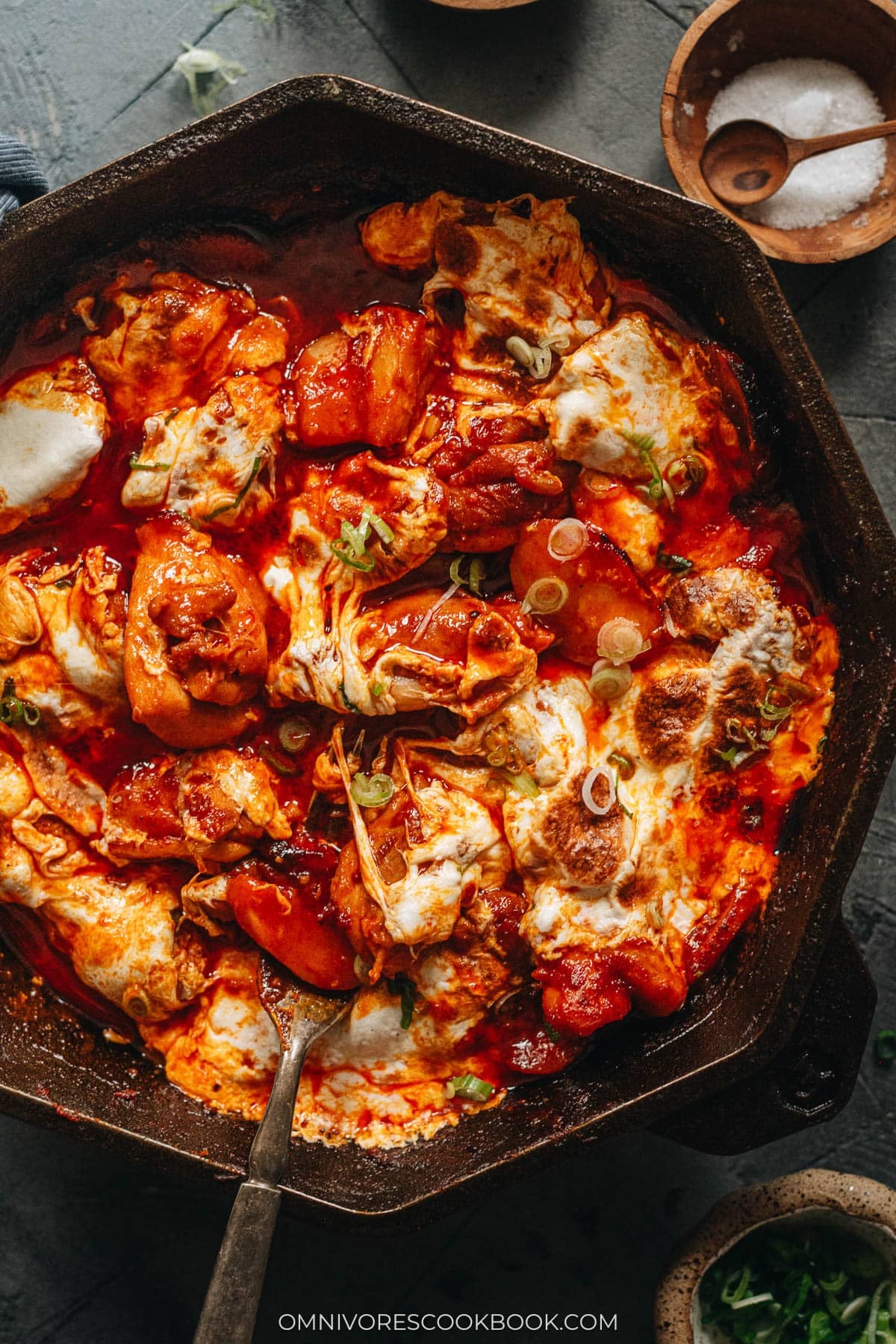
Cheese buldak is a modern street food version of buldak, the Korean fire chicken that gets its name from the volume of chili paste and chili flakes in the sauce rather than from any open flame. The cheese layer on top is a newer addition, melted under the broiler at the end so it bubbles and browns over the red sauce. It sits in the same Korean comfort food shelf as my Korean instant pot short ribs and japchae on the site.
I came to this recipe through Maangchi’s Big Book of Korean Cooking, which is the cookbook I reach for whenever I want to learn a Korean dish from the source. The first time I cooked it I underestimated how fast the broiler would go on the cheese and pulled the pan a minute past golden, with the top edges crossed into black. I have made it dozens of times since then and the broiler-watching habit is now muscle memory, which is the single biggest change between my first attempt and the version I cook now.
This recipe is very easy to make, and in my experience, even beginner cooks can make it with confidence. I mix the chili sauce in a bowl, toss the cubed chicken in it to marinate while the pan heats, pan fry the rice cakes, cook the chicken in the same skillet with a splash of water, fold the rice cakes back in, then cover the top in sliced mozzarella and slide the whole pan under the broiler. I recommend making this the next time you want an easy one-pan Korean dinner. Just follow the recipe below, where I walk you through every step and share the tips I’ve learned after years of making it for my family.
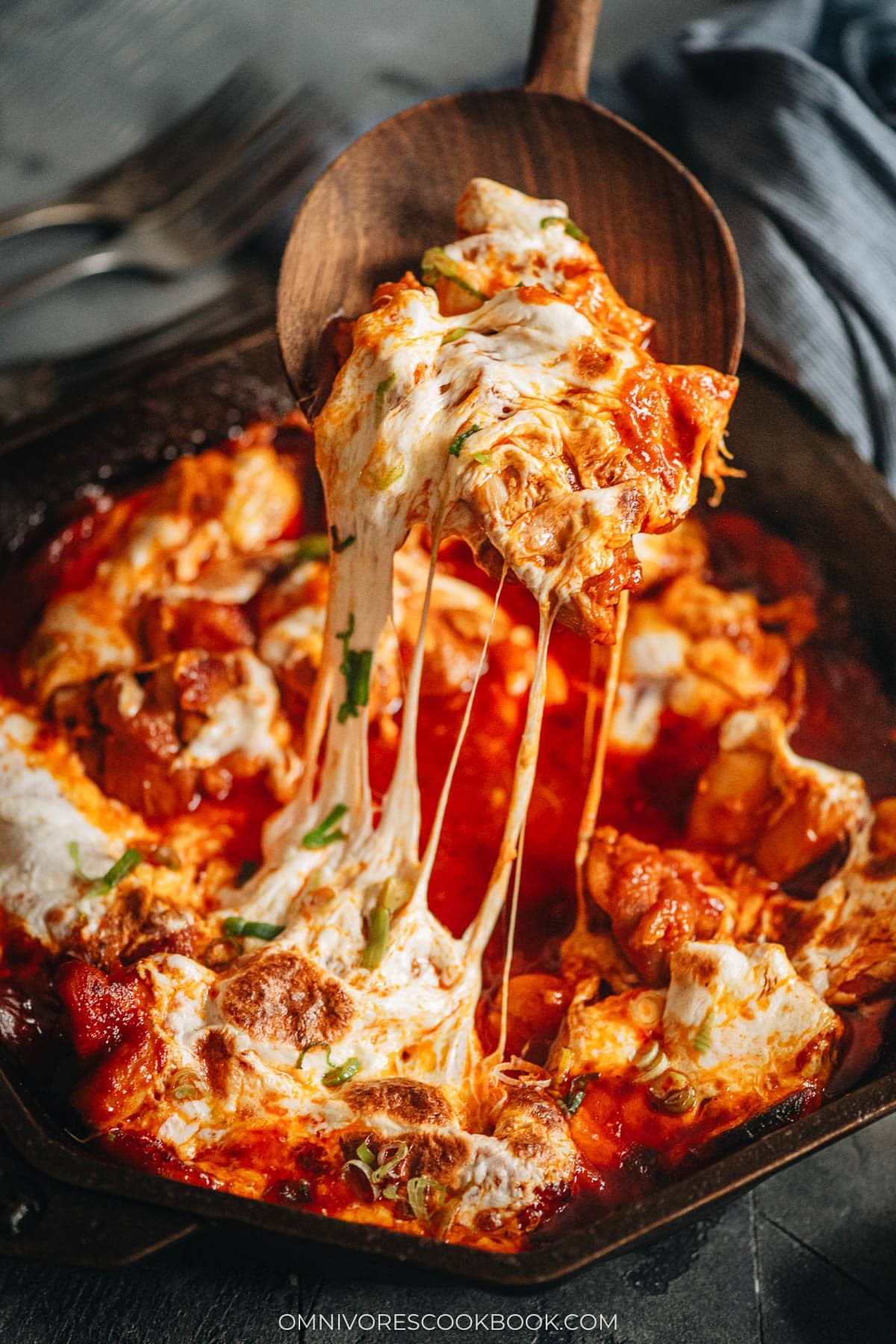
Ingredients
Most of this Korean Fire Chicken dish is pantry once you have a Korean grocery trip behind you. Here is what I use:
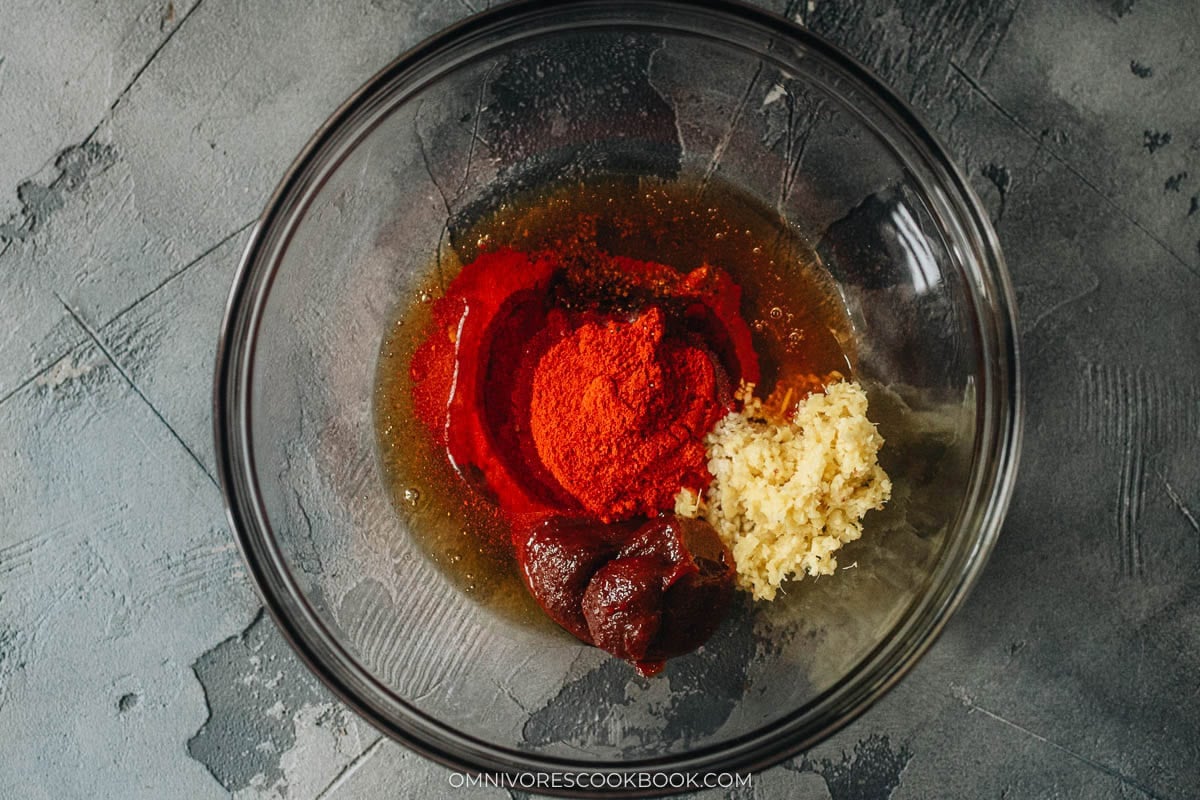
Chili sauce: I mix Korean hot pepper flakes (gochugaru) with gochujang, soy sauce, vegetable oil, ground black pepper, sugar, garlic, and ginger. Gochugaru and gochujang are both needed because they do different jobs, and I get into which is which in the FAQ below. Sugar is also important here because it balances the chili paste and pulls the sauce into a glossy coat instead of a chalky one.
Chicken and rice cakes: I go for for boneless, skinless chicken thighs because they survive the broiler finish without drying out. I cut them into small cubes so the lid-on simmer cooks them through in time with the rice cakes. Mochi rice cakes go in for the chewy contrast, sliced into rounds if I am using cylindrical garaetteok or kept whole if I am using the thinner oval shape.
Cheese topping: I cover the top with low-moisture mozzarella because it melts into a smooth blanket without breaking into oil pools the way fresh mozzarella does. Sliced gives me a cleaner top and shredded covers the surface faster, and I season the chicken with less salt when I use shredded cheese because the bagged shred is saltier than the sliced version.
How to Make
1. Mix the chili sauce: Combine the gochugaru, gochujang, soy sauce, 2 tablespoons of vegetable oil, black pepper, sugar, garlic, and ginger in a large bowl. Stir until the sauce is smooth.
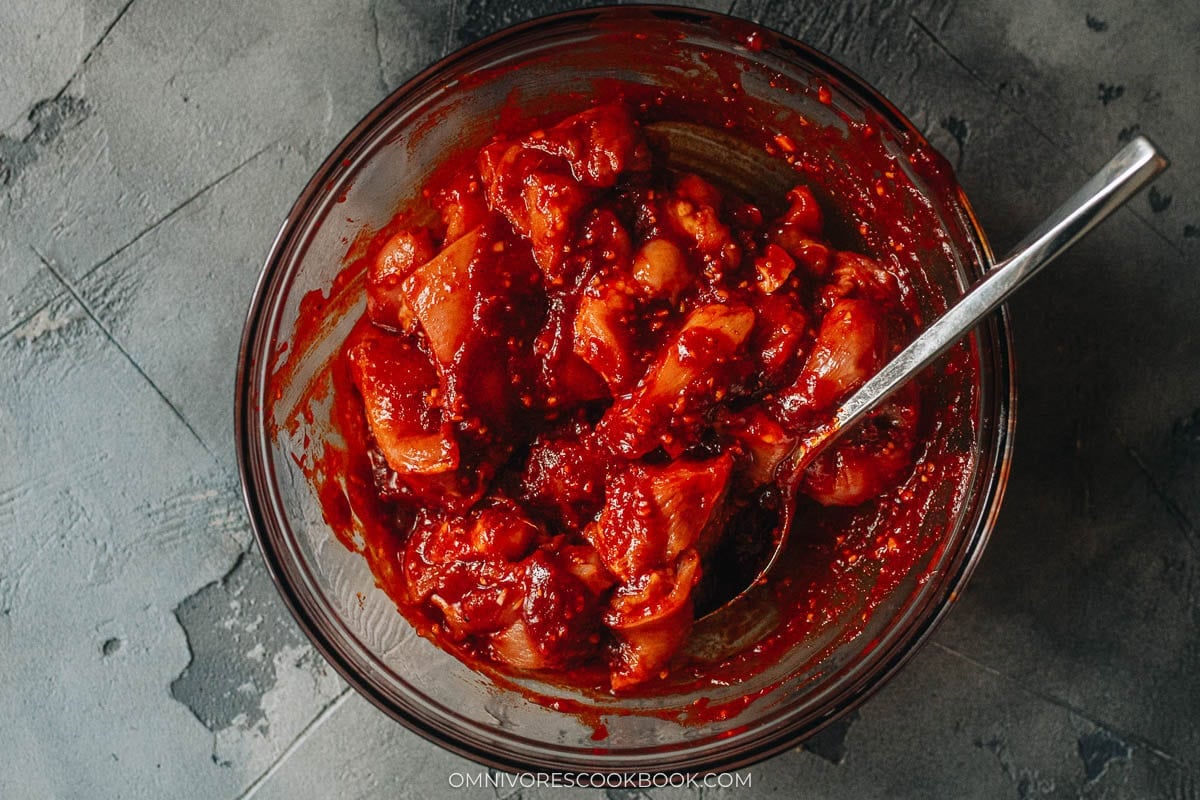
2. Marinate the chicken: Add the cubed chicken to the bowl. Stir with a spoon until every piece is coated in the sauce.
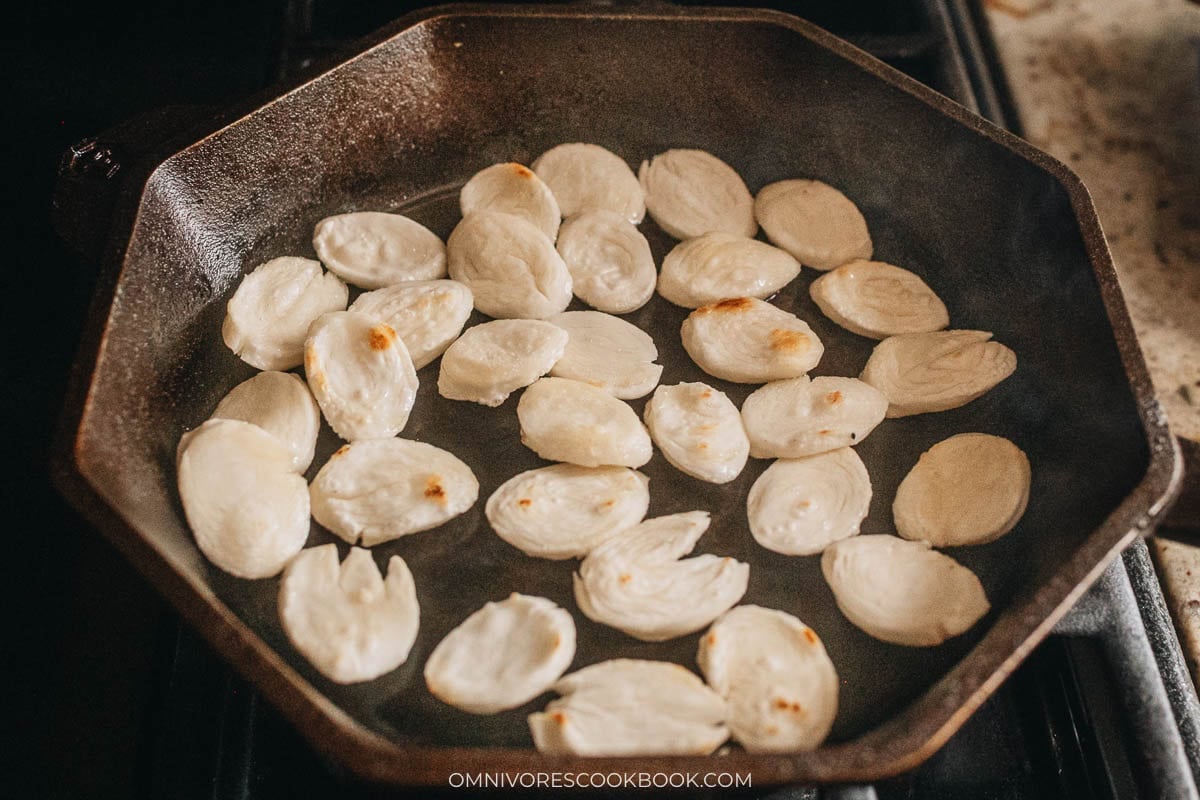
3. Pan fry the rice cakes: Heat a medium oven-safe 9″ skillet over medium-high heat. Add the remaining 1 tablespoon of oil and the rice cakes. Cook, turning with a spatula, for 3 to 4 minutes. Transfer the rice cakes to a small bowl.
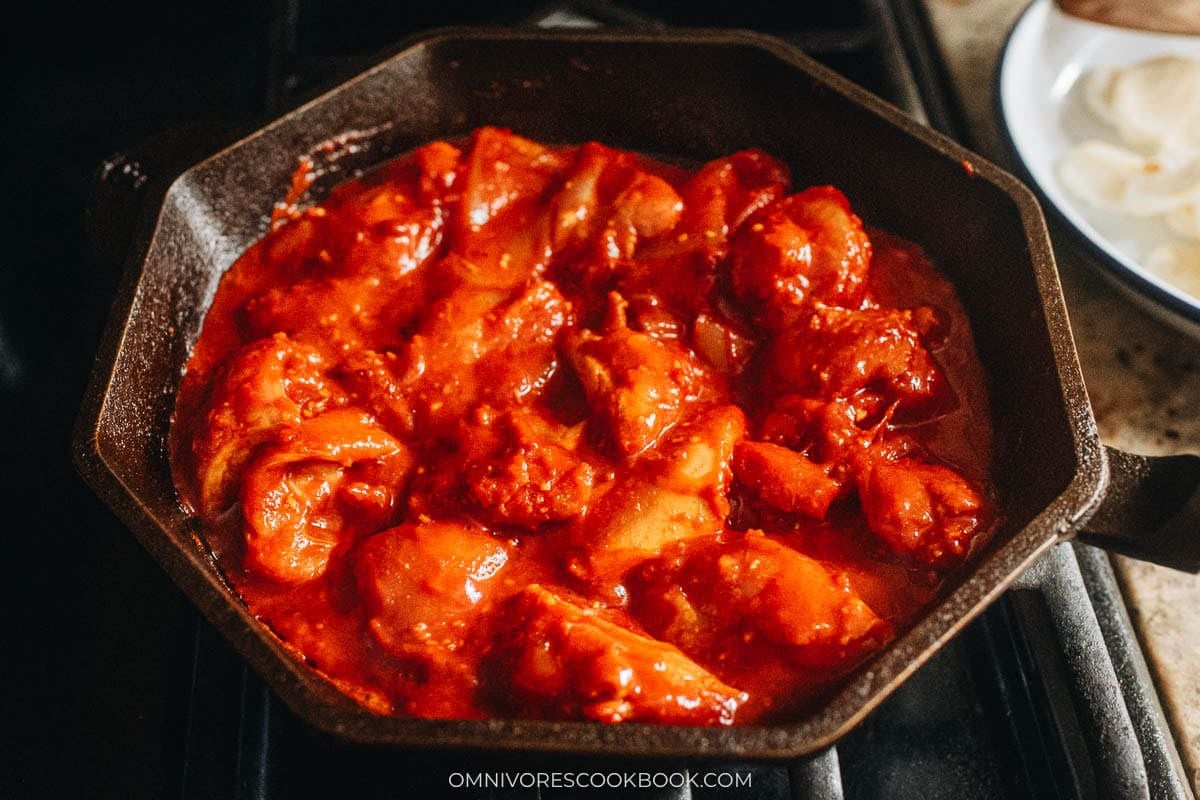
4. Cook the chicken: Add the marinated chicken, salt, and 1/4 cup of water to the same skillet. Cover and cook, stirring occasionally, for 7 to 8 minutes.
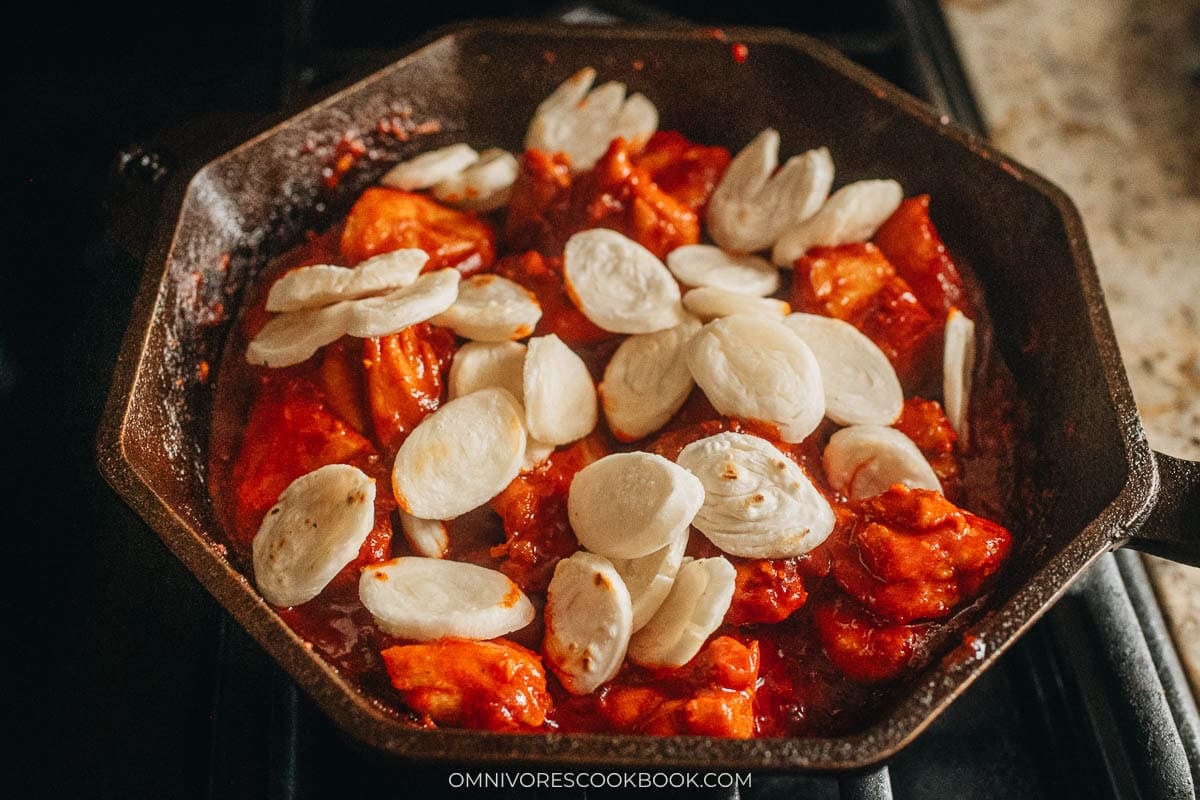
5. Add back the rice cakes: Stir the rice cakes into the chicken. Reduce the heat to low, cover, and cook for 5 more minutes until the chicken is fully cooked.
6. Preheat the broiler: While the chicken is finishing, preheat the broiler in the oven with the rack on the middle level.
7. Top with cheese: Lay the mozzarella over the chicken in one layer.
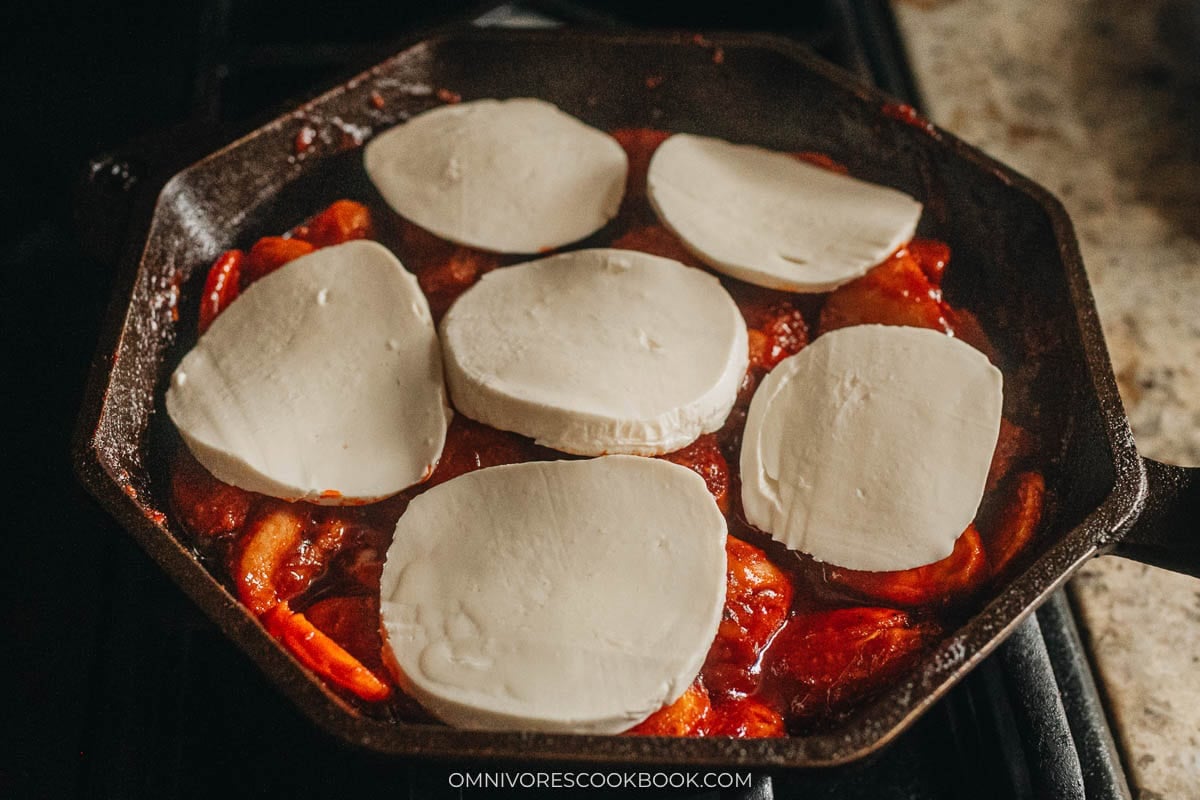
8. Broil the cheese: Transfer the skillet to the oven under the broiler. Broil for 1 to 3 minutes until the cheese is melted, bubbling, and lightly charred. Watch closely and check every minute because broilers vary.
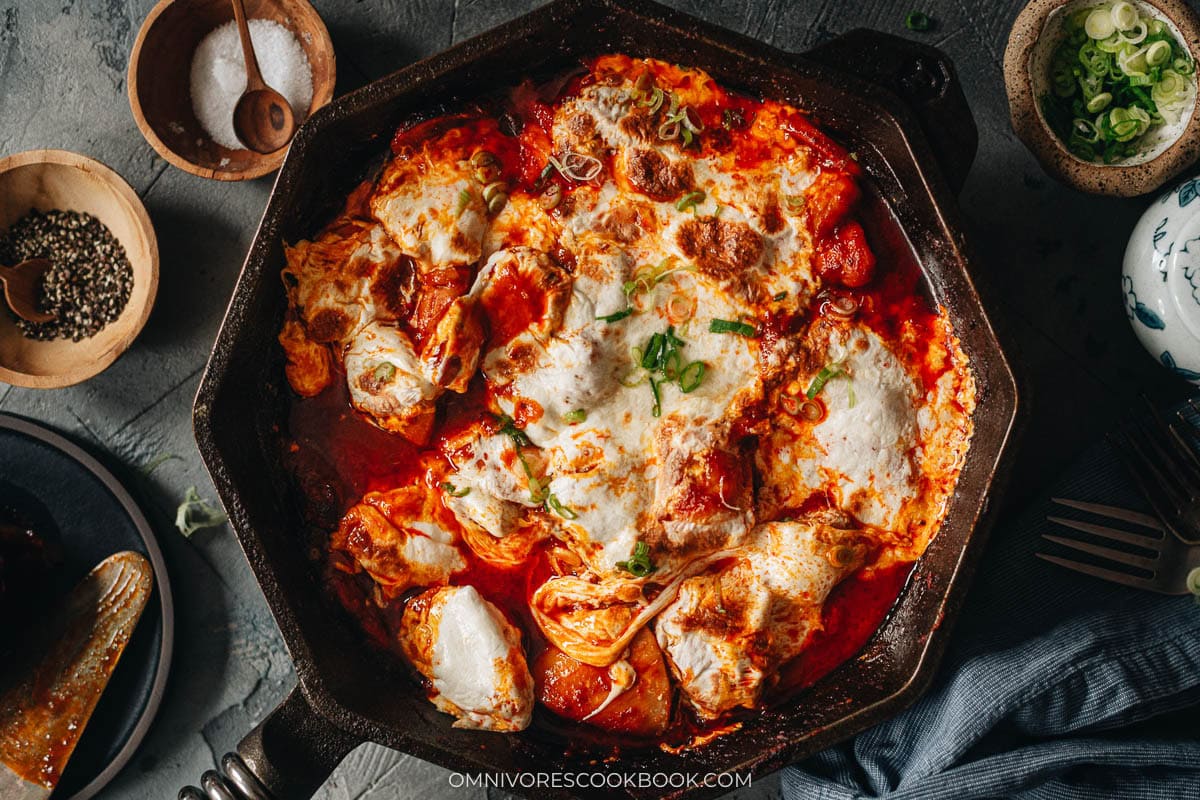
9. Rest and serve: Remove the skillet from the oven and let it sit for 5 minutes so the cheese sets enough to pull. Serve hot from the skillet as a main.
Cooking notes
Pick an oven-safe skillet that just fits the chicken: A 9 or 10 inch skillet is the right size for a single batch because the chicken should cover the bottom of the pan in one layer. If the pan is too big the chicken sits in a thin layer and the sauce pools into bare metal, which scorches under the broiler.
No broiler, no problem: If my oven-safe pan is in use or I do not want to fire up the broiler, I scatter the cheese over the chicken, cover the skillet, and let it melt on the stove over low heat for 2 to 3 minutes. The top will not brown the way the broiler version does, but the cheese still pulls.
Test the gochugaru before you commit: Korean chili flake heat varies by brand, harvest year, and grind. I put a quarter teaspoon on the tip of my tongue before measuring out the recipe amount, and if the flake is hotter than usual I drop the recipe down by a tablespoon. Older bags lose color but not heat, so I judge color by eye before I commit to the full 1/4 cup.
Skim the surface fat before the cheese goes on: Chicken thighs release fat as they cook with the lid on, and a thin pool of red oil sometimes collects on top of the chicken before the broiler step. I tilt the pan toward one corner and spoon off the surface oil so the cheese melts onto the chicken instead of floating on top of a pool of fat.
How to Serve
I bring the skillet straight from the broiler to the table because the cheese pull is the whole point and it does not survive a transfer to a serving plate. I set the pan on a trivet, hand out serving spoons, and we eat over bowls of plain steamed rice that I cook in the rice cooker while the chicken is on the stove. The rice catches the spicy sauce and tames the heat at the same time, which is why I never serve this dish without it.
For a larger Korean meal I serve this with a vegetable side and a different-protein dish to give the palate a break from the heat. Korean seafood pancake is my favorite partner, I also add a vegetable like a summer vegetable bibimbap for a fuller table, and on cold nights I make Korean army stew as the soup so everyone has something brothy to alternate with the cheese pulls.
Frequently Ask Questions
What is the difference between gochugaru and gochujang?
Gochugaru is the Korean coarse or fine red chili flake that gives the dish its red color and slow heat, sold in a bag. Gochujang is the fermented chili paste that comes in a tub, deeper in flavor, tastes spicier and saltier with a hint of sweetness, because it is fermented with rice and soybeans. Both are needed for this recipe because they do different jobs, and one cannot stand in for the other.
My cheese is not browning under the broiler, what do I do?
The most common reasons the cheese stays pale are a rack set too low in the oven and a broiler element that has not finished preheating. I position the rack on the middle level, not the bottom, so the cheese is close enough to the broiler to take color. If the broiler has only been on for 2 minutes when the chicken is ready, I leave the skillet under the heat with the oven door cracked and watch through the gap until the brown spots appear, usually around 4 to 5 minutes instead of the typical 2 to 3.
How long do leftovers keep in the fridge and freezer?
Leftovers keep in an airtight container in the fridge for 3 days, and I reheat them in a 350 degree oven for 8 minutes or in the microwave for 90 seconds until the cheese softens again. I do not recommend freezing this dish.
Want to Save This Recipe?
Enter your email below & we’ll send it to your inbox. Plus get great new recipes from us every week!
Korean Fire Chicken (Cheese Buldak)
Ingredients
- 1/4 cup gochu-garu (Korean hot pepper flakes) (*Footnote 1)
- 2 tablespoons Gochujang
- 1 teaspoon soy sauce
- 3 tablespoons vegetable oil , divided
- 1/4 teaspoon ground black pepper
- 3 tablespoons sugar (*Footnote 2)
- 3 cloves garlic , minced
- 1 teaspoon minced ginger
- 1 lb boneless skinless chicken thighs (or breasts) , cut to 3/4” (2 cm) cubes
- 1/2 teaspoon salt (use 1/4 teaspoon if using shredded cheese) (*Footnote 3)
- 1/3 cup mochi rice cakes , sliced (*Footnote 4)
- 8 oz mozzarella cheese , sliced thin (or shredded mozzarella cheese)
Instructions
- Combine the hot pepper flakes, hot pepper paste, soy sauce, 2 tablespoons of vegetable oil, black pepper, sugar, garlic, and ginger in a large bowl. Mix well. Add the chicken. Mix with a spoon until it’s evenly coated.
- Heat a 9" oven-safe skillet (*Footnote 5) over medium-high heat. Add the remaining 1 tablespoon of oil and the rice cakes. Cook for 3 to 4 minutes, turning with a spatula, until the edges of the rice cakes turn light golden. Transfer the rice cakes to a small bowl.
- Add the chicken, salt, and 1/4 cup of water into the same skillet. Cover and cook, stirring occasionally, for 7 to 8 minutes.
- Add the rice cakes and stir to mix well. Reduce the heat to low. Cover and cook for 5 minutes, until the chicken is fully cooked.
- While the chicken is cooking, preheat the broiler in the oven, with the rack positioned on the middle level.
- Spread the mozzarella cheese over the chicken. Transfer the skillet into the oven under the broiler. Broil until the cheese is melted completely, bubbling and lightly charred. You should keep an eye on it closely. It took me 3 minutes to melt the cheese, but you should check on it every minute or two.
- Remove the skillet from the oven and let it sit for 5 minutes to let the cheese set. Serve hot as a main dish.
- The dish can be made in advance and warmed up in a 350 °F (176 °C) oven. You can heat up the leftovers in the microwave or in the oven.
Notes
- It might sound like a lot of chili pepper flakes. But as long as you use the Korean chili flakes, the result won’t be too spicy. If you do not have Korean chili flakes, I would use a combination of paprika and some other type of chili flakes as an alternative. The blend will depend on the type of chili powder you use and the desired spiciness. As a general guide, I would use 3 tablespoons of paprika powder, and 1 tablespoon or less of chili flakes (or powder).
- Maangchi’s recipe calls for 1/4 cup of rice syrup or 3 tablespoons of sugar. I’ve tried both but ended up liking the result made with sugar more. Rice syrup is hard to find and can be expensive, even in a grocery store. So I highly recommend you save yourself the trouble and use sugar instead.
- The original recipe doesn’t use any salt. However, I think the salt is very important to bring out the flavor of the chicken and sauce. You should use less salt if using shredded cheese, which usually tastes saltier than fresh mozzarella.
- The original recipe calls for 3 ounces of rice cake, which is only a few slices. I love the rice cake texture in the dish and increased the amount.
- A 9” round pan is perfect for cooking this dish. You can use a 10” pan, but the chicken will form a very thin layer. Avoid using a pan bigger than 10”, because the chicken won’t be enough to cover the bottom of the pan completely.
Nutrition

Did you make this recipe?
I’d love to hear how it turned out for you! Please take a moment to leave a 5-star rating ⭐️ and share your thoughts in the comments further down the page. It really helps others discover the recipe too.
Paul
This recipe sounds delicious. Would these rectangular rice cakes be suitable from Amazon in the UK?
https://shorturl.at/OYlh2
Many thanks for brightening my life with so many your easy to follow, well illustrated recipes🙏
Best wishes, Paul
Maggie Zhu
These are Japanese mochi. They are quite different from Korean rice cake (made with different type of rice). I’ve never tried using mochi in this recipe. It is definitely possible, but you might need a slightly longer cooking time (the square mochi is larger and thicker than Korean rice cake) and they will have a different texture.
Paul
🙏 Thank you Maggie👍
JohnS
Are you using fresh mozzerella (very soft – usually packed in liquid) – or aged mozzerella – or does it matter? Thx!
Maggie Zhu
I think both will work well. I used the fresh one and it was lovely. I’m sure the aged type works as well 🙂
Resa Truslow
I was a bit apprehensive to make this since you called it “fire chicken” but even with my low spice tolerance, it was AMAZING! So much so, that my family is requesting a triple recipe for the second time this week. I’m off to get extra fresh mozzarella since we are loving the gooey cheese. 😍
K
This was so very good. Made it last night. I overcooked the darned rice cakes, but otherwise it is a keeper. I can be spice intolerant but was very surprised that I could eat this very easily. I keep rice syrup on hand so I did use it instead of the sugar. Thanks for sharing your take on the recipe. Love me some Maangchi too. (Where I learned to make the rice syrup, ha ha.)
Nyss
This is so amazing! I cooked this and instead of rice cake, I used lettuce. Soooo soooo good. I couldn’t stop eating. I have a love hate relationship with rice cake so I am not sure how to get one that is not too chewy.
Karen
This is a family favourite. I use less meat though and add some mushrooms and veggies instead. Also I add more rice cakes (to avoid cooking rice on the side)
Chef Mimi
I have printed this recipe and I’m so excited to make it! It so unique. Thanks!
John-Mark
Hi Maggie!
It looks from the pictures that you are using fresh Mozzarella cheese (Italian version?), rather than what most Americans think of when they think of Mozzarella cheese. But shredded Mozzarella cheese tends to be the American version rather than the fresh Italian style.
Could you clarify if you prefer one version over the other, or if either are equally acceptable?
Jeffrey
Hi Maggie,
I’ve made Maanchi’s recipe before and something I was really surprised by is that the chicken isn’t browned off before the liquid is added. Is this a common technique in Asian cooking? Is there any benefit to browning the chicken before adding the liquid or will that just make a sticky mess? Would you suggest marinating the chicken in the sauce for some time before cooking?
Thanks for all of your lovely work. Have a great day.
Bill Zigrang
IIRC (If I Remember Correctly), you and Maangchi are now NYC “neighbors.”
Bill Zigrang
Maggie
I believe so! Hopefully I’ll run into her on the street lol
Kat
What kind of rice cake are you using and where did you buy it? To me, “rice cake” is that very crunch, dry almost cracker cake made from puffed rice. This looks like some kind of soft thing that you can slice. Looks amazing and I can’t wait to try it!!
Maggie
Hi Kat, these are Korean rice cakes that are made with glutinous flour and water. They are hard when it’s uncooked, but turns chewy after cooking. You can find them in Korean and Asian market, usually at freezer section or sometimes you can find fresh ones at refrigerated section. You can also find them on Amazon: https://amzn.to/2L5vWS7
Happy cooking!
Chelsea
I’ve been doing to try this recipe but I cannot find the mochi rice cakes anywhere. I love in farm country and even online the only ones I find have reviews of turning up moldy. Is there a substitute that could be used in it’s place? Thank you for your help!
Maggie Zhu
I think you can totally ignore and skip the rice cake if it’s hard to find. Yes they add a fun texture to the stew, but the main star is really the chicken and the sauce. Plus, you do some the gooey texture from the sauce. I would simply cook this dish without the rice cake and serve it over rice. Alternatively, I would add some potatoes (you can blanch, steam, or pan fry so they are mostly cooked) to replace the rice cake for a nice texture.
Rachel
I have heard people say that using gnocchi (while not at all Korean) is a great dupe for the glutinous rice-cake if you can’t access them!