
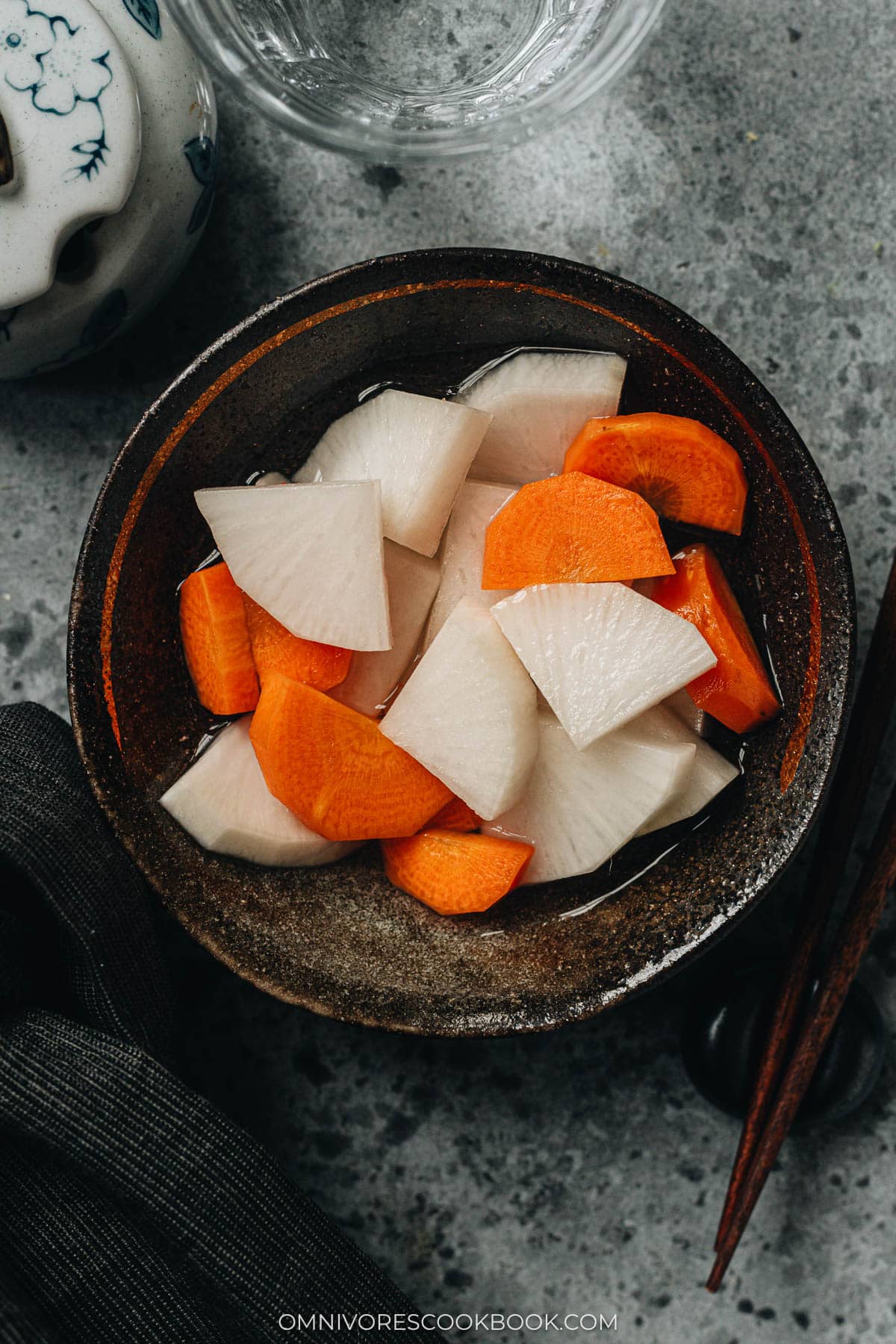
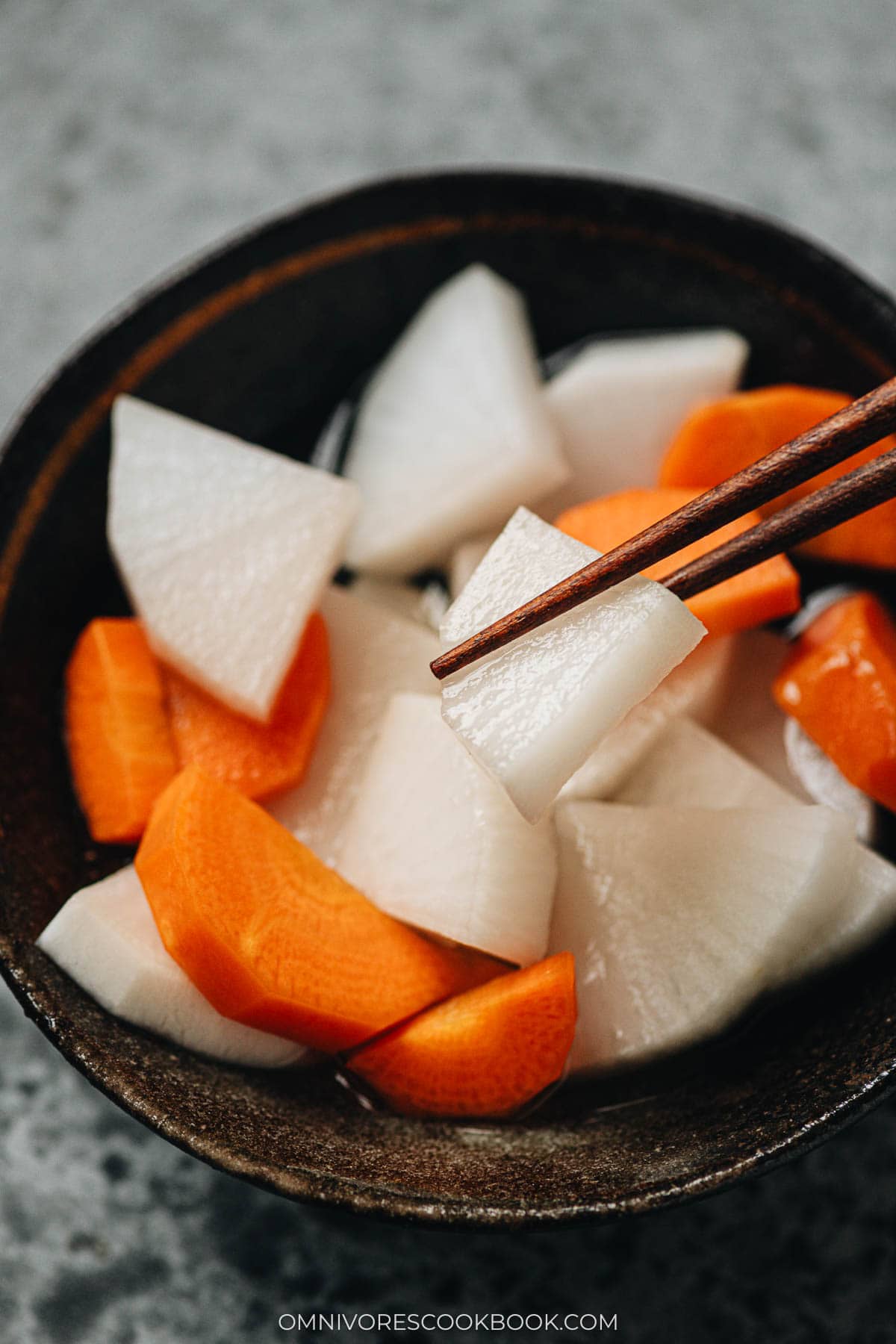
Chinese pickled daikon is a Cantonese cold appetizer where mild white radish and carrot cure in a sweet and sour vinegar brine until the vegetables turn crunchy and lightly tangy. I would put this dish in the same category as the small refreshing plates that come out before a Cantonese meal, and it goes great with hearty dishes like a bowl of wonton noodle soup as a bright counterpoint. Scroll to the end of the post to see my favorite serving suggestions.
I keep a jar of these pickles in the fridge for the weeks when the dinner table skews rich. The recipe is a Cantonese classic I picked up early in my Beijing kitchen years and later refined in New York to work with the vinegars I actually stock, since Chinese white vinegar is not a bottle I keep on hand. My combination of Japanese rice vinegar and distilled vinegar gives me the same fruity sour profile without asking you guys to hunt for a specialty bottle.
Plus it is super easy to prepare in 2 phases, first at the cutting board and then at the stove. I cut the daikon into thick fan pieces and the carrot into half moons, rinse both under cold water so the daikon smell drops away and the carrot color does not tint the daikon orange, then boil the vinegars with sugar and salt into a quick brine and pour it hot over the vegetables to cure in the fridge. You have to make this a few days before a bigger meal using my directions below, I promise the pickles get better as they rest and they hold in the fridge for a week.
Ingredients
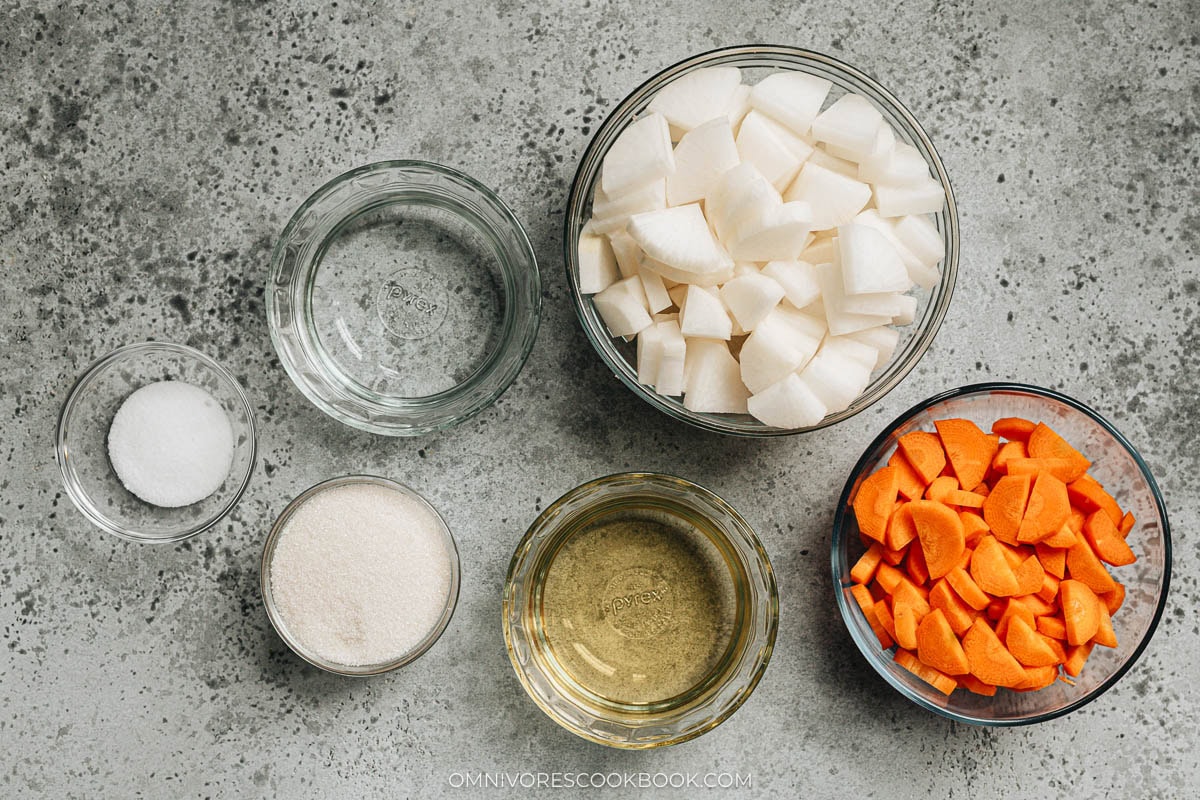
The whole Pickled Daikon with Carrot dish rests on 5 things, and the balance of sweet, sour, and salt is what makes it work. Here is what I use:
Vegetables
I look for a daikon that is firm and heavy for its size, with smooth skin and no soft spots, which gives me the crunchiest pickle. I use regular carrots, and I keep the carrot volume lower than the daikon so the daikon stays the main vegetable.
Brine
I combine rice vinegar and distilled white vinegar in equal parts as my base. This mix gives me the fruity sour profile of Chinese white vinegar, which is the traditional base for this pickle but is not a bottle I keep in my Chinese pantry. The sugar softens the sharpness of the vinegar and pulls out the natural sweetness of the daikon and carrot, and the salt draws water out of the vegetables so they crisp up.
How to Make
1. Cut the vegetables: Peel the daikon and carrots. Cut the daikon into 1/3 inch rounds, then quarter each round into fan-shaped pieces. Then cut the carrots into 1/4 inch rounds, then slice each round into half moon pieces.
2. Rinse until clear: Place the daikon and carrot in a colander and rinse under cold running water until the water runs clear. This step removes the daikon funk and keeps the carrot from bleeding orange into the white daikon. Drain well and transfer the vegetables to a heat-proof bowl or the jar you plan to store the pickles in.
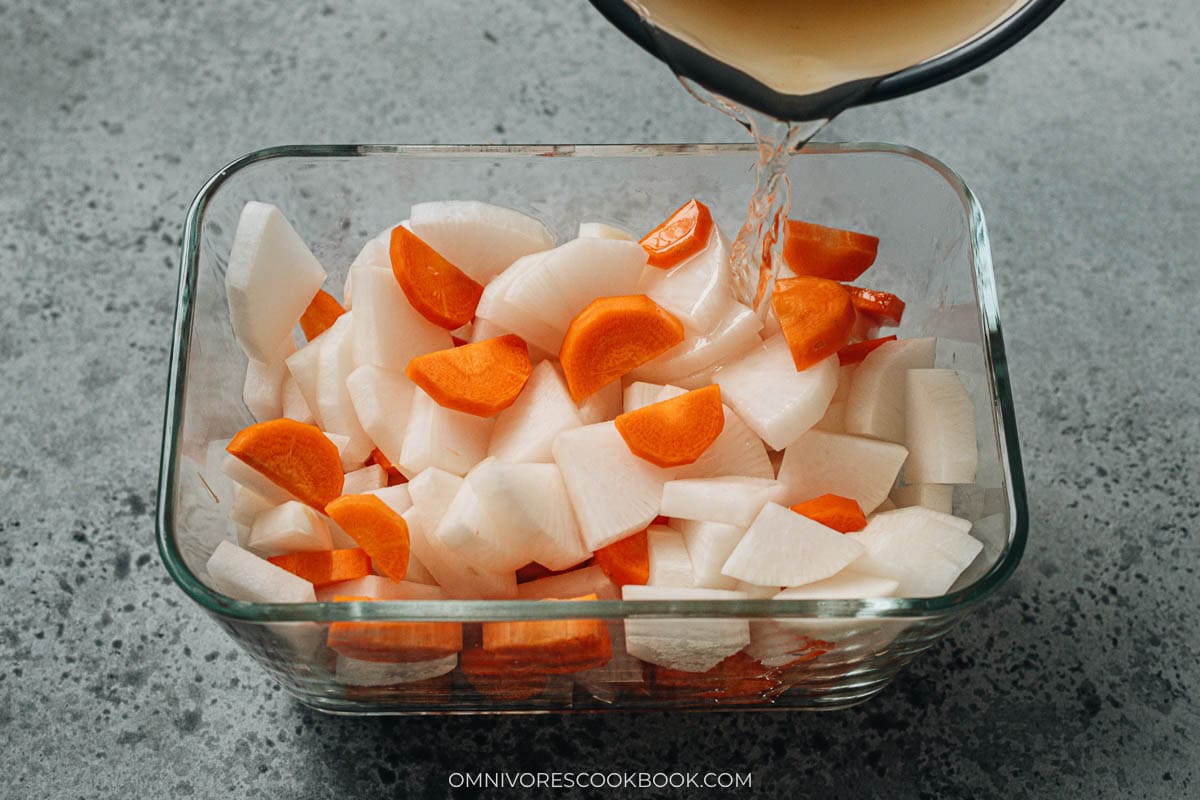
3. Boil the brine: Add the rice vinegar and distilled vinegar to a small saucepan and bring to a boil over medium-high heat. Once vigorously boiling, add the sugar and salt, whisking until fully dissolved.
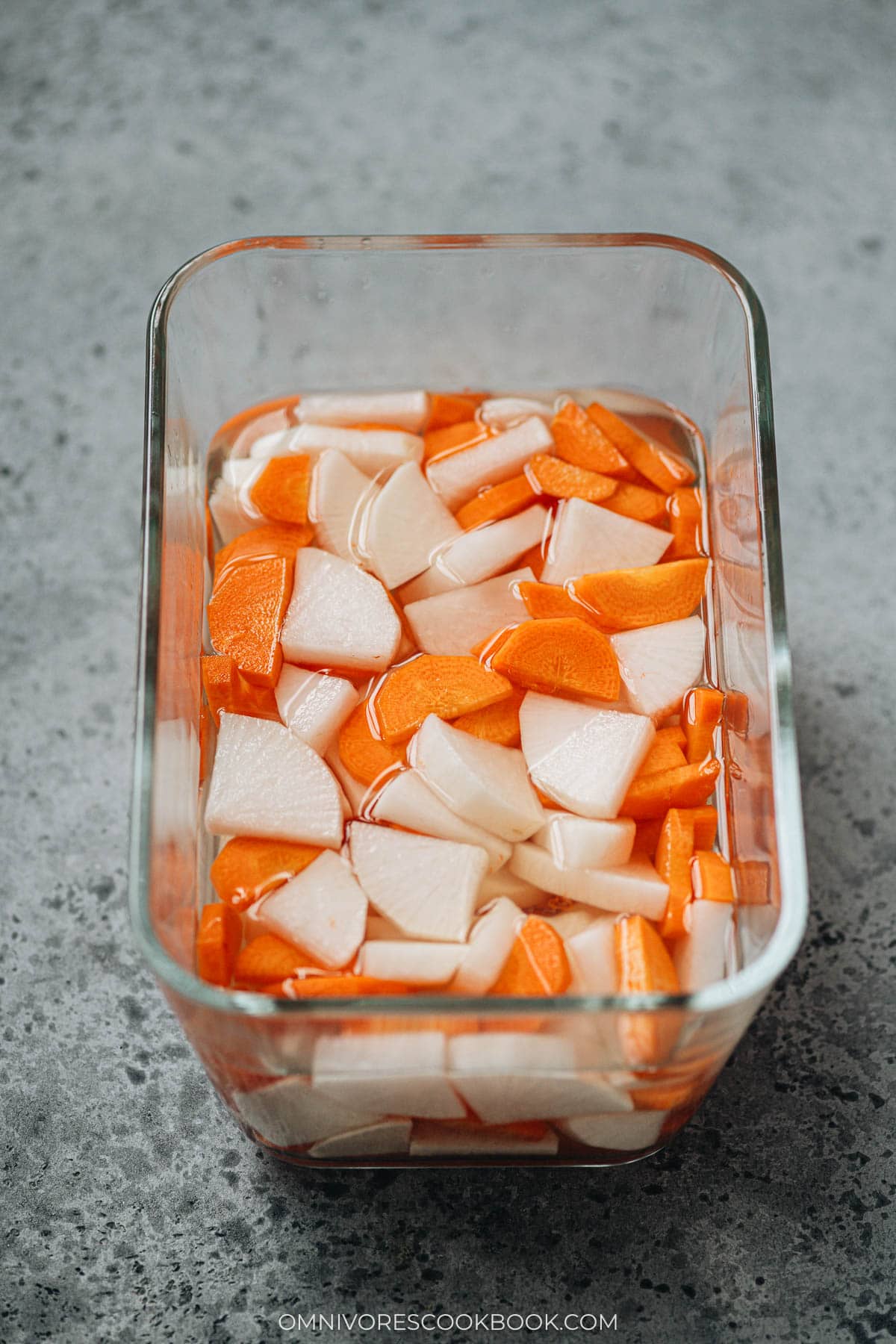
4. Pour hot over the vegetables: Pour the boiling hot brine over the daikon and carrot. The brine will not fully cover the vegetables at first, but as they release water it will rise to cover them. Let the pickles sit for at least an hour before eating, or overnight in the fridge for a rounder flavor.
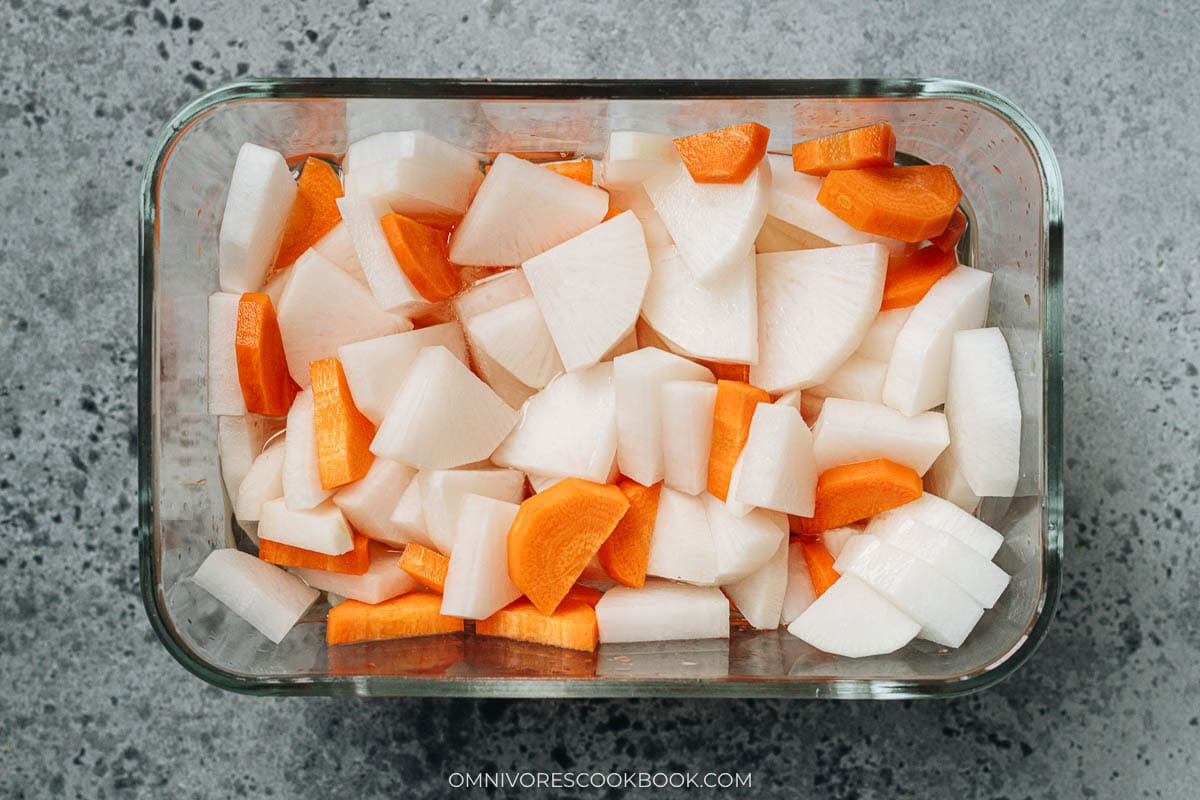
5. Cool and store: Once the brine has cooled completely, cover the container and store the pickles in the refrigerator.
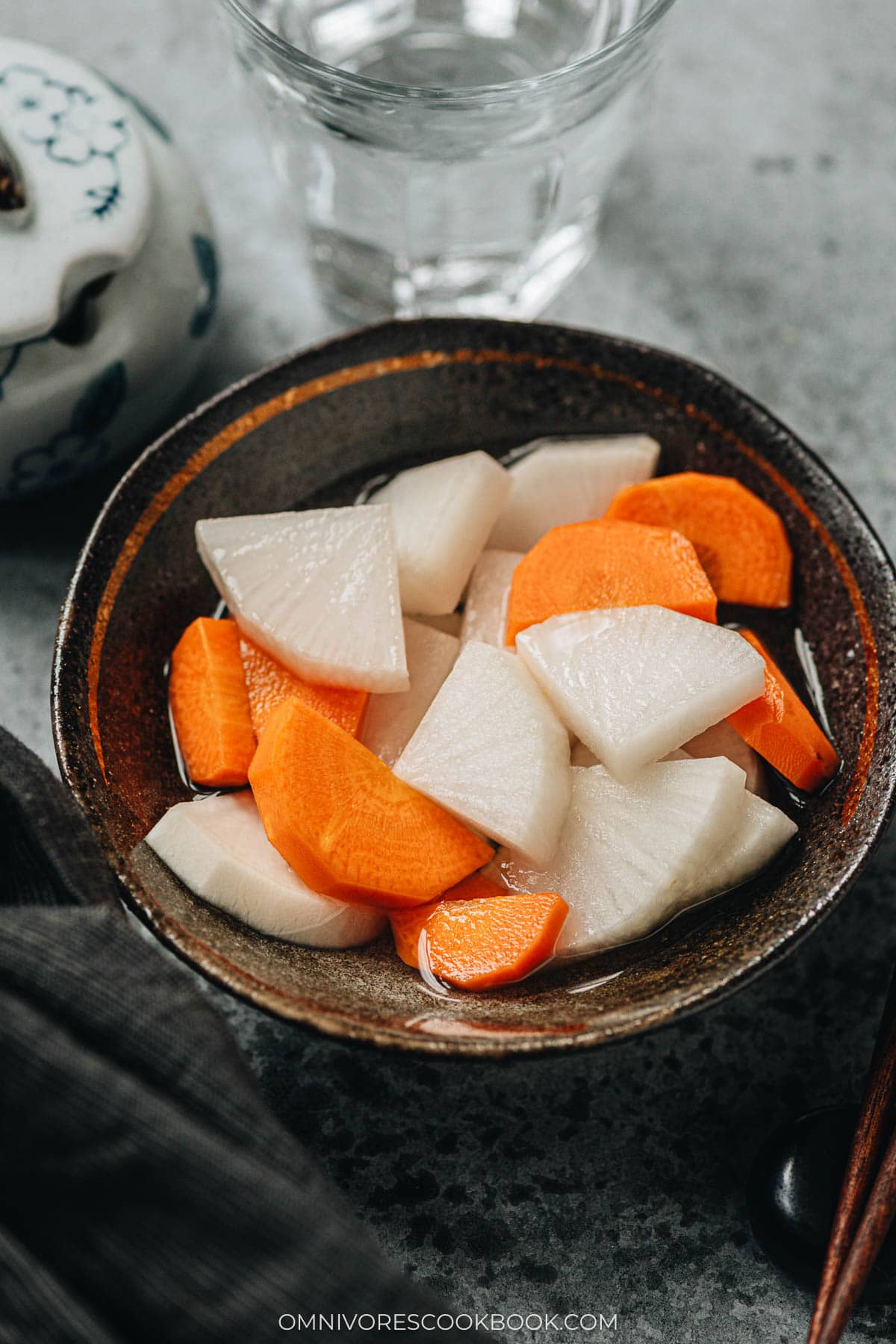
Expert Tips
Rinse the cut vegetables until the water is clear: This is the step readers most want to skip, and it is the difference between a clean-tasting pickle and one that smells slightly funky in the fridge on day 3. Rinsing also washes off the surface starch that would otherwise cloud the brine.
Pour the brine on hot, not warm: The boiling brine partially cooks the outside of the daikon and carrot, which is what gives the pickles their signature crisp-tender texture. A cooled brine will not draw out the water the same way and the pickles turn watery instead of crunchy.
Give the pickles at least a night in the fridge: 1 hour is the fastest you can eat them, but the flavor rounds out and the crunch deepens after 12 hours or so. I aim for a 24 hour rest when I have the time.
Cut the daikon thicker than the carrot: A 1/3 inch daikon piece and a 1/4 inch carrot round finish curing at about the same time, since the carrot is denser and cures more slowly at the same thickness. Matching thickness across the 2 vegetables gives me an uneven pickle, with the daikon over-cured before the carrot catches up.
Always serve with clean utensils: Introducing raw food particles into the jar will shorten the shelf life, so I keep a small pair of dedicated chopsticks next to the jar. Clean utensils are the reason a jar can last 2 full weeks in my fridge.
Serving Suggestions
I serve this pickle as the small tangy plate that opens a meal or next to a rich main dish. My favorite pairing is a slab of Cantonese char siu with a bowl of egg fried rice, where the sharp sweetness of the pickle cuts through the caramelized fat on the pork and refreshes the palate between bites of the plain warm rice.
For a bigger Cantonese-style party at home, I place these pickles as a cold appetizer alongside a hot centerpiece and a green vegetable. A plate of pork and chive dumplings with the pickles on the side, a bowl of Lanzhou beef noodle soup as the main, and a plate of beef and Chinese broccoli covers a table for 4 to 6 with a real Chinese meal.
Frequently Ask Questions
Can I use Chinese white vinegar in place of the 2 vinegars?
Yes, and if you have it in your pantry, please use it. Substitute 1 1/2 cups of Chinese white vinegar for the rice vinegar and distilled vinegar combined. The pickles will taste closer to the version I grew up eating in China, since the 2 vinegar mix in this recipe is my way of mimicking that fruity sour profile without the specialty bottle.
How long do these pickles keep in the fridge?
Stored in an airtight container in the refrigerator, the pickles keep for up to 1 week. I use a vacuum-sealed container at home, which extends the shelf life to about 2 weeks. Always serve with clean chopsticks or a clean spoon to avoid introducing contamination, and if the brine ever smells off or the vegetables lose their crunch, discard the batch.
Can I freeze these pickles?
I do not recommend freezing. The daikon and carrot cell walls break down when frozen and thawed, and the pickles lose the crisp texture that is the whole point of the dish. Make a fresh batch every 1 to 2 weeks instead, since the brine takes about 15 minutes of active work to put together.
Want to Save This Recipe?
Enter your email below & we’ll send it to your inbox. Plus get great new recipes from us every week!
Pickled Daikon with Carrot
Ingredients
- 1 daikon radish (about 1.3 lbs / 600 g)
- 2 small carrots (about 10 oz / 300 g)
- 3/4 cup rice vinegar (*Footnote 1)
- 3/4 cup distilled vinegar
- 1/2 cup sugar
- 3 teaspoon salt
Instructions
- Peel the daikon and carrots. Cut the daikon into 1/3” (1 cm) thick rounds, then cut each round into four equal fan-shaped pieces. Cut the carrot into 1/4” (6 mm) rounds, then slice each round into half moon pieces. Place the daikon and carrots in a colander, run under cold water until the water runs clear. This removes the daikon’s funky smell, and prevents the carrots from tinting the daikon orange. Drain well and move to a heat-proof bowl or container you plan to store the pickles.
- Add the rice vinegar and distilled vinegar into a small saucepan and bring to a boil. Once vigorously boiling, add the sugar and salt, stirring with a whisk until fully dissolved.
- Pour the boiling hot pickling liquid over the daikon and carrots. (*Footnote 2) Marinate for at least 1 hour before eating, or overnight for a better flavor. Once the brine cools off completely, store the pickles in an airtight container in the refrigerator for up to a week.
Notes
- The combo of Japanese rice vinegar and distilled vinegar mimics Chinese white vinegar, which is fruitier than distilled vinegar but more pungent than Japanese rice vinegar. It creates a brine that has the sour taste coming through while maintaining a fruity note.
- The brine will not cover all the ingredients at the beginning. But once the daikon and carrot sit in it for a while, they will release enough liquid so the brine covers everything.
Nutrition

Did you make this recipe?
I’d love to hear how it turned out for you! Please take a moment to leave a 5-star rating ⭐️ and share your thoughts in the comments further down the page. It really helps others discover the recipe too.
J-Mom
This was great! Nice balance of the vinegar, salt and sugar. The fact that carrots need to be cut smaller than daikon was very helpful.
Tay JM
Thanks lots, looks easy to make.
Will certainly try. especially, you gave measurements and best before date.
it’s important for people like me who can’t cook .
I love all kinds of pickles,
especially Korean Kimchi
malinda
A simple and delicious, easy dish to make. Just the right amount of sour. I wondered if I could use the highly recommended Chinese vinegar, Chinkiang instead of the 2 vinegars mixed. Next time I will try it.
Maggie Zhu
You can use Chinese white vinegar, which is different from Chinkiang vinegar. Chinkiang vinegar has a much stronger flavor and a darker color, which is not suitable for this recipe. The Chinese white vinegar looks like distilled vinegar, all transparent, and it should be the type of Chinese vinegar used in this recipe to replace the 2 vinegar mixed.
Kevin Patrucco
Maggie,
Unless I’m mistaken, this recipe is nearly identical to a Vietnamese pickle entitled “Do Chua” (forgive the incorrect spelling). Sweet, slightly salty and quite pungent.
Lovely on the table with any asian meal.
Regards…
Maggie Zhu
That’s so interesting. My version is from Cantonese cuisine, although there are two mainstream ways to make it (the other method uses a different cutting, and the seasoning is sweeter). I’ve never had the Vietnamese version. But I wouldn’t be surprised if the dish is similar. I’ve had similar dish from Japanese cooking and the flavor is quite close as well.
LORENE
I love these pickles. I have always loved the pickles you get in a Chinese restaurant, and now I can make them at home. I sliced the carrot and daikon thinner than suggested to make it easier to eat.