

Chinese Steamed Eggs (鸡蛋羹) is an authentic Chinese homestyle dish that has been cooked in family kitchens for generations. It is known for its silky custard texture, gentle steaming technique, and natural egg flavor, which sets it apart from Western egg dishes that rely on higher heat or heavier seasoning.
I created this Chinese steamed eggs recipe because it was one of the first dishes my mom taught me to cook, and it is still something I make often for my family today. I whisk eggs with water and salt, strain the mixture, then steam it gently for about 10 to 12 minutes before finishing with soy sauce, sesame oil, and scallions, and I share the full process with photos below so you can see how simple and traditionally rooted this dish is in my Chinese cooking experience. There are different versions of steamed eggs as well. If you want a more substantial version, check out this Steamed Egg with Minced Pork.
This is a wonderful choice for when you want something comforting for breakfast or something soothing when you are under the weather. It is soft, delicate, and familiar, and it has always been a simple way my family shares comfort through food. I also love making this breakfast dish for friends who are curious about Chinese home cooking. After many years of cooking in my own kitchen, this is still a recipe I make all the time because it is quick to prepare, nourishing, and consistently comforting. I hope you give it a try!
Ingredients
When I make this delicious Chinese Steamed Eggs (鸡蛋羹), I simply use the ingredients listed below:
For the base:
Eggs: I always use fresh free range large eggs because they create the best flavor. They are the heart of my recipe.
Salt: I season the eggs lightly so the flavor stays balanced.
Warm water: It helps the eggs blend smoothly and cook softly during steaming. The right ratio is key for texture, and I share more details in my expert tips below.
Garnishes:
Sesame oil: I add a light drizzle at the end for fragrance.
Light soy sauce: A small splash enhances the savory flavor. It complements the eggs rather than masking them.
Green onions: I finish with sliced green onions for freshness and color.
How to make
1. Prepare the eggs: Prepare the steamer and bring the water to a boil, then break the eggs into a liquid measuring cup and add the salt. Beat the eggs with a fork until smooth but not airy, and check that the volume measures about 1/2 cup.
2. Add the water: Add warm water at just under two times the volume of the eggs, usually slightly above 3/4 cup, then whisk until the mixture is smooth and consistent.

3. Strain the eggs: Prepare a heat proof bowl that fits inside the steamer, then use a fine mesh strainer to strain the egg mixture into the bowl. This is the key step to create silky and smooth texture of egg custard without any lumps.

4. Steam: Gently scoop off any bubbles on the surface, cover the bowl with plastic wrap, and poke a few small holes to allow steam to escape. Reduce the heat of the steamer to medium low, then carefully place the bowl inside and steam for 7 to 12 minutes until just set, lightly shaking the steamer rack or bowl after 7 minutes to check doneness.
The steaming time depends on the shape and material of your bowl. If using a shallow bowl with thin wall, the cooking time would be way less than a tall bowl with thick wall.

5. Finish and serve: Turn off the heat and transfer the bowl to a coaster or trivet, then let the eggs rest for 5 minutes. I carefully remove the plastic wrap, drizzle with sesame oil and light soy sauce, garnish with green onion, and I serve hot as breakfast or a snack.

Expert tips
Velvety egg texture: I always follow a tip my mom taught me years ago. I add warm water that is just above body temperature to the beaten eggs to gently temper them, which helps the custard cook into a silky, even texture, and when I am unsure about the water temperature, I simply mix equal parts boiling water and room temperature water, a method I still use today because it brings the eggs back to the way she made them for me.
Liquid balance ratio: Water volume plays a big role in getting the right texture, and over the years I have learned that using more water creates the softest steamed eggs. I aim for a ratio of 1 part egg to slightly less than 2 parts water so the eggs just set into a very gentle curd, and when I do not use a measuring cup, I rely on 2 large eggs with 3/4 cup water, which consistently gives me smooth, tender results every time.
Steaming time guide: Cooking time depends on the container, and I have learned this through plenty of testing in my own kitchen. I prefer a heat proof glass bowl because it heats quickly and cooks the eggs evenly, and while I sometimes use a ceramic bowl for appearance, it takes a little longer and required some trial and error to get the timing right, though even when the eggs cook a bit longer, they still stay soft and silky with a pudding like texture that is very enjoyable to eat.
How to serve
At home, I usually serve these steamed eggs the same way I grew up eating them, right in the center of the table with rice and a few simple dishes my family can share. When I’m feeling fancy, I serve them with You Tiao (Chinese Savory Donuts) just like what we did in China.
When I want to change things up or serve this to friends, I treat steamed eggs as a flexible base that works well with many flavors. Sometimes I pair them with Hong Kong French toast for a sweet and savory contrast, or I swap green onions for chives depending on what I have on hand, and it is also a great dish for small kids since the eggs are very tender, the flavor stays mild, and my baby boy absolutely loves it.

Frequently asked questions
Why do my steamed eggs have bubbles on the surface?
When bubbles appear, it usually means too much air was mixed into the eggs or the steaming heat was too strong. I always whisk slowly, strain the mixture through a fine mesh strainer, and keep the heat gentle so the eggs cook calmly and stay smooth across the surface.
How do I know when steamed eggs are done?
Around the 7 minute mark, I gently shake the bowl to check the center. When the eggs move slightly but no liquid pools on top, they are ready and will finish setting during a short rest.
Why do my steamed eggs taste watery?
A watery result often means too much water or not enough steaming time. Measuring the liquid carefully and steaming until the eggs are just set helps create a smooth texture with balanced flavor every time.
Chinese Cooking Made Easy
Are you new to this website? This free email series is a great place to start. I’ll walk you through a few of my most popular recipes and show you how and why they work. You’ll quickly start to cook better Chinese food in your own kitchen.
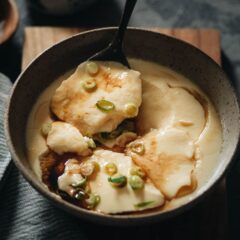
Chinese Steamed Eggs (鸡蛋羹)
Ingredients
- 2 large eggs
- 1/4 teaspoon salt
- 3/4 cup warm water , or according to the size of your eggs (*Footnote 1)
Garnish
- green onions , Sliced
- Light soy sauce (or tamari for gluten-free) (Optional)
- Sesame oil
Instructions
- Prepare the steamer and bring the water to a boil.
- Break the eggs into a liquid measuring cup and add the salt. Beat the eggs with a fork until they are smooth, but not airy. Check the volume measurement of the beaten eggs, it should be about 1/2 cup.
- Add the water, just under two times the volume of the egg, just slightly above 3/4 cup (about 1 tablespoon more) in most cases (*Footnote 2). Whisk until the mixture is consistent.
- Prepare a heat-proof bowl or container that can fit in your steamer. It can be a big wide bowl that’s about 24 oz (700 ml) or two 12-oz (350 ml) ramekins. (*Footnote 3)
- Using a fine mesh strainer, strain the eggs into the bowl you prepared. If there are any bubbles on the surface, use a spoon to gently scoop them off. Cover the bowl with plastic wrap and poke a few small holes in it.
- Reduce the heat of the steamer to medium-low. Carefully transfer the bowl with the egg into the steamer.
- Steam for 7 to 12 minutes, until the eggs are just set. After 7 minutes, lightly shimmy the steamer rack or the bowl to judge how set your eggs are. The eggs should jiggle slightly without any obvious liquid on or under the center of the surface. Let it cook longer, if needed, until the eggs are set. (*Footnote 5)
- After the steaming is done, turn the heat off and transfer the bowl onto a coaster or trivet. Let the eggs rest for 5 minutes. Carefully peel off the plastic wrap. Drizzle with sesame oil and light soy sauce and garnish with green onion.
- Serve hot as breakfast or as a snack.
Notes
- The water temperature should be around 100-110°F (38°C), just a bit above body temperature. The warm water will temper the eggs so it yields a smooth result when steamed.
- The water ratio should be just under 2x the volume of the eggs to create the softest result. If you use too much water, the eggs won’t set. If you use too little water, the texture will become a bit harder.
- The shape of the bowl affects the cooking time. It’s the best to use a wide heatproof glass bowl. You can use a ceramic bowl as well. The thicker and taller the bowl you use, the longer the cooking time.
- The amount of steaming time can vary a lot depending on the size, shape, and material of the container used. Thin metal or plastic will cook faster than ceramic. Shallow, wide dishes will also lead to a faster cook time. If using one container it will likely take longer than if you cook the same number of eggs in two containers.
- I used a thick-ish ceramic bowl that is about 6.5” (16 cm) wide and 2.3” (5.8 cm) tall. It took me 9 minutes of cooking time and 5 minutes of resting time to get the perfect texture.
Nutrition

Did you make this recipe?
I’d love to hear how it turned out for you! Please take a moment to leave a 5-star rating ⭐️ and share your thoughts in the comments further down the page. It really helps others discover the recipe too.
Feifei
Hi Maggie, this is the first time I’ve used broth while making this dish. It tasted great and my husband also loved it! Thank you for sharing this simple but tasty Chinese treat!
Anne
What should I do if steam egg turned out too water?
How to secure? Put more egg or steam longer?
Maggie Zhu
You can add one more egg or reduce the water slightly.
KB
This was delicious. I used a more traditional rounded bowl, rather than a flattened one. It took about 9 mins, then I left for 3 mins without stove on, and 2 mins out of pot to cook. I served with nutritional yeast, coconut aminos, tamari, sesame oil, sesame seeds, chili flakes, and sliced scallions. A+! It was worth the wait and minimal prep. Loved this recipe and will make again. Thank you
Quinn
This is one of the very few Chinese recipes that I learned to master before discovering this blog. I do mine a bit different. I blend four eggs with one cup of whole milk instead of water (my “golden ratio'” for this dish). I strain this mixture into two small bowls that are in an inch of cold water in a pan. I put the lid on the pan and place it on low heat until it starts to boil, which I can hear because the bowls start to rattle in the pan. I then shut off the heat and leave the lid on for about 20 minutes.
The trick with this dish is to bring it up to temperature slowly so that the eggs achieve a custard-like consistency. If too fast, then the texture is more like scrambled eggs.
It might take a few tries to get it just right, but the end result is worth it!
Paulinn
Yummy especially as late night snack. Easy to make recipe. Add in dried scallops into the eggs for better taste!
Rachel
I’m in love with these eggs! They turned out so soft and smooth and perfectly custardy! I love the mesh strainer trick, and I used the instant pot on the steam setting with the full 12 minutes and they came out just right. Thank you!
Hannah
Thanks for the Instapot tip! I have a traditional bamboo steamer, but I don’t like to break it out for everyday use.
Sally Emerich
I had some fresh duck eggs, made this and well, yum! Wonderful addition to my egg repertoire.
Amy
This worked great! I even made a few mistakes like missing the step of the plastic for the first 4 min and it still worked. I added the plastic and cooked for a little bit longer.
Kelsey
Just made this and it was the smoothest silkiest most yummy eggs I ever ate. So glad I found this recipe, thank you!
Jean W
Love your blog, Maggie. I would like to try your recipe for steamed eggs but it calls for the use of plastic wrap. The FDA does not recommend the use of plastic wrap in the cooking of food unless the wrap is made specifically for cooking. Would covering the eggs in aluminum foil work just as well?
Maggie
Yes. Aluminum foil works too (don’t forget to poke some holes on it). If you don’t mind the surface to be less perfect, you don’t need to cover the bowl at all. My mom never does it, but sometimes the water drops to the eggs from the lid.
JG
Hi Maggie, I don’t have a steamer. Can these be made in the microwave?
Thanks!
Maggie
I’m afraid not. The microwave’s output is very strong and it will over cook the eggs and result in a weird texture… I’ve seen chefs done that but I wouldn’t cook eggs in a microwave.
Michael
All you need is a large pot or sauce pan with lid. Put the water egg in a shallow dish or bowl that can fit inside the pot. Find something that you can place underneath the dish or bowl and fill with enough water just to the top of the bottom stack. You can use two small ceramic plates, a small bowl or anything that can withstand the boiling water. They do sell those round wire racks, some taller and some shorter at most Asian markets.