

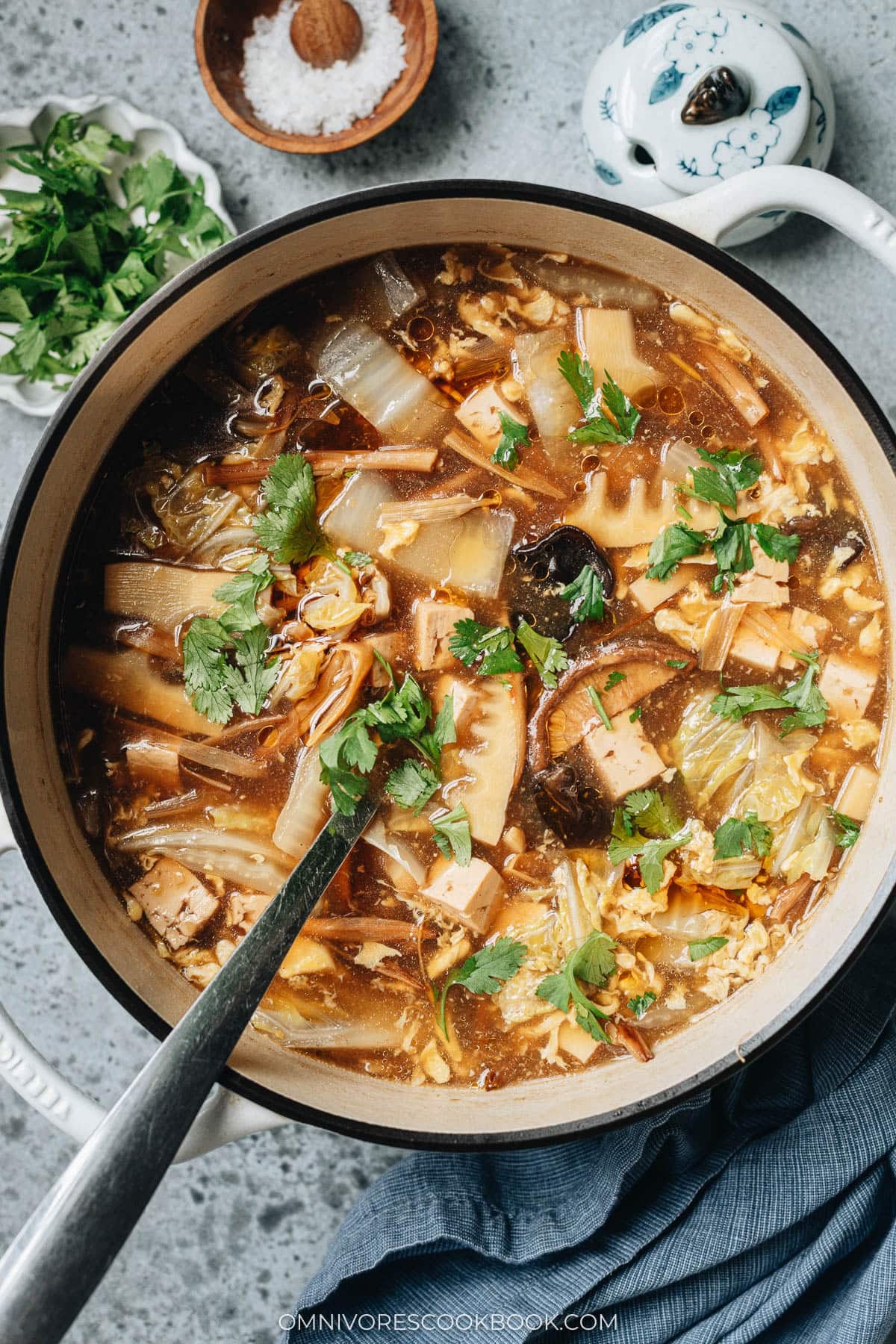
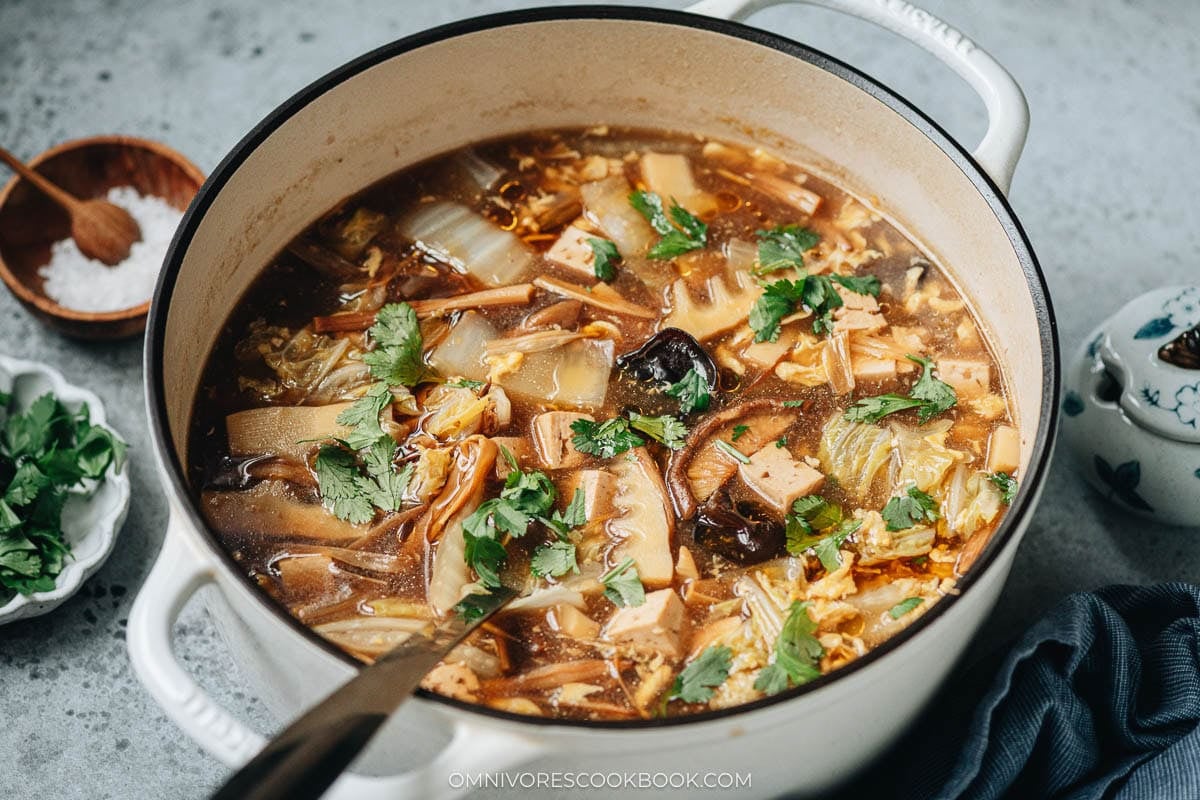
Vegetarian hot and sour soup is an authentic northern Chinese dish that gets its signature flavor from Chinkiang vinegar and white pepper powder. Unlike the Cantonese version that uses rice vinegar and chili oil, this style relies on black vinegar for a malty tang and white pepper for an earthy heat that warms your whole body.
Growing up in Beijing, soup was a must have on our dinner table every day, even in summer. It is a dish that connects all the elements on the table, like a glass of wine to a French family dinner. This recipe might look long, but the ingredient list is mostly dried shiitake mushrooms and dried lily flowers that I always keep in my pantry, which means I can make it even when the fridge is nearly empty.
For my recipe, I brown the rehydrated mushrooms to build flavor, simmer them with the soaking liquid and vegetable stock, add tofu and napa cabbage, then finish with a cornstarch slurry, egg ribbons, and a hit of Chinkiang vinegar and white pepper at the very end, all in less than an hour. Much like my Chinese Vegetable Soup, the vegetables and tofu make it filling enough to serve as a main dish to my family of 3. I highly recommend you giving this vegetarian hot and sour soup a try!
Ingredients
These are the ingredients I use to make this easy and comforting Vegetarian Hot and Sour Soup:
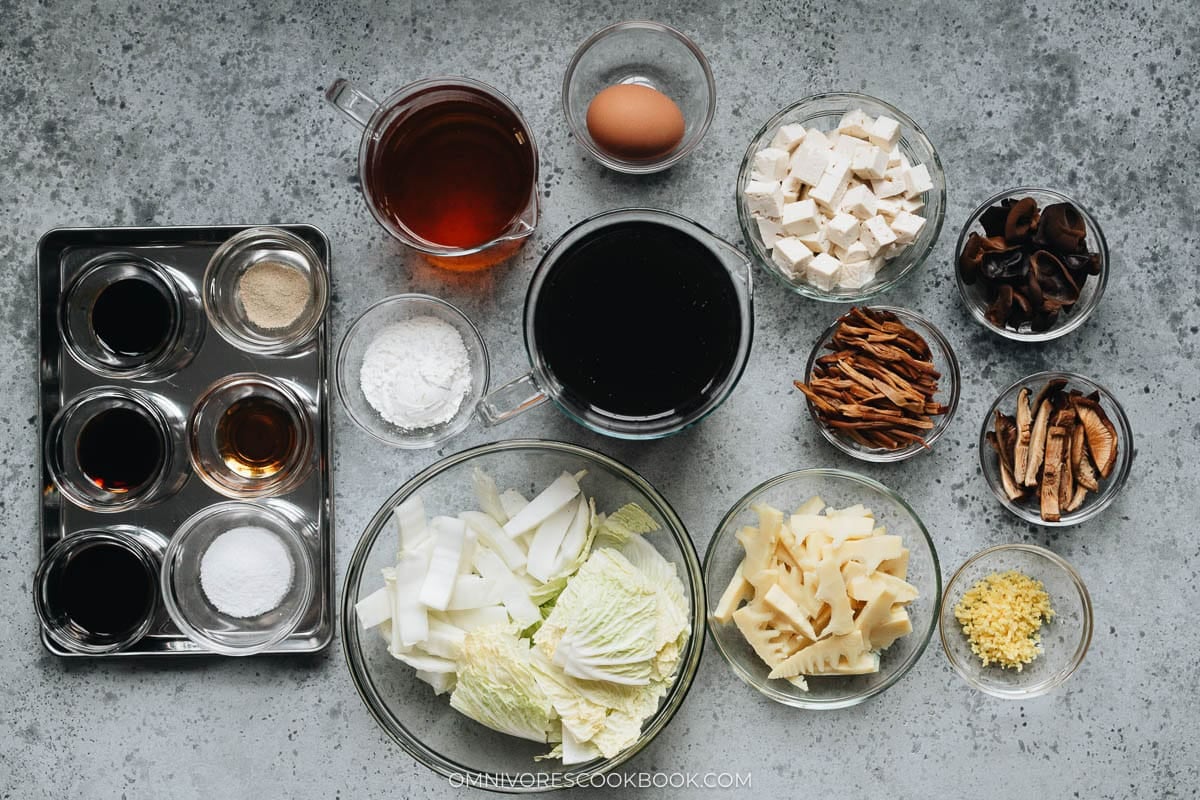
Dried goods: I use dried shiitake mushrooms, dried lily flowers, and wood ear mushrooms. I soak them in warm water until tender, then reserve the soaking liquid as a natural vegetable broth that adds deep umami to the soup.
Soup base: Vegetable stock combined with the mushroom soaking water creates a rich broth. Firm tofu cut into small cubes adds protein, and bamboo shoots bring crunch. I cook napa cabbage in 2 stages, whites first for body, then greens for color.
Finishing ingredients: Cornstarch slurry thickens the broth into a silky texture. I add beaten egg for optional egg ribbons. Chinkiang vinegar and white pepper go in at the very end so they keep their full flavor. Sesame oil and cilantro finish the soup.
How to Make
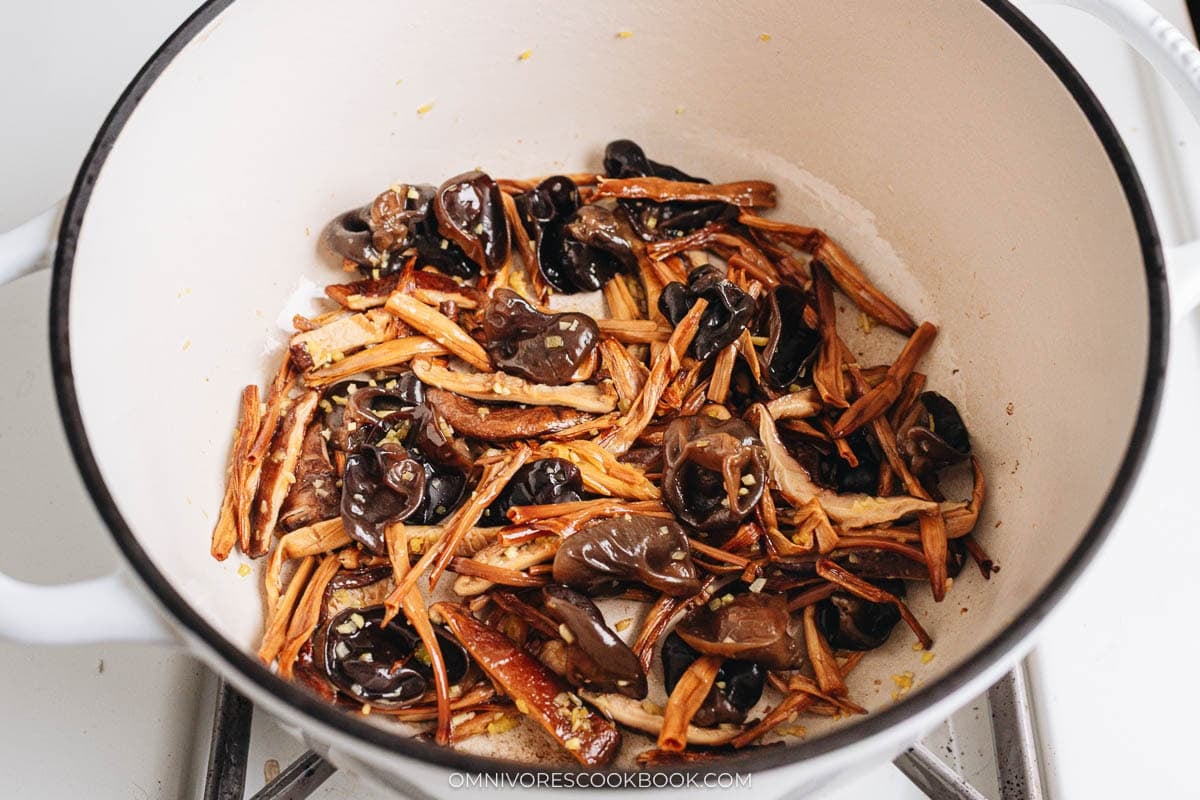
1. Cook the dried mushrooms: Heat oil in a large pot over medium heat. Add the lily flowers and shiitake mushrooms. Cook and stir until lightly browned, 1 to 2 minutes. Add the wood ear mushrooms and minced ginger. Cook for another minute.
2. Build the broth: Pour in the vegetable stock and the reserved soaking water. Turn to medium high heat and bring to a simmer. Add soy sauce, salt, tofu cubes, and bamboo shoots.
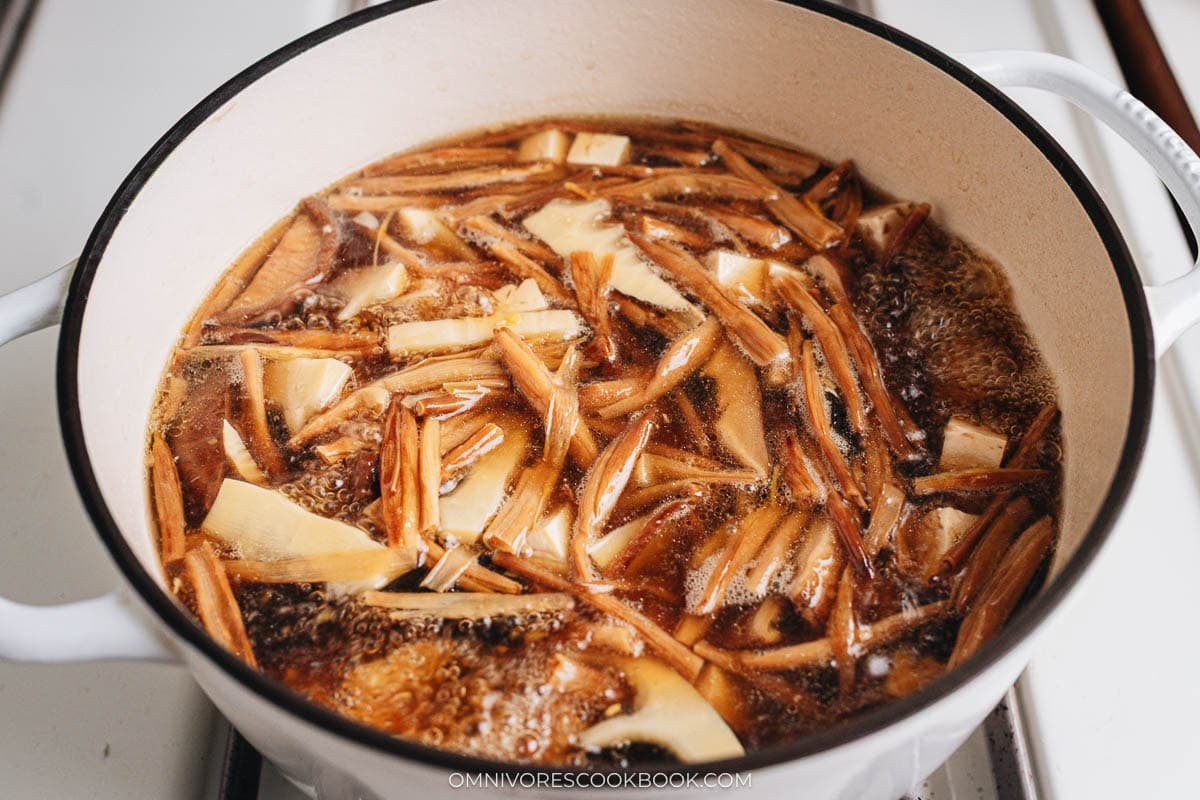
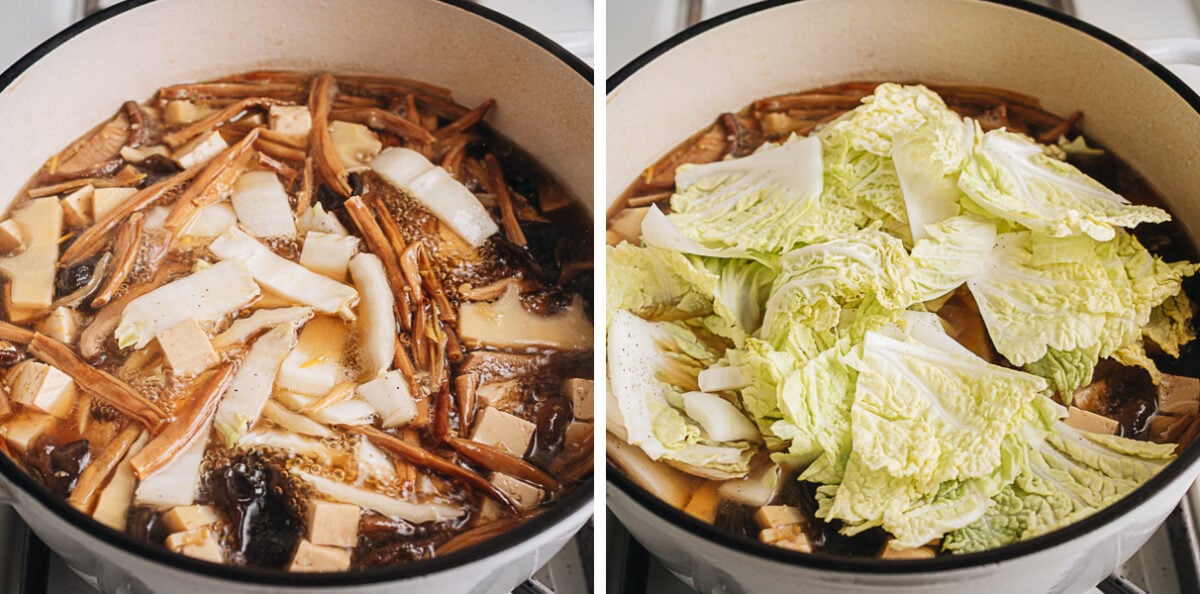
3. Add the cabbage: Once the broth returns to a simmer, add the napa cabbage whites. Cook 2 to 3 minutes until starting to soften. Add the cabbage greens and cook another 2 to 3 minutes until tender.
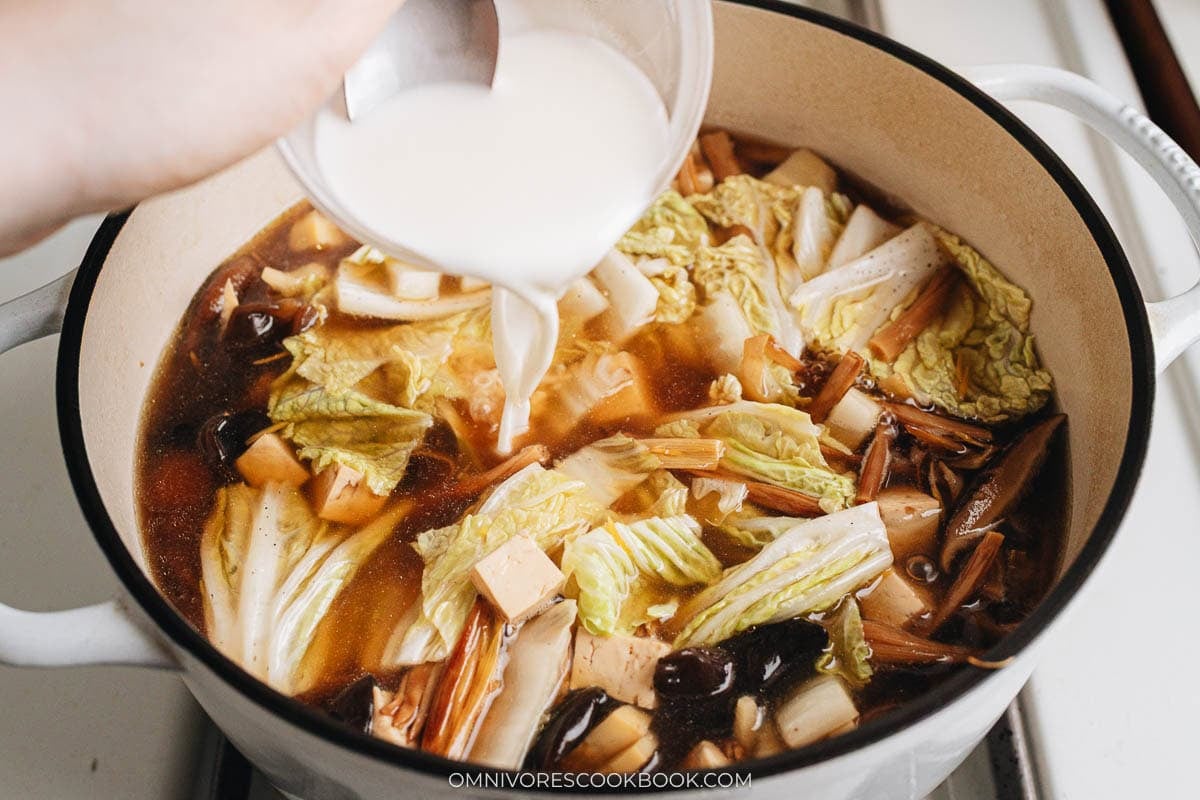
4. Thicken the soup: Turn to medium low heat. Mix cornstarch with water until dissolved. Slowly swirl the slurry into the soup while stirring until the broth thickens to a silky consistency.
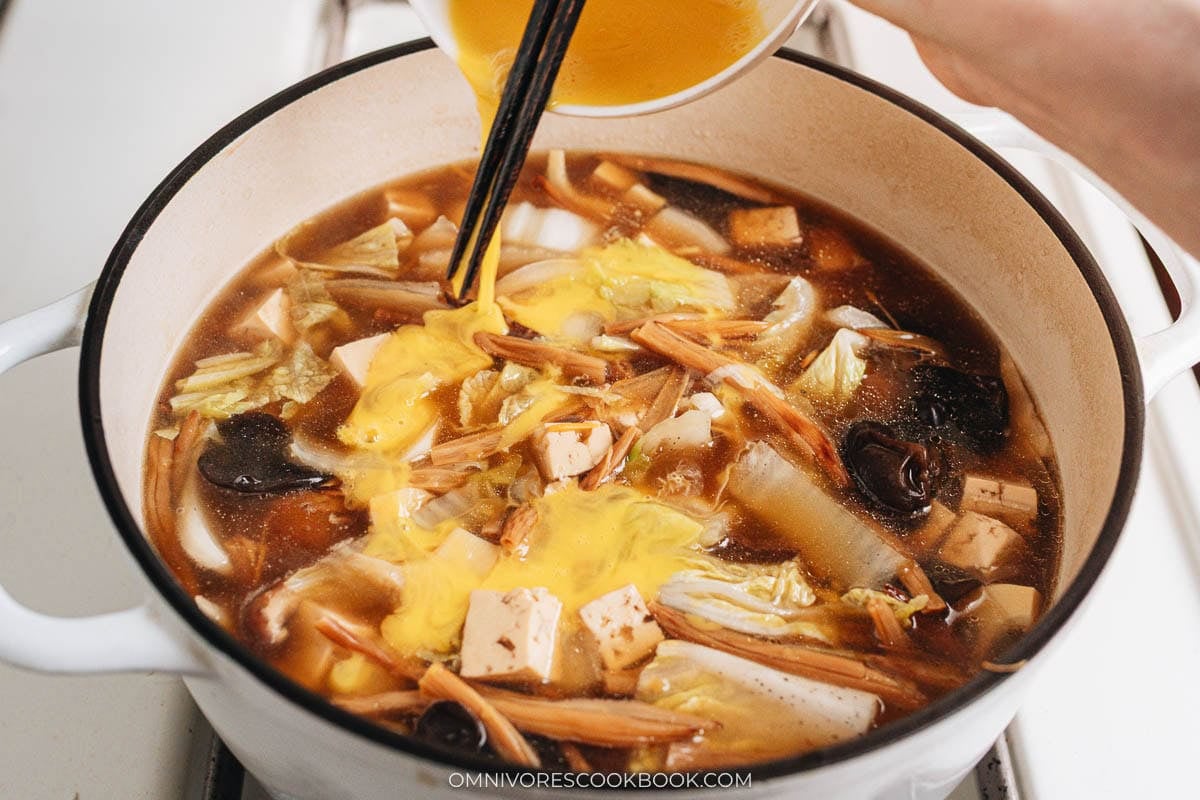
5. Add the egg: Slowly drizzle the beaten egg in a thin stream using a fork against the rim of the bowl. Let cook 30 seconds to set, then stir to break up the ribbons.
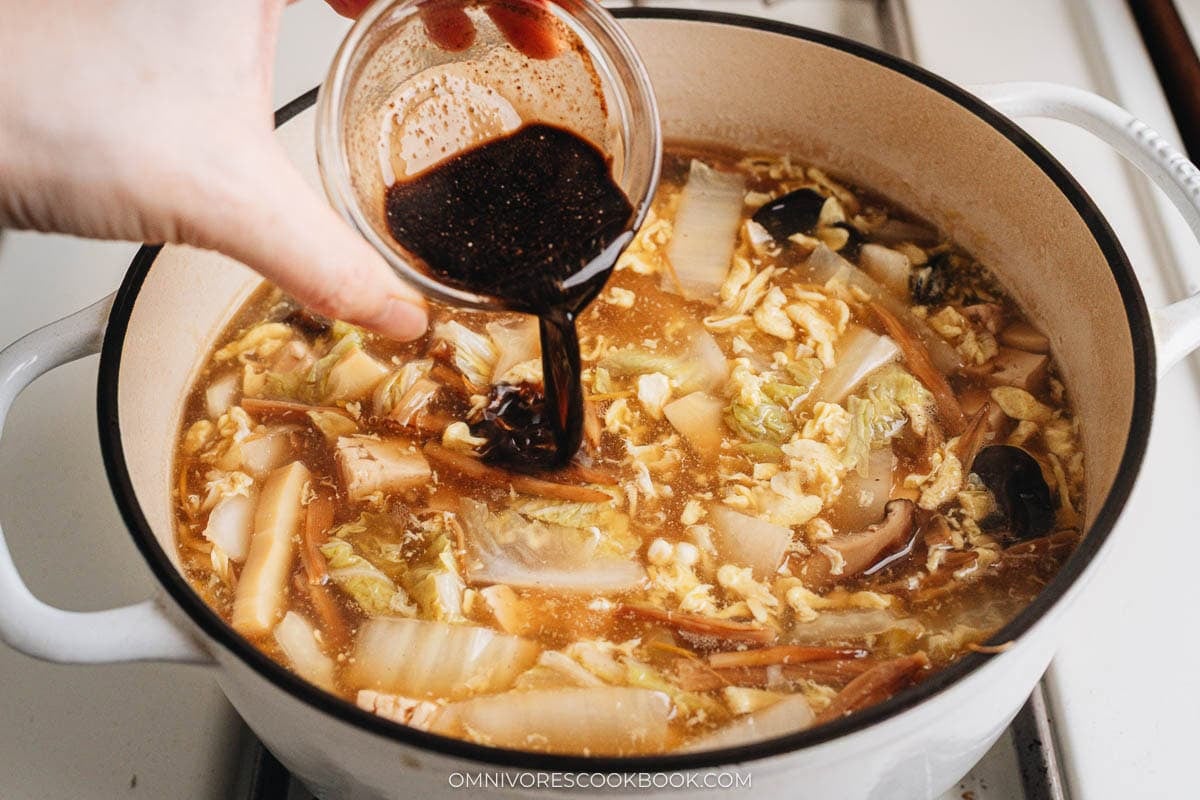
6. Finish and serve: Mix Chinkiang vinegar with white pepper in a small bowl until dissolved. Turn off the heat, then stir the vinegar mixture into the soup. Adjust salt to taste. Drizzle with sesame oil and top with chopped cilantro. Serve immediately.
Cooking Tips to Consider
Add the vinegar and pepper at the very end: Both Chinkiang vinegar and white pepper lose their punch if cooked too long. I always turn off the heat before stirring them in. The residual warmth mellows the sharp edge of the pepper within a few minutes.
Reserve the soaking liquid: The water used to rehydrate dried mushrooms and lily flowers becomes a rich, natural broth. I never discard it because it adds a nice flavor that replaces the need for expensive stock.
Brown the dried mushrooms first: Cooking the rehydrated mushrooms in oil before adding the liquid builds a layer of flavor that makes the soup taste more complex. A minute or two of browning is enough.
Thicken before adding the eggs: The broth needs to be properly thickened with the cornstarch slurry before the egg goes in. A thick broth suspends the egg ribbons so they form long, silky strands instead of clumping.
How I like to serve
When I serve this vegetarian hot and sour soup as part of a full, comforting dinner, especially during the winter when New York gets especially chilly, it always warms everyone up. It pairs great with lighter mains, particularly any Chinese vegetable stir fry recipes. I usually just pick one and go for it.
When my in laws come over for dinner, I like to step it up and make something a little more traditional, so I browse through my collection of Authentic Chinese Noodle Recipes and put together a full spread for everyone to enjoy.
Frequently ask questions
What order should I add the vegetables?
I add the firmer vegetables like bamboo shoots and wood ear mushrooms first since they need more time to heat through. Softer ingredients like napa cabbage leaves go in toward the end so they do not overcook or lose their shape.
How do I keep the tofu from falling apart in the soup?
I use firm or extra firm tofu and cut it into small cubes. I add it toward the end of cooking and stir gently so the pieces hold their shape. Soft or silken tofu works too if you prefer a softer texture, but it breaks apart more easily.
How do I reheat leftovers without losing the texture?
I reheat on the stovetop over medium heat and add a small splash of water or broth since the soup thickens as it sits in the fridge. I taste and add a little more vinegar at the end because the sour flavor fades overnight.
Chinese Cooking Made Easy
Are you new to this website? This free email series is a great place to start. I’ll walk you through a few of my most popular recipes and show you how and why they work. You’ll quickly start to cook better Chinese food in your own kitchen.

Vegetarian Hot and Sour Soup (素酸辣汤)
Ingredients
Rehydrate
- 2 tablespoons wood ear mushrooms , Optional (*Footnote 1)
- 4 dried shiitake mushrooms
- 1 cup dried lily flowers
Soup
- 2 tablespoons vegetable oil
- 1 tablespoon minced ginger
- 4 cups vegetable stock
- 2 cups dried ingredient soaking water
- 1 1/2 tablespoons light soy sauce
- 2 teaspoons salt , or to taste (*Footnote 2)
- 1/2 block firm tofu , cut to 1-cm (1/2-inch) cubes
- 1 5 oz. can bamboo shoots (*Footnote 3)
- 4 to 6 napa cabbage leaves , yields 4 cups loosely packed once cut, slice the white part into 1/2” pieces and the green part into 2” pieces, white and green parts separated
- 3 tablespoons cornstarch
- 1 egg , beaten (Optional) (*Footnote 4)
- 2 tablespoons Chinkiang vinegar
- 1/2 teaspoon white pepper powder
- 2 teaspoons toasted sesame oil
- 1/4 cup chopped cilantro
Instructions
Rehydrate
- To rehydrate wood ear mushrooms, shiitake mushrooms and lily flowers, gently rinse each with tap water, drain and add to individual bowls. Then add 1 1/2 cups of warm water to each bowl. Rehydrate for 15 to 20 minutes, until the ingredients have turned tender.
- For wood ear mushrooms, remove tough ends if needed, and slice into bite sized pieces.
- For shiitake mushrooms, reserve 1 cup marinating water, gently squeeze water from the mushrooms, remove stems and thinly slice. Pat dry with paper towels.
- For lily flowers, reserve 1 cup marinating water. Remove the tough ends of the lily flowers and halve crosswise (*Footnote 5). Pat dry with paper towels.
Soup
- Heat oil in a 4-qt dutch oven (or pot) over medium heat until shimmering. Add the lily flowers and dried shiitake mushrooms. Cook and stir until lightly browned, 1 to 2 minutes.
- Add the wood ear mushrooms and ginger. Cook and stir for another minute or so, to release fragrance.
- Pour in the vegetable broth and use your spatula to lift any browned bits from the bottom of the pot. Add the reserved 1 cup of lily flower soaking water and 1 cup mushroom soaking water.
- Cook over medium-high heat until the broth comes to a simmer. Add the soy sauce, tofu, 1 teaspoon salt, and bamboo shoots. Once the broth is simmering again, add the napa cabbage whites. Cook for 2 to 3 minutes, until just starting to soften. Add the napa cabbage greens. Cook for another 2 to 3 minutes, until tender.
- Turn to medium-low heat. Whisk the cornstarch with 1/4 cup of water in a small bowl until cornstarch is fully dissolved. Slowly swirl the cornstarch slurry into the soup, and stir to thicken while the broth is at a low simmer.
- Slowly swirl in the beaten egg with a fork against the edge of the bowl. Let cook for 30 seconds so the eggs start to set. Then gently stir a few times to break up the eggs.
- Combine Chinkiang vinegar and white pepper in a small bowl, mix well until the white pepper is completely dissolved. Turn off the heat. Add the vinegar pepper mixture and stir well. Add the rest of the salt and adjust seasoning if needed. Drizzle the sesame oil into the soup and add the cilantro. Serve hot.
Notes
- Dried wood ear mushrooms will expand more than 10 times in size after soaking, so a small amount goes a long way. They do not have so much flavor and are added here for texture. You can skip this ingredient without affecting the taste of the soup.
- The quantity of the salt depends on the type of broth you use. That’s why I only add 1 teaspoon at the beginning and adjust the seasoning later. If you have mushroom powder, it’s a great ingredient to add to enhance the flavor as well. Replace 1 teaspoon of salt with 1 tablespoon of mushroom powder to boost the umami.
- I used a whole bamboo shoot in this recipe. I highly recommend it if you can find it. It has a better texture than the canned type.
- Skip the eggs if you are making a vegan soup.
- Depending on how the lily flowers were harvested, they might have a very tough woody end on the side of the stem. You can feel it by squeezing with your fingers. You need to remove it (either with a knife or a pair of kitchen shears).
- It is very important to add the vinegar and white pepper at the end, because both ingredients lose their aroma if cooked for too long. The white pepper will taste very sharp right after you stir it in. But the residual heat will cook it a little further and the sharp taste will mellow out in a few minutes.
Nutrition

Did you make this recipe?
I’d love to hear how it turned out for you! Please take a moment to leave a 5-star rating ⭐️ and share your thoughts in the comments further down the page. It really helps others discover the recipe too.
MKW
My husband adores Hot & Sour Soup and this recipe was a winner; he now asks me to make it once/week for him. We live in a rural area with no decent Chinese restaurants and the “Asian” style restaurants are extremely expensive & geared towards week-end tourists. So this recipe and in fact, your entire blog, has allowed us to enjoy terrific Chinese meals at home. Thank you!
Jon Zaid
What an amazing collection of recipes! I’m vegan and even the non-vegan recipes are adaptable. I made this one; exchanging collard greens for cabbage; cooking a little bit longer. Before putting in cornstarch, I threw in some Pancit noodles and let them cook for another 5 minutes. Then added cornstarch, and finally vinegar. Came out fantastic.
BTW, is there anyway to include photos?
Maggie Zhu
Thanks so much for leaving a positive review! The collard greens sound super tasty in the soup and I’ll try that out next time 🙂 Unfortunately there’s no way to include photos in the comment area. Please feel free to tag @omnivorescookbook if you share it on Instagram, so share the photos via email (info in my contact page).
Gina
What a great recipe! Couldn’t get dried lily flowers so I upped the amount of veg stock as indicated. Everyone in my family loved it and even my daughter wolfed it down although she doesn’t like spicy (the pepper comes out pretty strongly but I guess that’s the plan 🙂 ).
Valentino Azzurro
Excellent. Authentic – reproduces flavours of good restaurant soup. Sizes up or down, works with fish, pork, beef or prawns too. Got me eating tofu which I’ve always hated.
Oliver
Yesterday I made the soup according to the recipe, and it had an extremely strong and therefore somewhat unpleasant taste of dried shiitake and dried lily flowers. As I’ve never tasted the soup when I was in China, I don’t know if this is intended. I used 700ml of the rehydration liquid and 700ml vegetable stock. Is this too much of the rehydration liquid, i.e. should I use less of it next time, or is the soup supposed to taste like this? (In my home town there are no restaurants where I can try authentic hot and sour soup, unfortunately.)
Maggie
Hi Oliver, I think the taste of the dried ingredients might be unpleasant if they are too old (sometimes they are not fresh at the grocery store depending on where you get them so they taste kinda dusty). Shiitake mushrooms rehydration water can be quite strong, so you can definitely use less. The lily flower rehydration water has a special taste (very earthy) but it shouldn’t be unpleasant. We use a lot of rehydration water because we usually use water instead of stock to make the base. Next time if you are using a veggie stock, you should reduce (or skip) the rehydration water because veggie stock should add enough flavor.
Donna
Hello Maggie, I plan to make this today and know it makes 4 servings, but what is the serving size? I have all the ingredients but is there anything I can substitute for the soy sauces as even the lite has an extreme amount of sodium , as does fish sauce. If I could get around the high salt, I would be a happy camper!
Maggie
The recipe uses 6 cups liquid. On top of the veggies, you will have a pretty big pot of soup that contains at least 2 cups per serving.
For the soy sauce, maybe try a low-sodium one and use smaller amount (start with 1 teaspoon and add a bit more if needed). The soup is pretty sour so I’m afraid it won’t taste right if you do not add enough salt to balance it out…
Lakshmi
Hello maggie! I tried the recipe – for a big group of friends! (No trials here- as I’ve tried a couple of your other recipes and they have all been amazingly easy and nice!) And it turned out brilliant!! Yes the prep did take a wee bit of time, but once I got it on, it was very quick. I never thought I’d make hot and sour soup… Thank you.
Adina
Hi Maggie! I LOVE your blog! Tonight I tried making this Hot and Sour soup but the white pepper was overwhelming! The soup looks fantastic but it tastes SO peppery! I put in only 1 teaspoon with the 2 tablespoons of vinegar and I actually used 8 cups of water/Veg stock. Is there a way I can balance the white pepper taste? Will the peppery taste subside the next day when I’m enjoying the soup? Just want to see if you have an answer for this. Thank you so much for your time and for the beautiful site!
Katie
Hot and sour soup is such a comfort food item for me, and also what I named my blog! I love that it is so easily adaptable to be vegan-friendly. I did not know that vinegar and pepper should be added at the end, but that’s a great tip to add. I definitely have to make some tonight!
Maggie
How interesting! I’m glad to hear that you love the soup so much and named your blog after it 🙂
Joyce
This is my favorite Chinese soup. I grew up in Xi’An and I remember my mom used to make this during the cold seasons, especially when somebody in the family got a cold. I can have this soup for every meal.
Bam’s Kitchen
Feeling pretty happy as I have access to Chinkiang vinegar right here at the local market. Loving your vegetarian version! Where did you get your beautiful bamboo shoots? With the change of weather and this dampness needs we need this soup to stay healthy . Take Care
Maggie
I’m glad to hear that you managed to locate a good Asian market Bobbi! Chinkiang vinegar is truly unique and I cannot think of any replacement for it.
I got these bamboo shoots in our Japanese market. They are super pricy but worth it!
I hope your website issue will be solved soon. Stay warm and happy cooking 🙂
Wei @ Red House Spice
I like your version. Very authentic yet you provide a formula to make it flexible!! Great way to write recipes. I’ve been writing in a similar way. It’s reader-friendly.
Maggie
Thank you Wei! Yes I’d always prefer a formula because I like to change things up according to my pantry. Glad to hear you like this style too 🙂
Aimee Mars
This looks so delicious and I bet it’s the perfect weekday lunch. I find it so fascinating to learn about cuisines from other cultures and how interesting that each area has a different version.
Sarah | Well and Full
I haven’t had a good hot and sour soup in years…. and I’ve been intimidated to make it at home! But this recipe seems approachable so I definitely feel inspired!!
Maggie
Hi Sarah, the hot and sour soup is actually very easy to make if you have the right ingredients! Happy cooking and hopefully you’d like to challenge it in your own kitchen some day 🙂
Kevin | Keviniscooking
I make mine almost exactly Maggie! Really, but I add dried red chilies in the soup base, too. Once a guest was so surprised I actually had the dried lily buds in the soup. So good!
Maggie
The dried red chillies sounds so delicious! I’d like to try it out for my soup the next time. I believe you nailed the dish, since the lily buds IS the way to go 😉