Thanks, I’m sending it over now.
Check your inbox for the saved recipe. When you make it, I’d love for you to leave a rating and let me know how it turned out; I always enjoy hearing from you directly!
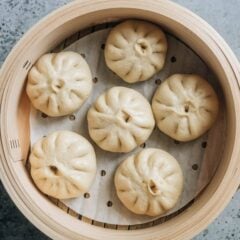
Steamed Chicken Buns (鸡肉滑鸡包)
These steamed chicken buns are a Northern Chinese baozi I grew up eating in Beijing, with a soft pillowy wheat dough wrapped around a juicy filling of ground chicken, dried shiitake mushrooms, ginger, and scallions. I serve them hot from the steamer with a small bowl of Chinkiang vinegar on the side for breakfast, lunch, or supper.
Ingredients
Dough
- 2/3 cup water warm water
- 1 teaspoon sugar
- 1 teaspoon active dry yeast
- 2 cups all-purpose flour
Filling
- 6 dried shiitake mushrooms
- 11 oz ground chicken
- 1 tablespoon oyster sauce
- 1 tablespoon light soy sauce
- 1/2 tablespoon Shaoxing wine
- 2 teaspoon cornstarch
- 1 teaspoon grated ginger
- 2 scallions , thinly sliced
- 1 teaspoon kosher salt (or 1/2 teaspoon sea salt)
- 1/2 teaspoon sugar
- 1/8 teaspoon ground white pepper
- 1 tablespoon toasted sesame oil
Dipping sauce
- Chinkiang vinegar
- Soy sauce (Optional)
- Homemade chili oil (Optional)
Instructions
Mix the dough & 1st rise
- Heat the water in the microwave or over the stovetop until warm to the touch, about 110°F (43°C). Add the 1 teaspoon sugar to the water and stir to dissolve. Add the yeast. Let sit for 5 minutes or until the yeast is bubbling up.
- Option 1 - use a stand mixer: Add the flour into the mixing bowl and pour the water into the center. Mix on low with the dough hook until a shaggy dough forms. If there’s dry flour in the bowl after kneading for a while, add 1 teaspoon of water at a time, until there’s no dry flour left. Turn the speed to 4 and keep kneading, until the dough is smooth and elastic, 15 minutes or so. After 8 minutes, if the dough does not come together, use your hands to help gather the flour on the bottom. The dough should be slightly tough to the touch and shouldn’t stick to your hands. Shape the dough a few more times with your hands so it forms a round ball.
- Option 2 - knead by hand: Add the water into a big mixing bowl. Slowly drizzle the water with yeast into the flour while stirring with chopsticks in a circular motion. After all the water is added, mix until a shaggy dough forms. The dough flakes should be a bit firm to the touch and there should be no dry flour in the bowl. If there’s still dry flour, add 1 teaspoon of water at a time and keep mixing. Press the dough together using your hands, then transfer the dough and any flour left onto a clean working surface. Knead until a smooth and elastic ball is formed, about 15 to 18 minutes. The dough should be slightly tough to the touch and shouldn’t stick to your hands.
- Cover the mixing bowl with plastic wrap. Rest until the size doubles, about 1 hour (45 to 90 minutes depending on heat and humidity).
Prepare the filling
- Soak the dried shiitake mushrooms in warm water until turning soft, 15 to 20 minutes. Gently squeeze out the water, remove and discard the tough stems, and mince the caps.
- In a big bowl, add the chicken, minced shiitake mushrooms and the rest of the filling ingredients except for the sesame oil.
- Mix everything together in one circular direction by hand or with a wooden spatula, until all the liquid is absorbed and the chicken is streaky.
- Add the sesame oil and mix well. Cover with plastic wrap and transfer into the refrigerator until the dough is ready.
Prepare the steamer
- Use a piece of steamer paper to line the steamer. If you don’t have steamer paper, you can cut a piece of parchment paper into a circle, then cut a few holes in it.
- If you plan to use a bamboo steamer, rinse it thoroughly with cold water before using to prevent scorching.
- If you are using a stainless steel steamer, prepare a clean kitchen towel and use it between the lid and the steamer. This will prevent the condensation from dripping onto the buns and affecting their rise.
- Form the buns & 2nd rise
- Once the dough has doubled in size, punch it down with your fist. Knead with your hands until it returns to its original size, about 5 minutes.
- Divide the dough into 2 even pieces. Transfer one piece back to the bowl and cover it with plastic wrap to prevent it from drying out.
- Work on the other piece by rolling the dough into a long log. Cut the log into 6 even pieces, or 38 g per piece using a scale.
- Always cover the dough pieces with plastic wrap when you’re not working on them. For each dough piece, tuck it with your hand, knead a few more times to smooth out any air bubbles, then shape it into a ball. Place the ball on a tray and cover. Repeat with all the dough pieces. Once done, let the dough rest for 10 to 15 minutes to relax, so it will be easier to roll out.
- Press the dough into a round disk using your palm. Start to roll it out with a rolling pin. If you’re not familiar with the process, roll the dough a few times, rotate it and roll the short ends again. After a few times, start to focus on rolling out the sides so the center is thicker and the edges are thin. If you’re skillful, use one hand to rotate the dough with the other hand rolling out one end until forming a round wrapper. Once done, the wrapper should be about 4.5” (11 cm) in diameter, with a slightly thick center and thin edges.
- Place about 1.5 yo 2 tablespoons of filling (or as much you can wrap) in the center of the wrapper. Make pleats by pinching a piece of the edge to itself, then folding the adjacent edge over your finger holding the pinch, then press the folded edges together. Rotate and repeat the process until all the edges are pleated. Then spin and pinch the center together to seal the bun.
- Once done, place the buns into the lined steamer, then cover them with plastic wrap or a damp towel.
- Repeat the process until you fill the steamer, making sure you leave at least 1” (2.5 cm) between the buns. Let rise for 15 minutes, or until the size becomes a bit larger. (*Footnote 1)
Cook the buns
- Bring the water to a boil and steam the buns over medium-high heat for 15 minutes.
- Once done, turn off the heat and let sit for 2 minutes before removing the lid. (*Footnote 2)
Serve
- Serve hot with vinegar as a dipping sauce. If you want to make the dipping sauce saltier, you can add a splash of soy sauce. You can also add some chili oil to the dipping sauce if you want some spice.
- Store the leftover buns in an airtight container in the fridge for 3 days or in the freezer for 1 month.
- You can reheat the refrigerated buns in the microwave. For best results with frozen buns, heat them up in the steamer until warmed throughout.
Notes
- If using a regular steamer, you’ll probably need to cook in 2 batches because it won’t fit all the buns. You should cook the first batch immediately after resting, while you work on the second batch.
- Let the buns sit, let the steamer reduce pressure gradually, so the buns won’t collapse when you open the lid. This step is more important for stainless steel steamers, since the lid is tighter than with a bamboo steamer.
Nutrition
Serving: 1serving, Calories: 123kcal, Carbohydrates: 18g, Protein: 7g, Fat: 2g, Saturated Fat: 1g, Polyunsaturated Fat: 0.5g, Monounsaturated Fat: 1g, Trans Fat: 0.02g, Cholesterol: 22mg, Sodium: 340mg, Potassium: 178mg, Fiber: 1g, Sugar: 1g, Vitamin A: 20IU, Vitamin C: 0.4mg, Calcium: 7mg, Iron: 1mg