Thanks, I’m sending it over now.
Check your inbox for the saved recipe. When you make it, I’d love for you to leave a rating and let me know how it turned out; I always enjoy hearing from you directly!
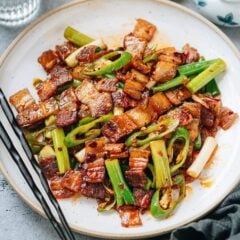
Twice Cooked Pork (回锅肉)
My twice cooked pork recipe walks you through all the ingredients and steps to recreate the authentic tasting dish just like you’d get at a restaurant. Crispy pork belly tossed in a rich spicy savory sauce with scallion and chili pepper: a scrumptious dish that’s rich and balanced. It’s easy enough to cook on a weeknight yet festive enough to serve for a dinner party.
Ingredients
- 1 lb uncut pork belly
- 1 thumb ginger , sliced
- 1 tablespoon vegetable oil
- 2 cloves garlic , sliced
- 1 1/2 tablespoons Doubanjiang
- 1/2 teaspoon ground Sichuan peppercorn
- 1 tablespoon Shaoxing wine
- 1 teaspoon light soy sauce
- 2 teaspoons sugar
- 1 long hot pepper , sliced (or other chili pepper you prefer) (*Footnote 1)
- 4 scallions , cut into 2” (5 cm) pieces
Instructions
- Cut the pork belly crosswise into 2 to 3 pieces, so it fits your pot. Add the pork belly and ginger to a medium pot. (*Footnote 2) Add cold water to cover the pork by 1” (2.5 cm). Bring to a boil over medium-high heat. Turn to medium-low heat and simmer for 30 minutes, until the pork is just cooked through.
- Remove the pork from the pot, rinse with cold tap water to remove any impurities from the surface, and place on a plate lined with a few layers of paper towel to cool and drain the extra liquid, until you can handle it with your hands. Thoroughly pat the pork dry with paper towels and slice it into 1/8” (3-mm) thick pieces. Use more paper towels to dry the pork so it causes less splatter during the stir fry.
- Heat oil in a wok or large skillet over medium-high heat until hot but not smoking. Very carefully lower the pork belly and spread it out with no overlap. Cook, stirring frequently, until the pork turns light golden and some pieces turn golden brown.(*Footnote 3) If the pork starts to splatter too much, turn to medium heat. Use a ladle to remove most of the rendered fat, leaving about 2 tablespoons of oil in the pan. (*Footnote 4)
- Add the garlic, doubanjiang, and Sichuan peppercorn. Stir and cook until the pork is evenly coated.
- Turn to medium high heat. Add the pepper, scallion, Shaoxing wine, light soy sauce and sugar. Stir and cook for 1 minute, until the scallion softens. Transfer everything to a plate. Serve hot over steamed rice as a main dish.
Notes
- Use Anaheim or cubanelle pepper for a milder taste. You can also use red bell pepper as well.
- I usually keep the pork skin on since I like the texture. If you do not like pork skin, remove it before starting cooking.
- You want to render off the pork fat so the meat tastes less greasy and has a nice chewy-crispy texture. But if cooked for too long, the lean part will dry out. I found that it’s best to cook until most pieces have a light golden color, but have not turned dark golden.
- Depending on the fat content of the pork belly, you might render off a lot of fat or little fat. The pork belly I used in this recipe was well marbled and contained a good amount of fat, and I had to remove about 1/3 cup of rendered fat. If using a very lean cut of pork belly, you might not need to remove the fat.
Nutrition
Serving: 1serving, Calories: 365kcal, Carbohydrates: 7.9g, Protein: 6.1g, Fat: 34.5g, Saturated Fat: 11.6g, Cholesterol: 42mg, Sodium: 634mg, Potassium: 53mg, Fiber: 0.5g, Sugar: 5g, Calcium: 22mg, Iron: 1mg