Thanks, I’m sending it over now.
Check your inbox for the saved recipe. When you make it, I’d love for you to leave a rating and let me know how it turned out; I always enjoy hearing from you directly!
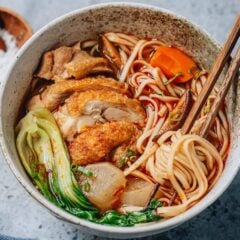
Chinese Spicy Chicken Noodle Soup
This Chinese spicy chicken noodle soup features juicy braised chicken, tender vegetables and chewy noodles in a spicy and savory broth. It has the comfort of homemade chicken noodle soup but with the bold, complex flavors of Sichuan cooking.
Ingredients
- 4 dried shiitake mushrooms
- 2 bone-in skin-on chicken legs (or 4 bone-in skin-on thighs)
- 1/2 teaspoon salt
- 1 tablespoon peanut oil (or vegetable oil)
- 1 thumb ginger , sliced
- 2 scallions , sliced, white and green parts separated
- 1 star anise pod
- 2 tablespoons doubanjiang
- 4 cups chicken broth
- 2 tablespoons Shaoxing wine
- 2 tablespoons soy sauce
- 2 teaspoons sugar
- 2 carrots , roll cut into 1/2” pieces (*Footnote 1)
- 4 ” daikon radish , roll cut into 1/2” pieces
- 12 oz dried wheat noodles (*Footnote 2)
- 4 baby bok choy heads , halved lengthwise (*Footnote 3)
Instructions
- Add shiitake mushroom into a medium-sized bowl and add warm water to cover. Rehydrate until turning tender throughout, 15 to 20 minutes. Once done, squeeze water out of the mushrooms, remove the tough stems and discard them. Slice the mushroom caps into thin pieces.
- Separate the chicken legs at the joint, pat dry, and sprinkle evenly with salt.
- Heat oil in a medium-sized pan over medium-high heat until shimmering. Carefully add the chicken pieces without overlapping, skin side down. Cook without touching until the bottom side is browned, 4 to 5 minutes. Flip to cook the other side for another 2 minutes. Transfer the chicken to a plate.
- There should still be enough oil in the pot. If not, add 1 tablespoon of oil. Turn to medium-low heat. Add the rehydrated shiitake mushrooms, ginger, scallion whites, and star anise. Cook and stir for 1 to 2 minutes until the aromatics turn light golden. Add the doubanjiang. Keep stirring until the doubanjiang evenly coats the aromatics.
- Pour in the chicken broth to deglaze the pan. Add the cooked chicken, Shaoxing wine, soy sauce, and sugar. Cook over medium-high heat until brought to a boil. Add the carrots and daikon. Skim the foam from the top of the broth. Simmer, covered, for 20 minutes, until the chicken has turned tender.
- While cooking the chicken, boil the noodles in another large pot according to the package instructions. Drain noodles thoroughly and set aside.
- When the chicken is finished cooking, add the baby bok choy and cover again. Let simmer for 1 to 2 minutes, until the bok choy has turned tender. Turn off the heat.
- To assemble the noodles, divide chicken braising liquid among the individual bowls. Portion the noodles into each bowl, top with chicken and baby bok choy. Garnish with scallion greens and serve immediately.
Notes
- Hold your knife at about a 45 degree angle relative to the carrot. Cut 1” from the end. Roll the carrot towards you until the cut side is facing up then cut again 1” from the end at the same angle. Repeat the rolling and cutting. All the carrot pieces should be roughly triangular in shape. This is a common knife technique in Chinese cooking, to create more edges on tougher vegetables so they soak up flavor while braising.
- I like to use wheat noodles that are about 1/8” (3 mm) in diameter. You can also use other types if you prefer. If you prefer the noodles to soak up a lot of flavor, use a thin type such as somen noodles. For a chewier texture, thicker noodles such as udon noodles or shaved noodles are great.
- Other greens such as gai lan, choy sum, and spinach work well in this dish. If using gai lan, increase cooking time until the vegetables turn tender. If using spinach, use less cooking time to avoid overcooking.
Nutrition
Serving: 1serving, Calories: 513kcal, Carbohydrates: 74.9g, Protein: 31.4g, Fat: 10.4g, Saturated Fat: 2.1g, Cholesterol: 65mg, Sodium: 1503mg, Potassium: 462mg, Fiber: 3.8g, Sugar: 7.3g, Calcium: 42mg, Iron: 1mg